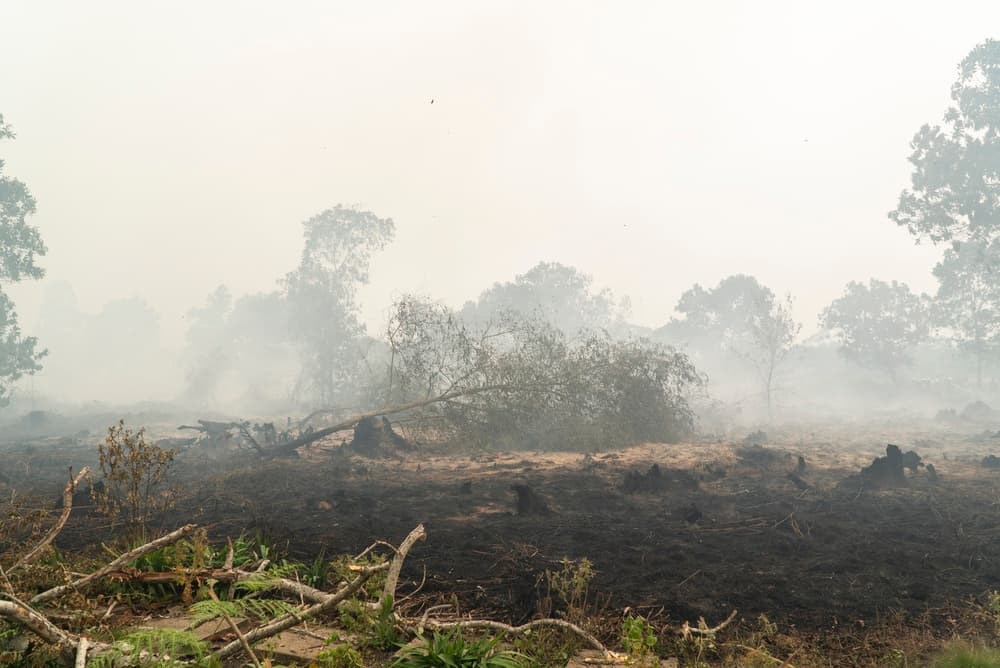
Kuala Lumpur (AsiaNews) – Haze caused by fires in Indonesia continues to blanket parts of Southeast Asia, while deteriorating air quality in Malaysia and Singapore has placed renewed diplomatic pressure on Indonesia.
Yesterday, Indonesian President Prabowo Subianto ordered the mobilisation of additional resources to fight the fires that have been ravaging the country's forests for months.
The blazes are concentrated primarily on the islands of Sumatra and Borneo, driven by El Niño, the cyclical warming of Pacific Ocean waters, which is particularly intense this year.
Singapore’s civil aviation authorities reported that 16 flights were diverted from Seletar Airport between 5 and 11 October due to poor visibility, while today the city-state recorded its highest level of fine particulate matter (PM2.5) pollution of the year.
In Malaysia, where the haze has reached health-hazardous levels in several regions, authorities have closed some schools.
Indonesia has also seen a rise in respiratory issues; according to the Ministry of Health, as of yesterday, the number of fire-related cases across seven provinces reached 283,270, more than twice the 113,336 cases recorded on 9 September.
According to data collected by Indonesia, approximately 202,000 hectares burnt by July since the start of the year; however, estimates from organisations monitoring deforestation are much higher.
For the environmental group Auriga more than 637,000 hectares were damaged between January and August, while the Nusantara Atlas monitoring system puts the figure at nearly 900,000.
According to Fire Emissions Watch, a portal developed by Copernicus, the European Union’s climate monitoring service, emissions from fires in Indonesia were the highest in the world for a month and accounted for nearly half of the global total during the final week.
The problem is not solely linked to the intensity of the dry season. In many areas, fires are used to clear land for farming, and peatlands can often fuel blazes that are difficult to extinguish; in fact, fires can continue to burn beneath the surface, releasing vast amounts of smoke.
Although the drought caused by El Niño has exacerbated the situation, the recurring nature of the crisis is linked to a lack of specific prevention policies, a criticism levelled at President Prabowo.
Experts emphasise the need to improve regional data sharing regarding fire hotspots, strengthen satellite monitoring, and support local firefighting teams. Equally important is engaging communities living in at-risk areas and offering alternatives to the use of fire to clear land.
The intensity of this year’s El Niño was forecast six to nine months in advance, yet Indonesia failed to take action to prevent the fires, observers note.
The smoke generated in Indonesia crosses national borders. Malaysia has offered assistance to fight the fires and now intends to raise the issue at the Association of Southeast Asian Nations (ASEAN), which brings together the region's 11 countries.
Malaysian Foreign Minister Mohamad Hasan announced on Monday that he would discuss the issue with his counterparts ahead of the November summit in Manila. Mechanisms for addressing natural disasters already exist, and, according to the minister, these extend to the issue of transboundary haze.
In recent months, Malaysia proposed strengthening the tools available to ASEAN. During a ministerial meeting in Bali in July, the Malaysian government put forward two ideas, i.e. introducing science diplomacy, collaboration among ASEAN nations on data usage, research, and scientific expertise; and increasing funding for the environmental sustainability fund to support fire monitoring, prevention, and control activities.
One way to combat the haze is to hold the companies responsible for the fires legally accountable. While Indonesia has sanctioned several companies, no firm has ever been successfully prosecuted by another ASEAN country for causing air pollution that crosses international borders.
Singapore is the only country in the region that has attempted to address this shortcoming, enacting a law in 2014 that penalises actions causing or contributing to air pollution with fines of up to US$ 1.6 million. However, so far, no legal proceedings have been brought under this law against anyone.
In fact, the ASEAN Agreement on Transboundary Haze Pollution (AATHP) – signed in 2002 and entered into force in 2003 – is already in place among member states. It commits member states to work together on fire prevention and management, share information, and provide mutual assistance.
Yet, it does not provide for a sanctions mechanism capable of automatically penalising a state for non-compliance; consequently, its implementation relies largely on the willingness of individual governments to cooperate.
All ASEAN agreements are grounded in the organisation’s core principles of consensus-building and non-interference, principles that are, however, increasingly showing their limitations.
For the time being, Indonesia has neither considered accepting foreign aid to bring the fires under control nor declared a state of national disaster.
Faced with criticism, Syahganda Nainggolan, head of Indonesia’s Government Communication Agency, retorted that, “We don't just send smoke; when there is no smoke, we send oxygen,” which “comes from our forests”.
ASEAN has also proposed establishing a coordinating centre to monitor transboundary air pollution, though it is not yet operational due to a lack of necessary ratifications by member states.