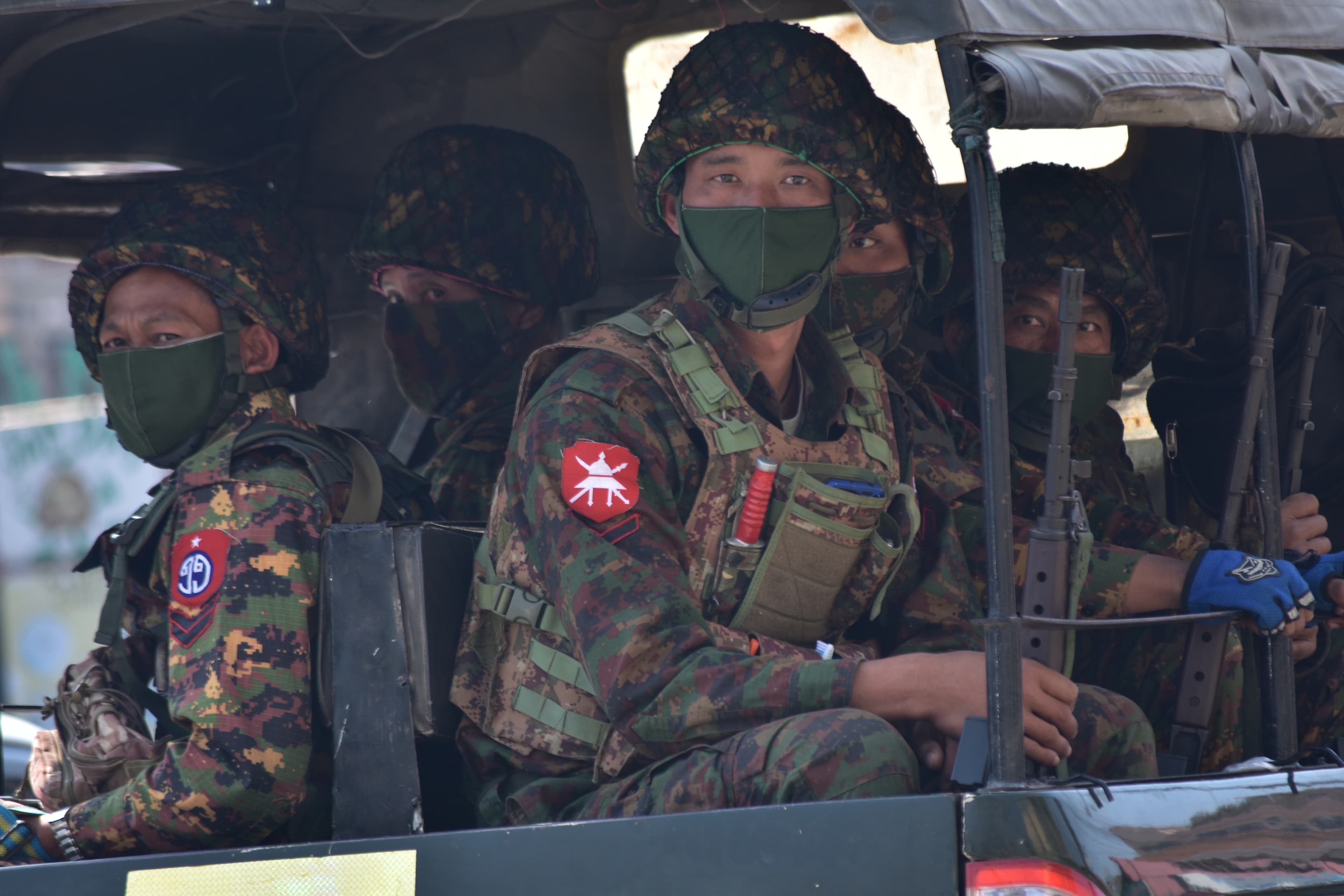
Bangkok (AsiaNews) – Although the special envoy from the Association of Southeast Asian Nations (ASEAN) is in Myanmar to monitor access of humanitarian aid to the civilian population, the civil war continues, taking its toll on civilians and infrastructure on several fronts. This includes recent fighting between the military and Karen armed groups that spilled over into Thai territory, leaving a woman wounded in Mae Sot.
In Sagaing, a region in the country’s northwest, resistance forces claim to have inflicted heavy losses on regular troops, while, in the western state of Rakhine, Myanmar’s Navy lost three more ships during its counter-offensive against the Arakan Army (AA).
Maria Theresa Lazaro, a Philippine foreign affairs official serving as the ASEAN’s special envoy for Myanmar, began her three-day visit yesterday.
The delegation she leads travelled to Taunggyi, Shan State, to observe the distribution of humanitarian aid organised by the ASEAN Coordinating Centre for Humanitarian Assistance (AHA Centre), with support from the Myanmar Red Cross. The mission then moved to the capital, Naypyidaw, where Lazaro met with government authorities.
The mission’s goal is to expand access to aid in war-torn areas. According to the Associated Press, more 11,000 households in Karen and Shan States are expected to benefit by November.
Meanwhile, a meeting with Aung San Suu Kyi has not been confirmed. Myanmar’s former democratically-elected leader, detained following the February 2021 coup, was recently allowed to speak by phone with her son, Kim Aris, for the first time in five years.
ASEAN is trying to keep the dialogue with Myanmar open without giving up on its plan to end the violence, even though several member states have taken independent action. Myanmar’s president, General (ret) Min Aung Hlaing, has in fact visited Laos, Cambodia, Thailand, and Malaysia in recent months.
Civilians wounded in fighting on Thai border
In the early hours of this morning, clashes between Myanmar soldiers and Karen fighters around Min La Pan, a village near Myawaddy, saw mortar shells land on the Thai side of the border, in Tak province.
According to Khaosod English, a 55-year-old Thai woman was struck by shrapnel at her home in Ban Huai Mahawong, Mae Sot district. Other houses were also damaged, prompting some people living along the Moei River, which separates the two countries, to seek safety elsewhere.
Thai forces responded by firing warning shots and increasing patrols along the frontier.
The clashes follow an offensive by Myanmar’s military against opposition forces in Min La Pan.
Resistance slows the army’s advance in Sagaing
Further north, in the Sagaing region, the military is struggling to consolidate control over territories it recaptured.
According to The Irrawaddy, a news outlet aligned with the opposition to the military regime, an offensive launched earlier this month in Indaw township, near the border with Kachin State, saw regular troops suffer heavy losses following a series of ambushes by resistance forces.
The army had regained control of the town of Indaw and the road between Mandalay and Myitkyina in late April, but it has failed to secure the entire area.
On 4 October, some 700 soldiers stationed in Indaw began advancing southward towards Wuntho and Tigyaing. The troops split into two groups, both of which came under attack by anti-regime forces.
Sources close to the resistance reported that more than 50 soldiers’ bodies were found near several villages, and that more than 20 soldiers either surrendered or were captured.
Clashes continued on 25 and 26 October, accompanied by aerial bombing. According to a source close to the armed groups, local residents have fled about 35 villages in the Indaw and Wuntho townships.
The operations involved units of the People’s Defence Force (PDF), which is affiliated with the National Unity Government in exile (made up of lawmakers from the previous government), alongside the Kachin Independence Army and other allied groups.
More Navy ships lost in Rakhine
In Rakhine, on Myanmar’s western coast, the military’s counteroffensive against the Arakan Army (AA) has failed to secure the desired control over the territory.
The AA announced that it destroyed three Navy ships at the mouth of the Kaladan River, bringing to six the number of vessels disabled over the past month. According to an AA spokesperson, two of the ships sank, while a third was rendered inoperable.
The counteroffensive is part of Operation 4926, which the military launched nearly two months ago to halt the AA’s advance and break the siege of Sittwe, the state capital. Nga Pyi Island, located near the mouth of the Kaladan River, is a strategic point in the fighting, as it controls river access to AA-held areas.
The military has tried to retake the island by launching assaults using boats, supported by airstrikes and artillery. However, according to The Irrawaddy, government forces have so far failed to capture it and have reportedly suffered significant losses.
The AA has also reportedly seized several positions near the Shwe Mingan naval base and along the road connecting Sittwe and Ponnagyun.
The military pressure extends further south into the Kyaukphyu township, where the AA is attacking army positions near the Taung Maw Oo naval base.
The Arakan Army currently controls 14 of Rakhine’s 17 townships, in addition to Paletwa in Chin State.
The government, for its part, maintains a presence in Sittwe, Kyaukphyu, and on Manaung Island, areas that are significant because they host Chinese infrastructure projects.
The second front in Rakhine
The AA is also involved in another front in northern Rakhine, on the border with Bangladesh.
According to The Diplomat, the armed group is trying to relocate certain border villages to more accessible areas within Maungdaw district, in order to protect residents from the Arakan Rohingya Salvation Army (ARSA).
In this area, home to a mixed population of Buddhists (including ethnic Mro and Arakan) and Rohingya Muslims, the Arakan Army (AA) has struggled to exert the same level of control it has elsewhere in the state.
ARSA, a Rohingya armed group, is at loggerheads with the AA; according to reports cited by The Diplomat, ARSA has kidnapped and killed members of non-Rohingya groups. Some residents have reported intimidation and pressure to cooperate with the group.
The prospect of further attacks is of particular concern to some 20 villages inhabited primarily by the Buddhists. What is more, Myanmar’s military regime may attempt to exploit these ethnic and religious tensions, as it has done in the past, by recruiting anti-AA Rohingya, opposed to the AA’s goal of setting up a state for ethnic Arakan (or Rakhine).
Some families have already abandoned their home villages, with about a thousand people from four different locations reportedly moving to other parts of Maungdaw district. This has created significant economic hardship for those who previously relied on shifting cultivation or small-scale trade with Bangladesh.
Meanwhile, the military’s ongoing airstrikes continue to prevent any safe relocation.
Escalating clashes underscore how far off a political solution to the conflict remains. While Lazaro’s mission may keep channels for humanitarian aid open, there are, once again, no signs that the violence will de-escalate any time soon.