As CEO of Consulus, Lawrence Chong’s name is immediately associated with the Economy of Communion, the practical application of which he demonstrates through his global consultancy work. Author of the book *Creative Change* on changemaking, in 2020 he was appointed consultant to the Dicastery for Interreligious Dialogue.
Currently in Rome from Singapore for the conference ‘Bridging Worlds: Religion, Development, and the Future of Global Partnerships’, we interviewed him on religion, the economy and future prospects.
The pairing of religion and the economy is not always viewed favourably. What is your view on this?
Religion is an economy. And it has been for a very long time. If you think of China, it is truly fascinating that religion arrived there through trade. Returning to the West, Tom Holland – in his book *Dominion* – shows how the Roman Empire converted to Christianity not through the use of military force but through the economy. Another example is that of Saint Martin of Tours – whose feast day we have just celebrated in the Catholic calendar – who turned down a post offered by the emperor in order to live a life of poverty. But let us also look at Buddhism: the Buddha was a prince who renounced wealth to embrace a completely different way of life.
So, we can see how religion has always, in some way, had an economic logic underpinning its theory of change.
Your last two examples are of people who set aside wealth. Does it follow, therefore, that the economic theory of change concerns the renunciation of money?
If we consider the economy as a whole, it is not just about the production and generation of wealth. This is just one element of what we call the wealth cycle, which, in its broadest sense, concerns how wealth is created, how it is passed on, and how it benefits society – that is, generation, responsible management and giving. When we talk about gross domestic product, we are talking about production and consumption. But, once again, many economies already recognise that this is not a holistic measure of the economy.
So, in our case, the reason we say that faith has always been present in the economy is because faith has always shaped the concept of money and how it is managed and also given away. Almost all the world’s major religions speak of responsible stewardship. We are therefore not inventing anything new, but, for the first time, we are trying to understand and measure it.
So what proposals is Consulus, your company, putting forward to respond to this vision?
Our work is very straightforward. We are seeking to promote an inclusive economy in areas where we believe capitalism has failed to deliver the benefits it promised, given that 90 per cent of the world’s capital is in the hands of those who already have money.
We have therefore established our company on the basis of the Economy of Communion, which draws inspiration from the Christian tradition, convinced that our business has a role to play in promoting the common good. Consequently, both in our consultancy work and in our investment activities, we always seek to allocate a portion of our revenue and profits to the poorest and most needy communities, providing them with funding and support.
Pope Francis met with you in 2017. What guidance or advice did he give you on that occasion?
In 2017, when Pope Francis met with the entire Economy of Communion movement, he challenged us to recognise that it is not enough simply to give money to the poor. He said that it is not enough to be good Samaritans. Too many rules have been broken, and until we manage to shape a new socio-economic system that ensures there are no victims, it cannot be considered a vision of the Economy of Communion.
And what is communion in this context? The Economy of Communion is the way in which people are welcomed, can access growing wealth and can look after their own families. And we always say that a true economy of communion has a vibrant middle class, which – if we look at most current economies – is precisely what is missing. The middle class is crushed within a system where the top 1 per cent owns ever more money, whilst the chronically impoverished are unable to escape their situation, and those in between are extremely limited.
In this context, you are working at an interfaith level. What does this mean, and how are you going about it?
Ours is a huge challenge, a very ambitious project that cannot be carried out alone. That is why we have realised that, in reality, within the interfaith sector – religiously inspired funders, donors, companies, and funds – there is an opportunity to forge alliances to take action and experiment in the interests of the common good.
We cannot expect everyone to have a high sense of generosity, but what we can and must do is build an alliance of multi-faith organisations and resources. These organisations do exist; however, there is not enough transparency, nor is there enough openness regarding the use of resources or the utilisation of these networks to come together and co-invest.
We spoke to the London Stock Exchange, which told us that, in reality, probably 5 out of every 10 dollars comes from faith-based organisations, but we have no way of verifying this. The only ones who are explicit in this regard are those operating through Islamic finance.
That is why we have begun working on the idea of an index that tracks any organisation that declares itself to be faith-based – be it Christian, Buddhist, Muslim, Hindu or Jewish – and maps its identity, statements and outcomes. Our preliminary findings indicate $1.25 trillion across 100 organisations. We are now working to see whether and how these religiously inspired organisations are willing to collaborate with organisations of other faiths.
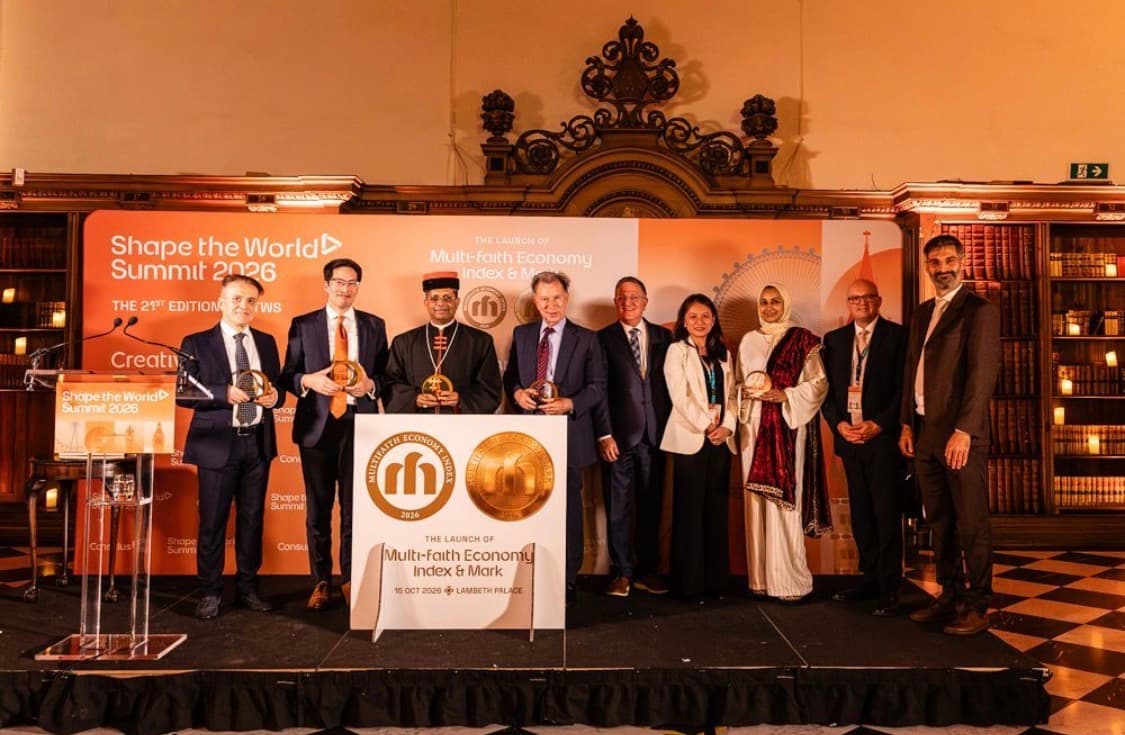
Consulus recently presented the multi-faith economic index at Lambeth Palace. Cardinal Koovakad, Prefect of the Dicastery for Interreligious Dialogue, was present. What did he say about the initiative?
He was very supportive and spoke of a concept known as ‘interreligious humanitarian action’. Indeed, he argued that there has been a great deal of dialogue, that there is a great deal of understanding, and that there are numerous academic studies on the various religions, which is positive. But he also noted the importance of goodwill and commitment in seeking to work together. Drawing on the words of Pope Leo XIV in the encyclical Magnifica Humanitas, in which the Pontiff emphasises very specifically the need to move from words to action, Cardinal Koovakad believes that a multi-faith, market-based economy is an example of collaboration, showing how different faiths can work together beyond mere words.
That is why we are planning, together with the Dicastery, to move from dialogue to action, bringing together a group of investors linked to religious organisations and religiously inspired projects, so that they are willing to make commitments to implement an action plan and collaborate with organisations belonging to other religious traditions.
Some people continue to wonder why they should support projects or organisations from other traditions, rather than supporting only those within their own community. And what we tell them is that, when you work together, you gain greater credibility in the markets. If you act solely on the basis of your own faith, the market thinks you are trying to impose your faith. But if you manage to collaborate and join forces, you gain greater credibility and demonstrate that a better humanity is possible.