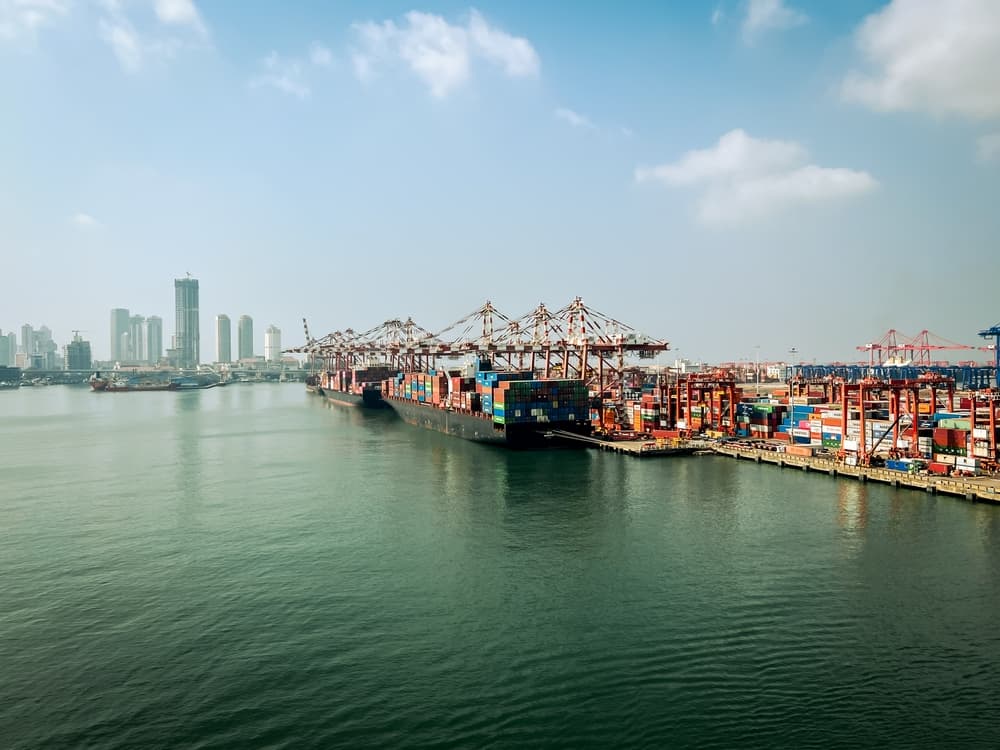
Colombo (AsiaNews) – Located along one of the busiest shipping routes between Asia and Europe, the Port of Colombo spans approximately 75 hectares; however, the East Container Terminal (ECT) is still not up operational because of inadequate planning, poor coordination, and weak governance.
Designed for the handling and transshipment of millions of containers, it is intended to accommodate the largest container vessels currently in operation. If it was it would, at the very least, be a reliable source of foreign currency revenue for Sri Lanka as it emerges from its worst economic crisis since independence.
Although it is wholly owned by the Sri Lanka Ports Authority (SLPA), which also oversaw its development, the terminal is not yet functioning as planned, despite substantial public investment. The first phase of development was completed in mid-2015. Now, with every month of delay, Sri Lanka incurs additional costs, a direct consequence of flawed decision-making.
Cancelled tenders
Four consecutive cancellations of tender processes have stalled the ECT going full operational. The government is now making a fifth attempt to procure 15 straddle carriers, rubber-tired machines used for moving and lifting containers, while simultaneously evaluating the possibility of entrusting the management of the state-owned facility to a private operator.
“A semi-automated terminal requires a stock of essential spare parts,” note senior academics Sithara Gamage and Nishamani Amarasinghe, speaking to AsiaNews. “They also need qualified maintenance technicians, adequate technology transfer from suppliers, and well-tested operational procedures before its first automated operation can take place.”
The scholars point out that, currently, nothing suggests that a comprehensive inventory has been conducted of the spare parts delivered alongside the 52 cranes, as contractually required. Likewise, no verification has taken place to ensure that these parts are complete, in good condition, and properly stored.
Although some 82–85 per cent of the civil engineering work has been completed, the terminal will have to wait another 10–12 months for the equipment to arrive once a contract is finally awarded. This is due to repeated failures in the procurement process for one of Sri Lanka’s major port development projects.
Since 2021, four of the five tenders have been issued for the straddle carriers were cancelled. In the third tender, a cabinet-approved award was put on hold after a few weeks, reportedly upon instruction, and later cancelled after the losing bidder went to court.
Inadequate handling operations and missing equipment
According to senior port officials, all 12 ship-to-shore (STS) cranes and all 40 automated rail-mounted gantry (ARMG) cranes were delivered. However, four STS cranes are not in use, while only 14 ARMG cranes are in service. In fact, the entire fleet of ARMG cranes is currently idle.
A test conducted without the use of straddle carriers achieved only 7.8 moves per crane per hour. World Bank benchmarks for port performance suggest a figure of more than 20.
Furthermore, the ARMG cranes highlight the cost of an inadequate operational sequence. Since the terminal was not ready, the cranes were offloaded elsewhere in the port, and some were used temporarily at that location.
As a result, they must now be moved and reassembled on their designated rails at a cost that was not included in the budget. This carries the risk of damage, such automation components misaligned, not to mention potential disputes with the supplier over defects.”
Losses of up to US$ 126.7 million by 2027
A “significant balance remains to be paid after US$ 550 million was already spent by early 2026 of the estimated cost of US$ 755 million for the two phases,” this according to former marine superintendents Ranga Malalasekara and Udaya Kamaladasa. “This covers civil works, straddle carriers (which have yet to be contracted), equipment, the terminal system, and the operations building.”
As these estimates exclude costs related to the relocation of ARMG cranes, potential compensation claims have yet to be resolved. With capital costs set at 7 per cent, the expenditure already committed to ECT’s Phase II represents an outlay of more US$ 30 million annually, even before a single revenue-generating operation has begun.
A committee of senior SLPA officials has estimated that revenue losses for 2026 could range between US$ 28.2 million and US$ 105.6 million, while losses in 2027 could reach as high as US$ 126.7 million, should the straddle carriers fail to arrive.