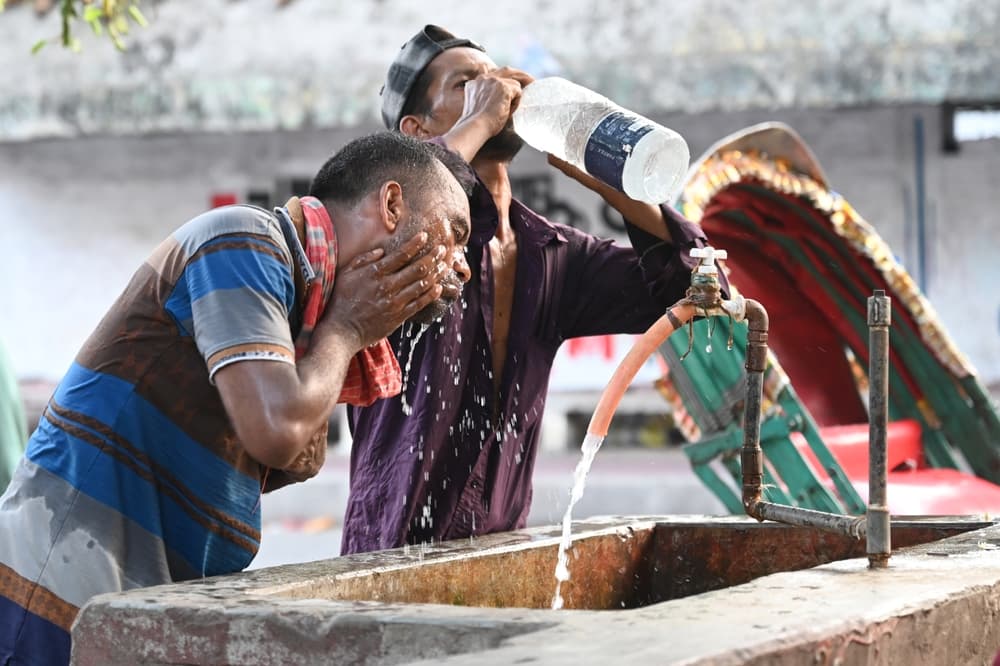
Singapore (AsiaNews) – The United Nations is developing a strategy to respond to heatwaves, drawing on cooling practices and systems already in place in Asia, where the issue has persisted for years and primarily impacts the poorest and most vulnerable people.
The announcement of a Global Heat Resilience Roadmap was made today in Singapore, where the UN Environment Programme (UNEP) brought together more than 60 countries for the first Global Cooling Pledge Assembly.
This forum follows a commitment made by more than 70 nations to cut emissions linked to air conditioning use by 68 per cent by 2050.
The UN faces a paradox: Air conditioning saves lives during periods of extreme heat, yet its increasingly widespread use risks exacerbating the very problem it is meant to solve.
Cooling systems already account for approximately 20 per cent of global electricity consumption, and according to the latest UNEP statistics, global cooling capacity could more than triple by 2050.
Without improvements in energy efficiency, this would mean doubling air conditioning-related energy consumption, straining power grids, and increasing emissions.
According to 2023 UNEP data, 1.2 billion people across Africa and Asia are already at high risk due to a lack of adequate access to cooling.
A World Bank report published in late July estimates that extreme heat already costs South Asia the equivalent of 31 million full-time jobs annually and could shrink the region’s economy by nearly 7 per cent by 2050.
By 2070, approximately 520 million people across Bangladesh, Bhutan, India, the Maldives, Nepal, and Sri Lanka could be exposed to at least one month of dangerous heat per year, four times the number of people currently exposed.
In Dhaka alone, extreme heat already wipes out the equivalent of 465,000 jobs annually, a figure the World Bank expects to double by 2080.
However, the impact is not uniform. The World Health Organisation notes that those unable to afford cooling and those performing outdoor manual labour are the most at risk. For these people, heat means lower productivity, reduced income, and increased health issues or accident risks.
A 2024 Asian Development Bank (ADB) estimate found that, across the Asia-Pacific region, women are 60 per cent more likely than men to lack access to cooling methods, especially since they are overrepresented in the informal, agricultural, and domestic sectors most exposed to heat.
In Cambodia, for instance, 22 per cent of surveyed female garment workers reported that heat hindered their ability to work, while 67 per cent stated that heat in their homes negatively affected their health.
In 2024, extreme heat forced school closures in Bangladesh, Cambodia, and the Philippines, disrupting the education of more than 63 million children.
The ADB warns that this risk may disproportionately affect girls, for whom a temporary interruption frequently leads to permanent school dropout.
Faced with these figures, simply increasing the number of air conditioners is not a sustainable solution, according to the United Nations.
For this reason, UNEP along with the Association of Southeast Asian Nations (ASEAN), is developing a Roadmap for Passive Cooling that prioritises a passive approach. This entails considering building orientation, shading, insulation, and natural ventilation, with mechanical air conditioning used only subsequently, if necessary.
According to UNEP, these strategies can lower indoor temperatures by 2–4°C under normal conditions, and by up to 8°C in the best-designed buildings, resulting in energy savings of between 20 per cent and 50 per cent.
In fact, several projects are already underway in South Asia.
India, one of the countries most exposed to heatwaves, adopted a national cooling plan back in 2019 aimed at cutting the demand for air conditioners by 25 per cent by 2037–38.
In Ahmedabad, following a devastating heatwave in 2010, around 7,000 low-income homes were fitted with reflective white roofs. According to UNEP, this measure has saved approximately 1,100 lives annually.
A new study launched in 2025, involving 400 families living in informal settlements, is now measuring the impact of those roofs on indoor temperatures, health, and electricity bills; early field findings already point to cooler homes and reduced energy consumption.
Meanwhile, in Dhaka, Bangladesh, a case study simulated four passive cooling interventions – green roofs, white roofs, insulated white roofs, and shading – on a textile factory that lacked air conditioning.
All of them lowered the indoor temperature by an average of about 2°C and reduced the time heat stress exceeded safety thresholds for moderate work by up to 603 hours a year, equivalent to roughly 75 eight-hour workdays.
However, another more recent study on reflective roofs in Dhaka urges caution. On its own, a white roof lowers surface temperature by just 0.57°C in the afternoon and can alter air circulation, meaning it needs to be paired with urban greenery and other measures.
Singapore represents the opposite extreme: a wealthy nation where air conditioning remains effectively essential.
The city-state is focusing on increasing efficiency through centralised cooling systems, a single plant distributing chilled water to multiple buildings, which, according to a 2016 statement, have already achieved energy savings of over 40 per cent in Marina Bay.
Singapore also announced the opening of more than 300 public cooling centres for use during heatwaves; furthermore, at today’s Global Cooling Pledge Assembly, it received the first Cool Leaders Award from UNEP, an honour also bestowed upon the United Arab Emirates and the chairwoman of the world’s largest air conditioner manufacturer, China’s Gree Electric Appliances.
For its part, the World Bank has highlighted that, in South Asia, traditional buildings were often designed to utilise passive cooling techniques, such as shading and natural ventilation.
However, with recent urbanisation, traditional materials like clay, wood, and bamboo have frequently been replaced by concrete, steel, and glass, thereby increasing heat retention and reliance on air conditioning.
The challenge UNEP seeks to address is ensuring that Asia can keep cool without repeating this mistake on an even larger scale.