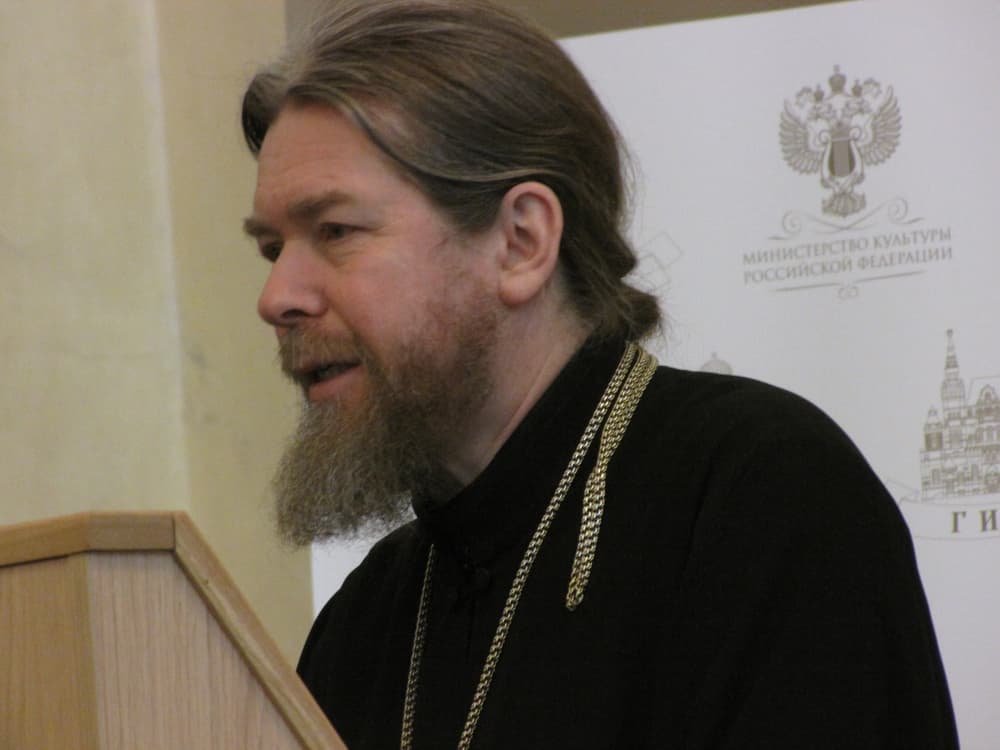
Astana (AsiaNews) - During the recent Easter celebrations, a Kazakh Orthodox priest of the Moscow Patriarchate, Fr Jakov Vorontsov, recited prayers in the Kazakh language in Akmola, arousing much concern both among church leaders and in outside circles of society, and also in the world of local Muslims.
Fr Jakov himself argues the need to find new ways of proclaiming the Gospel to the Kazakh people, and because of support for the war in Ukraine, he believes the local Orthodox should separate from the Moscow Patriarchate.
The video with the prayers in the local language has spread widely on social networks, where Fr Jakov is quite well known for his frequent Facebook posts condemning the Russian invasion of Ukraine, arguing that Kazakhstan itself should get out of all the institutions in which it stands alongside Russia, from the Eurasian Economic Union to the Csto, the military alliance.
Responding to Azattyk's questions, the priest remembers 'growing up hearing other kids speak in Kazakh' and always being interested in music and songs in the local language: 'it is an organic part of my understanding of the world. In his childhood, he did not give much importance to the language issue, which today is becoming crucial. Fr. Jakov recalls a friend, the poet and dancer Djusibek Nakipov, who told him at the age of 20 to study Kazakh, because 'without the language, Kazakhstan has no future'.
Lately he has really taken to studying Kazakh, especially in reaction to the events of the past year, when 'it came down to deciding which side to be on, with independent Kazakhstan or with the country barbarically assaulting its neighbours'. In Kazakhstan, there are many organisations trying to show that nothing can be done without Russia, and that the Central Asian country is a part of the 'Russian world', but 'I see that today in Moscow there is a regime of cannibals, who want to restore Stalinist traditions, those of godless people'.
The priest assures that he feels like a Kazakh like all other citizens, regardless of the Russian nationality written in his passport: 'we have long since ceased to be a Russian colony, and we must fight for our future, that of a multi-ethnic nation'. After trying to learn the language on his own, watching films and TV and reading books, Fr. Jakov began taking private lessons, adapting to the language model that is completely different from Russian, which 'implies another worldview'.
The Kazakh linguist Kanat Tasibekov maintains that to learn to speak in Kazakh 'one must first begin to think in Kazakh', a Turkic language that is also very different from Turkish, a child of nomadic culture, in which the natives themselves do not possess the language to the full. What is important is to 'appropriate the original links of history and culture', overcoming psychological, even before philological, barriers.
Fr. Vorontsov befriended an American Baptist pastor, serving in Almaty in the Akikat church, 'The Truth', who does not know Russian, but speaks a fair amount of Kazakh, and with him a very sui generis ecumenical and personal dialogue began. Communication was easier than with compatriots who speak both Kazakh and Russian, and it was there that he better understood the meaning of the 'psychological barrier'. After that, the Orthodox also began reading and commenting on the Gospel in Kazakh on social media, quickly becoming very popular.
In this new experience of evangelisation, Fr Jakov was then joined by another Orthodox priest, Fr Elisej Kukeev, an ethnic Kazakh native, who has long dedicated himself to the translation of religious literature. At the Easter proclamation of the Gospel, it is traditional to use several languages, including Greek and Latin, and on Vorontsov's initiative, it was also read in Kazakh in all the churches of Almaty, as a proclamation of a new season of faith and dialogue between peoples, against all wars and conflicts of the soul.