Dushanbe (AsiaNews) – Every spring and autumn, on the Saturday closest to the first quarter of the moon, World Astronomy Day is celebrated. This event features public stargazing sessions open to all, offering everyone the chance to admire planets and star clusters.
During this period, the Moon is in a phase where its craters, seas and surface are best seen through a telescope, thanks to the striking shadows at the boundary between light and shadow.
The most recent event took place on 19 September and, in honour of this day, Asia-Plus has decided to feature a place in Tajikistan where the stars seem closer. Situated 14 km south-east of Dushanbe, covering an area of 40 hectares, lies the Ghissar Astronomical Observatory, built in the middle of the last century. Today, only small bodies in the solar system and the Earth’s ionosphere are observed here, but during the Soviet era, multidisciplinary studies of global significance were carried out on the Earth’s atmosphere, small bodies in the solar system and artificial satellites in low Earth orbit.
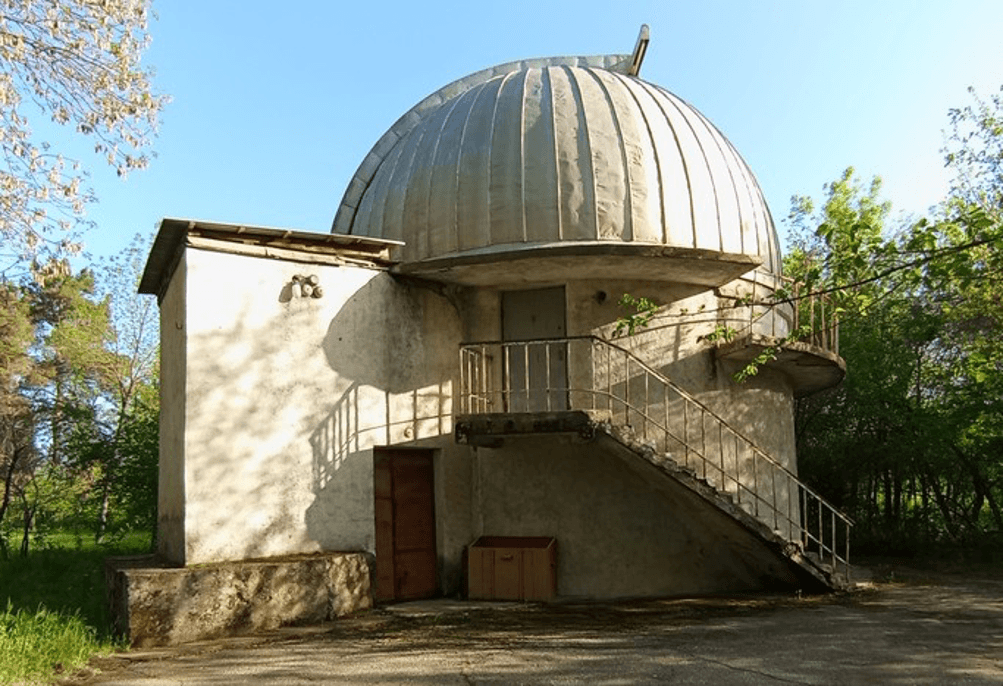
Stepping into the Ghissar Observatory is like stepping into another world: old buildings are nestled amongst the spring greenery, including the distinctive round rooms housing the telescopes, covered by steel domes. There is also a dilapidated two-storey residential block for staff, built in the 1960s. Looking at any building in the Ghissar complex, it is clear that it has not been renovated since at least the collapse of the USSR. One of the paths leads to the very same rounded building with the dome, which houses the AZT-8 (the Astronomical Reflecting Telescope) with a mirror 70 cm in diameter. Once the platform is reached, a member of staff presses a button and the large, rust-stained dome begins to open slowly with a rumbling sound, rotating on its tracks.
This allows the telescope to be pointed in the desired direction of observation, as celestial objects often require careful observation. It is here that guided tours for schoolchildren, students and tourists are still held today. The old telescope is fitted with a digital camera, and the resulting images are sent instantly to a computer. The telescope itself is no longer controlled by a large control panel with thermionic valves, but remotely – an upgrade that became necessary because film of the required format and size is no longer produced.
The telescope allows for clear observation not only of the Moon and the planets of the solar system, but also of nearby stars and galaxies. The site also houses other equally significant instruments and devices, which unfortunately are not currently in use for various technical reasons, such as a 40-centimetre German Carl Zeiss astrograph, installed in the 1960s and designed for observing comets and stars.
For many years, the renowned astronomer Svetlana Gerasimenko, discoverer of the legendary comet Churyumov–Gerasimenko, used it to closely monitor the sky.
It is equipped with an obsolete system using 30x30 cm film that is no longer manufactured; if modernised and subjected to regular maintenance, it could once again provide reliable service for many years to come. The Germans had built the observatory and installed the bespoke equipment: the walls are panelled in wood and the roof opens easily and silently by operating a fan, unlike the extremely noisy mechanism that opens the roof in the observatory housing the Soviet-made AZT-8. The observatory is decorated with black-and-white photographs taken with an astrograph, autographed by the observers.
Continuing along the path, past an abandoned checkpoint, you reach an area housing an ionospheric laboratory and a large disused warehouse. Two enormous rotating radar antennas with a power output of over 150 kW are also installed here; they have been inactive for some time and the area, once scorched by radio emissions, has been overgrown with grass. It was precisely from these installations, on the site of the reclaimed marshland, that the long history of the Ghissar Observatory began, as it sought to discover the paths to the Soviet space programme.