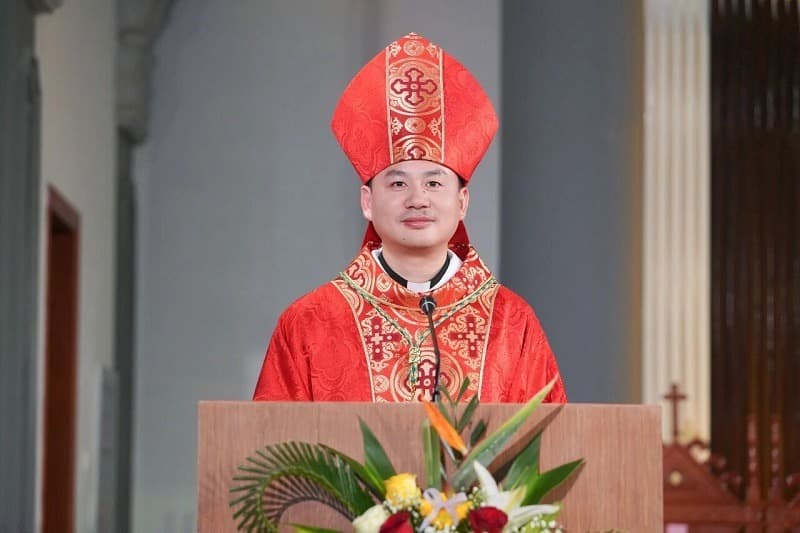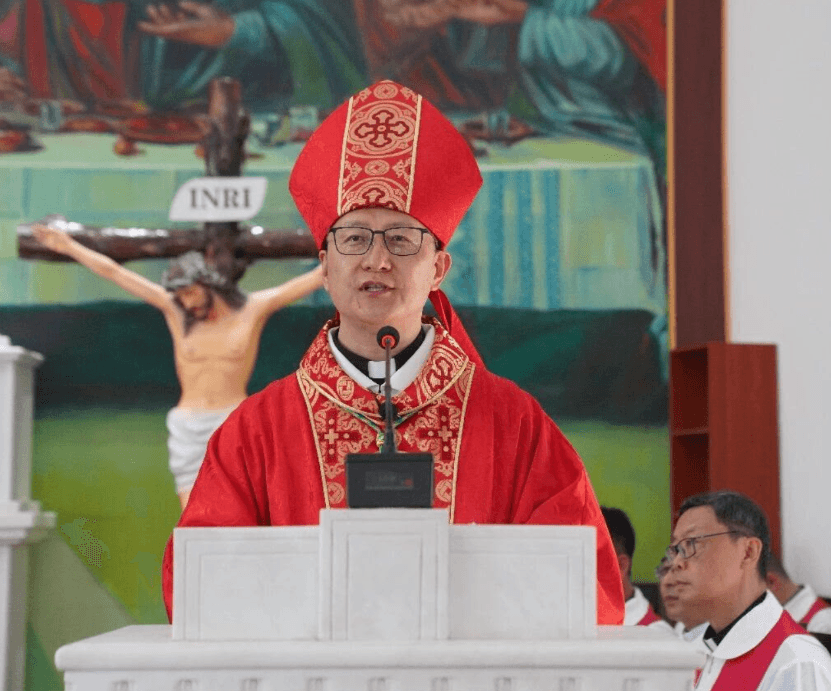
Xiamen (AsiaNews/Agencies) – A new bishop was consecrated today in Fujian under the provisional agreement between China and the Holy See. Mgr Joseph Liu Hengping, 54, was ordained and installed in the historic Diocese of Xiamen. The see had been vacant since January of last year, when the previous bishop, Mgr Cai Bingrui, was transferred, also under the terms of the China-Vatican agreement, to lead the Diocese of Fuzhou, the most significant city in Fujian Province.
Leo XIV’s acceleration
Today’s appointment marks the 10th Chinese bishop named under the current framework, and the sixth since the start of 2026. With a total of 20 bishops appointed since the agreement took effect in 2018, the acceleration over the past two years has become clearly evident.
The appointment of a bishop for Xiamen is particularly significant, since Fujian Province is one of the areas in mainland China with a substantial Catholic presence.
The consecration ceremony for Mgr Liu Hengping took place this morning at the Cathedral of Christ the King. The rite was led by Bishop Yang Yongqiang of Hangzhou, who is vice-president of the Council of Chinese Bishops (a collegial body not officially recognised by the Holy See).
The other co-consecrating bishops were: Bishop Huang Bingzhang of Shantou, who is vice-president of the Chinese Catholic Patriotic Association; Bishop Zhan Silu of Mindong in eastern Fujian; Bishop Cai Bingrui of Fuzhou, the former occupant of the see of Xiamen; Bishop Wu Yishun, in northern Fujian; and Auxiliary Bishop Lin Yuntuan of Fuzhou.
The fact that official Chinese sources mention the latter’s presence is significant since he is, in fact, from the underground community, having been appointed as an auxiliary by Pope Leo XIV following the transfer of Bishop Cai Bingrui to Fuzhou.
The appointment and profile of the new bishop
As is customary in such ceremonies, Father Yang Yu, secretary-general of the Council of Chinese Bishops, read the document approving the election, which had taken place on 29 June, in accordance with the principle of the self-governance of the Church in China.
A total of 500 people attended the ceremony, including priests, nuns, and representatives of the lay community.
The Vatican Press Office reported that on 15 October 2026, Pope Leo XIV appointed the Reverend Joseph Liu Hengping as Bishop of Xiamen, having approved his candidacy within the framework of the Provisional Agreement between the Holy See and the People’s Republic of China.
Bishop Liu Hengping was born on 24 July 1972, in Longhai District, Zhangzhou, Fujian Province. From 1992 to 1999, he studied theology and philosophy at the Sheshan Seminary in Shanghai. He was ordained a priest in September 1999 for the Diocese of Xiamen.
In March 2000, he was appointed parish priest in Houban, in the city of Zhangzhou. In the years that followed, he also took on the pastoral care of the parishes of Lindong, Yanqian, Lianchiwei, Gankou, and Guxian. At the time of his appointment, he was serving as vice-president of the Chinese Catholic Patriotic Association of Fujian Province.
The long history of the Church in Xiamen
As noted, Xiamen is a city of major importance in the history of Catholicism in China.
Franciscan missionaries arrived in this part of Fujian as early as the 14th century; in 1313, they established one of the first three Chinese dioceses, based in Quanzhou (which corresponds to present-day Xiamen).
Indeed, it was here that the relics of Friar Thomas of Tolentino, who died a martyr in India in 1321 while travelling to China, were brought.
Fujian itself was also deeply marked by martyrdom. Among the 120 Chinese martyrs canonised by Pope John Paul II on 1 October 2000, an act the Communist Party of China vehemently denounced as a “provocation”, the first six (those killed before the 19th century) were all Dominican missionaries who shed their blood to proclaim the Gospel in Fujian.
As a coastal province, Fujian served as a vital crossroads during the new era of missionary activity that began in China in the 19th century, a period, it must be noted, not without the ambiguities inherent to the age of colonialism.
It is no coincidence that the present-day Diocese of Xiamen began in 1883 as the Apostolic Vicariate of Amoy. Spanish Dominicans led the mission here until the expulsion of missionaries in the 1950s, under Mao.
In more recent times, the Church in Xiamen has also served as an important laboratory for dialogue across the Taiwan Strait.
This was evidenced by a gesture that took place during the ordination of Bishop Cai Bingrui in 2010, also with the consent of the Holy See, even before the 2018 Agreement. On that occasion, Bishop Emeritus Joseph Cheng Tsai-fa of Taipei was present at the rite.
When asked about this by AsiaNews, Bishop Cai at the time said that his diocese had long been receiving visits from Catholics from the nearby island of Taiwan, and that he hoped to continue the dialogue and exchange with the Church on the other side of the Strait.
Sixteen years later, the political climate between Beijing and Taiwan has changed significantly, and such a presence at today’s ordination would have been unthinkable. Yet, the commitment to dialogue within the Church of Xiamen remains entirely intact.