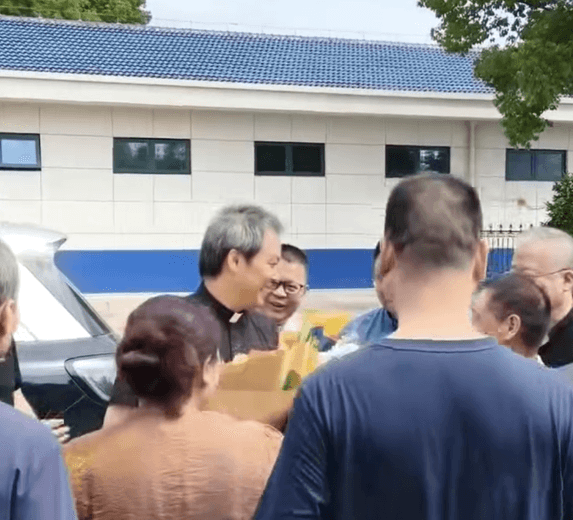
Milan (AsiaNews) – On 22 July, Fr Ma Xianshi – a priest of the Diocese of Wenzhou – was released from prison. He was met at the detention centre by the faithful and family members who had rushed to welcome him, and who surrounded him.
At around 9 am, a large crowd had gathered in the car park in front of the Yiwu detention centre. As the scheduled time for his release had already passed but no one was yet seen coming out, some people stepped forward to ask the officers outside the detention centre for an explanation. It transpired that, fearing the crowd gathered outside the entrance might cause public order problems, the prison guards had taken Fr Ma directly to the nearby police station. After some negotiations, the priest was brought back in a police car. Over a hundred people present immediately offered him flowers, accompanied him to have his hair cut and change his clothes; then a convoy of dozens of cars solemnly escorted him to Wenzhou, his hometown.
Father Ma’s arrest and charges
Looking back over past events, Fr Ma Xianshi was taken away by the police on 22 November 2024, the feast day of Saint Cecilia. That day coincided with the solar term of ‘Xiaoxue’ (Light Snow), whilst today, at the time of his release, the second ‘Dashu’ (Great Heat) had already arrived. Throughout this period, Fr Ma’s two elder brothers could do nothing but continue to tell lies to his mother – who was nearly ninety, ill and bedridden – saying that “our little brother is still abroad studying and cannot come home for the time being”, in order to reassure the elderly woman. Meanwhile, the hearing originally scheduled for early July 2025 has been postponed to 17 November of the same year. During this period, nuns, priests and the faithful of the diocese have suffered repeated harassment and threats from the authorities, in an attempt to force them to give evidence and increase the sentence imposed on Fr Ma. A person familiar with the facts commented: “For the authorities, this case is truly a hot potato. They originally thought that arresting him early on would certainly enable them to uncover some wrongdoing, but things turned out differently.”
In prison, Fr Ma has consistently maintained that the charge of “illegal commercial activity” for the alleged public sale of church hymnals was by no means a personal endeavour and that he had no intention of making a profit; which is why he resolutely refused to plead guilty and accept the sentence.
On 13 February, his brother Zhuang Qiantuan, who had been arrested in the same case and had chosen to admit guilt and accept the sentence (namely for the public sale of religious books), was released on bail pending trial and returned home to be reunited with his family.
However, following the trial, Fr Ma received no news of the verdict for a long time. Various theories were circulating amongst the faithful: if the verdict continued to be postponed, did this perhaps mean that the prosecution’s case was difficult to sustain and that the police still had to find new evidence? No ruling relating to the case could be found on the Chinese website for court verdicts: perhaps the proceedings had never actually been formalised? Following his arrest, although he had been removed from his post in the provincial ‘Two Assemblies’ (the official bodies of the Church in China, controlled by the Communist Party – ed.), surprisingly his role as the diocese’s legal representative has remained intact to this day.
During the Chinese New Year period, rumours had also circulated from somewhere that Fr Ma was due to be released soon, but in the end the faithful were left disappointed after harbouring false hopes until about a month ago, when news broke that Fr Ma had been sentenced to 18 months’ imprisonment. Unwilling to accept the sentence, he lodged an appeal, but the final judgement upheld the original sentence. News that he would be released on 22 July, upon completion of his sentence, then began to circulate amongst the faithful.
On the day of his release, over a hundred people went directly to the Yiwu detention centre to welcome him. More than 400 faithful from Lucheng, where Fr Ma had served for many years, were already waiting for him in Wenzhou’s main cathedral, as if to welcome the triumphant return of a hero. The faithful’ request to enter the church and ask Fr Ma to preside over Mass was rejected; the authorities only permitted the opening of a large hall capable of holding more than two hundred people. However, thanks to the perseverance of the faithful, the priests and the nuns, the Mass of thanksgiving was eventually celebrated in the hall, presided over by Fr Ma and concelebrated by three other priests.
It is reported that officials from the Religious Affairs Bureau were also present at the reception outside the Yiwu detention centre. According to the family, after the final release date had been set, government officials had previously ‘deceived’ the detention centre by using the names of family members to obtain visiting permission and had attempted to force Fr Ma to sign certain documents. On this occasion too, at the time of his release, the authorities again asked Fr Ma to return to Wenzhou in a vehicle arranged by them, even going so far as to attempt to stop the cars of family members on the motorway who had not followed their instructions.
The situation in the Diocese of Wenzhou
As Father Ma Xianshi has long held a leadership role in the official Church of the Diocese of Wenzhou (Yongjia), informed sources believe that the fabrication of charges against him was intended to remove him entirely from his leadership position. However, it remains unclear regarding subsequent matters, such as whether his certificate as a religious minister can be re-registered with the relevant authorities or whether the religious bodies will withdraw the document. Given that his 90-year-old mother has been seriously ill for some time, Fr Ma’s main task in the near future will be to care for her at her bedside.
Fr Ma’s case is not an isolated one. Fathers Gao and Wang of the Wenzhou underground Church had also previously been subjected by the Shanghai judicial authorities to administrative detention for 15 days (with a fine of 1,000 yuan) and 10 days (with a fine of 500 yuan) respectively. Both were released at the same time on 9 July. Upon their release, they were given stern warnings: if they were found to be administering the sacraments to the faithful again, they could face criminal charges.
Father Joseph, a priest of the Jiangnan underground Church, stated that there has recently been a clear intensification of crackdowns by the police and the offices for the management of religious affairs against activities deemed illegal. In many localities, judicial authorities have required lawyers and law firms that take on cases relating to religion to submit a notification within five days, attaching the power of attorney, the case acceptance record, the registration form and an explanation of the situation.
A parishioner from a municipality directly administered by the central government also reported that minors have been banned from entering churches and that summer catechism courses are now impossible to hold. When she expressed her concerns to the parish priest, he replied, feeling powerless, that this was a general trend and that he could not oppose it.
The Diocese of Wenzhou has around 200,000 parishioners. For historical reasons, it has long been divided into two groups: the official Church and the underground Church. In the past, each had more than 40 priests, and the faithful were divided almost equally between the two.
Over the past two years, the government has stepped up its efforts to ‘transform’ the clergy of the underground Church, stipulating that underground priests from other areas who do not wish to join the official Church may not reside in Wenzhou; local priests who refuse to register may not live in churches or publicly celebrate the sacraments. Every parish must establish the Catholic Patriotic Association, and families who harbour underground priests for the celebration of the sacraments risk a fine of 200,000 yuan.
The official Church currently has nearly 50 priests and over 40 nuns. Fr Ma Xianshi, who was in charge, has been replaced by Fr Hu Longjian, president of the Patriotic Association. The underground Church, on the other hand, has 24 priests and over 40 nuns from two different congregations; the legitimate bishop is Monsignor Shao Zhumin, who has also been deprived of his liberty on several occasions in recent years.