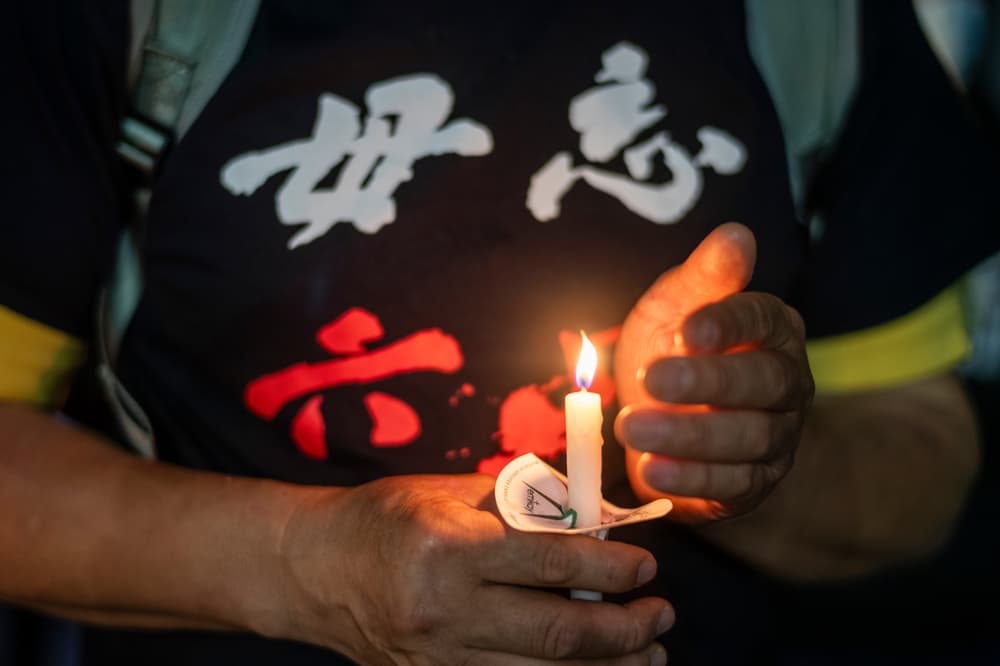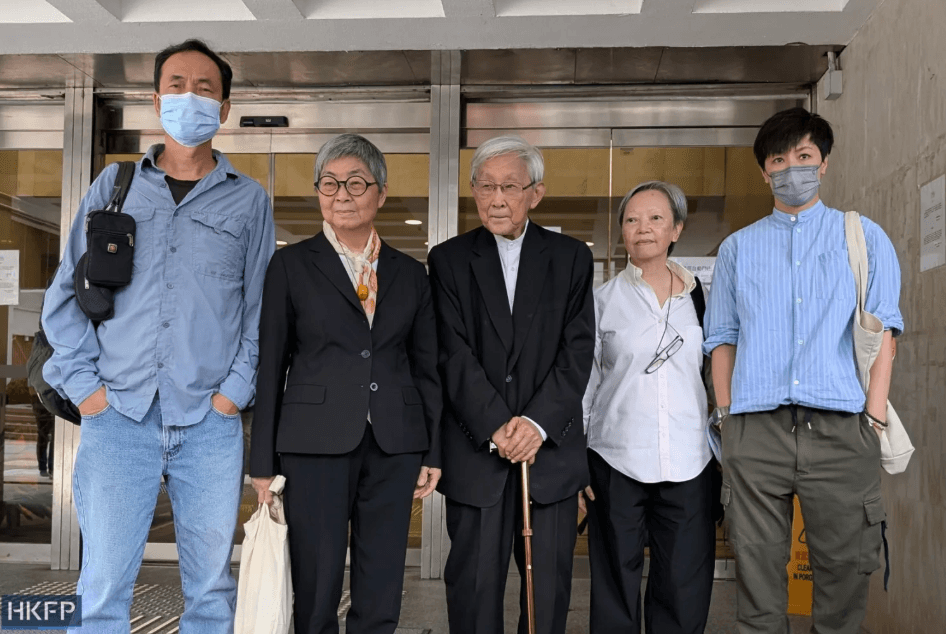
Milan (AsiaNews) – A week after the verdict, a ‘sentencing’ hearing was held today in Hong Kong for Chow Hang-tung and Lee Cheuk-yan, the two pro-democracy activists convicted of “subversion” due to their role in organising the annual vigils in memory of the victims of the 1989 Tiananmen Square massacre in Beijing, which were held in the former British colony until 2019. In the Hong Kong judicial system, the mitigation hearing is the stage between the conviction and the sentencing, during which the defence can essentially present mitigating circumstances. At this hearing, Chow Hang-tung – a lawyer who has been in prison for almost five years and has personally conducted her own defence – attempted to read out a text that she had managed to have published from abroad, including on her profile on the social network Pateos. In the courtroom, the judge stopped her after the first few sentences. We are publishing it in full below to give voice to her words and her stance in the face of this conviction, which is based solely on the denial of the value of freedom and democracy.
1. The 206-page judgment, after all, boils down to saying that pursuing democracy is a crime.
2. I find it entirely unpalatable that any political party can barter away a nation’s sovereignty, claim to represent the will of the people, appoint itself as the sole authority, and then insist that citizens are legally bound to uphold its self-fashioned throne. A law of this nature is nothing more than a euphemism for tyranny.
3. Believing that dictatorship is wrong and democracy is right – if that isn’t a belief, then what is? Even if the courts and the government attempt to claim, like a chanted mantra, that they are not judging beliefs, they cannot change the reality: under this judgment, anyone who believes in the principle of ‘ending one-party dictatorship’ has nowhere left to stand. In the eyes of this brand of ‘law’, holding such a thought inherently contravenes the Constitution – rendering it unlawful, an original sin. Even when we engage in entirely legitimate acts, such as commemorating June 4 th , it becomes a crime simply because of the perceived ‘impropriety’ of our thoughts.
4. Yet the law cannot govern what a person thinks. Not only is it incapable of doing so, but when it openly defies the human conscience, it is the law itself that ultimately suffers – forfeiting its very legitimacy.
5. People must draw a line somewhere, and the law must do the same. This marks one of the most fundamental distinctions between a democracy and an autocracy: genuine rule of law simply cannot survive under a dictatorship. When the Court completely disregard the underlying facts and the boundaries between right and wrong in the face of demands to ‘end one-party dictatorship’, choosing instead to blindly enforce the will of the regime and a supposed duty to obey, its conduct become as absurd as claiming a duty to execute Jewish people in Nazi Germany. Such an approach strips the law of its essential pursuit of justice, reducing it to little more than an instrument of political expediency.
6. It was precisely this unthinking obedience, devoid of the judgement of right or wrong, that brought about repeated horrors under Nazi rule and other totalitarian regimes. Today, both the judiciary and the state risk treading that exact same dangerous path. Indeed, given rapid technological advances and the expansion of state power as the nation asserts itself as a recognised ‘major power’, the present threat is greater still than that of the past.
7. As citizens, we have the responsibility to hold state power to account within a democratic framework, exercising our duty, as the master of the nation, to scrutinise and curb its excesses. This is vital not only to secure justice for past grievances, but to prevent even greater catastrophes in the future. Surrendering unchecked authority to the state apparatus under the banner of national security – at the expense of basic humanity and conscience – invites inevitable tragedy.
8. Ending one-party dictatorship is therefore an inescapable responsibility for our generation of Hongkongers and mainland Chinese alike. This is a task that we must achieve for ourselves – indeed, we are the only ones who can; no outside force can do it for us.
9. This is my sincere belief, and it is far from mine alone – as three decades of candlelight in Victoria Park have already proven. ‘Ending one-party dictatorship’ is the people’s bottom line; it is a universal demand. When the law presumes to challenge it, it serves only to bring about its own humiliation.
10. The Court pretends the issue is not about sharing ideas, but rather the so- called sowing of hostility. Yet, the belief in ‘ending one-party dictatorship’ has never relied on an us-versus-them mentality or the incitement of hatred to sustain itself. We need rely only on reason and facts – that alone is enough to win the support of all reasonable people.
11. A one-party dictatorship is the most blatant injustice of all: it disregards the equality and autonomy of every individual, imposes a system of rule that defies all logic, and reduces free citizens to subjects with no choice in the matter. Ending a one-party dictatorship is simply about reclaiming the dignity that is the birthright of every human being – a principle that anyone not wilfully turning a blind eye should easily understand.
12. Only those stripped of any rational argument must continually rely on hatred for mobilisation – and we simply refuse to do so. Only the profoundly insecure see hostility at every turn, and we certainly do not view the world in such terms. We hold unshakeable confidence in what we believe and what we stand for. That a dictatorship depends on hatred to maintain its grip does not mean we must dance to its tune, nor does it mean the world revolves around hatred. A belief in equality and justice, anchored in respect for humanity and truth, has always been a more potent and enduring force than hatred.
13. Belief is something that cannot be calculated or traded. To plead or apologise for everything you believe in is the most hypocritical thing imaginable, and it is an insult to everyone who shares those beliefs. That is why I will not do it – and why I cannot. The executioner who slaughtered a city has not even come forward to apologise; when on earth will it be our turn? Even when the world is turned upside down, we must not apologise for the wrongs committed by the regime, lest we become part of that inversion ourselves.
14. As for everything that has happened in the past, I refuse to use criminal terminology and concepts to assess the gravity, if exists, of what we have done. If the Court truly wants a point of reference, it can ask the Office for Safeguarding National Security, led by the Communist Party – they know full well how to view efforts to fight for democracy and human rights through a criminal lens. They have consistently and unabashedly insisted that this case is serious in nature and must be severely punished, without the slightest sense that they are interfering with judicial independence. In any event, if the Court ultimately does find our case to be ‘serious in circumstances’, I shall take it as a compliment, as it demonstrates that we have actually achieved something.
15. Being able to find a mission in which one believes, and partners to fight alongside, is the greatest joy in life. Thus, I have no regrets about the path I have walked with the Hong Kong Alliance and the people of Hong Kong. I have only my family and those who love me to thank for enduring such hardship, and it is only their forgiveness I must seek.
16. As for the future, whether inside or outside prison, I will persistently strive to release pro-democracy activists, vindicate the 1989 Democracy Movement, hold those responsible for the Massacre to account, end one-party dictatorship and build a democratic Hong Kong and China. I will learn, improve myself, and try all manner of things until the day democracy arrives. This is a promise I have made publicly countless times. It is the solemn vow I made to the departed in the sea of candles, and I have no intention of breaking my word.
17. If doing so makes me a criminal for life – if the law truly cannot accommodate our beliefs – then I would rather be a criminal than a person who betrays their conscience. I will stand with all the people of Hong Kong who refuse to give up, and we will continue on this unfinished path to democracy.
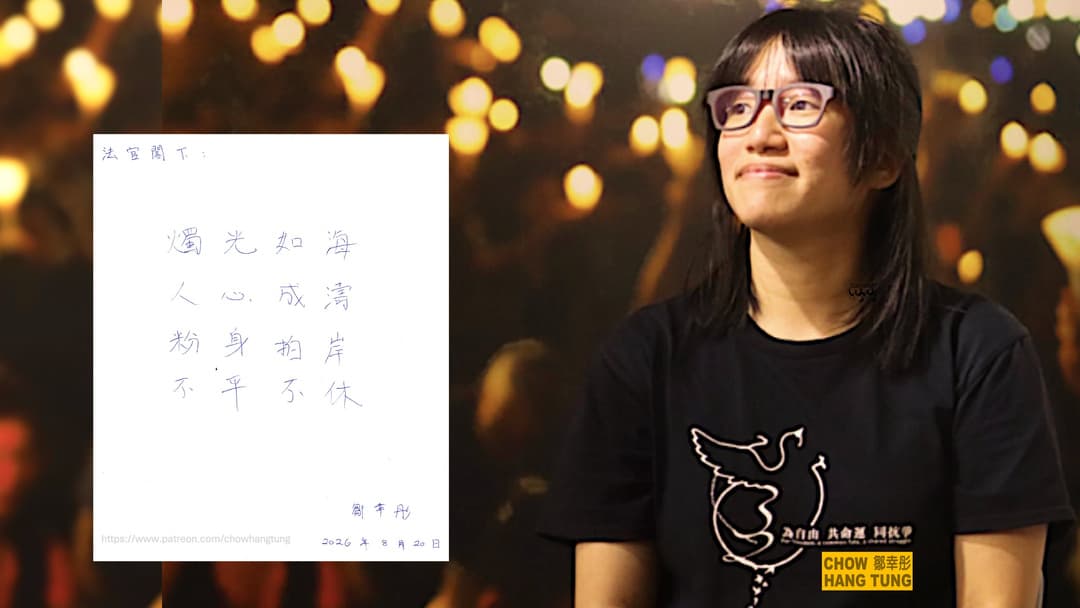
18. Upon a sea of candlelight, The waves of human hearts surge high, Unbowed and shattered wide, storming the shores, Until the dawn of justice wakes.