Hong Kong (AsiaNews) – “Guilty”. A single word uttered before the judges after five years in prison. This was how Joshua Wong, 29, one of the most recognisable faces of the “Umbrella Revolution” that brought thousands of young people onto the streets of Hong Kong in 2014, responded to the charges of “collusion with foreign forces” read out in court during his second trial, the one under the infamous National Security Law imposed by Beijing in June 2020 following the new wave of pro-democracy protests in Hong Kong. Just a few days after the conviction and subsequent “sentencing hearing” for Chow Hang-tung and Lee Cheuk-yan, another chapter in the judicial repression of dissenting voices in Hong Kong unfolded today at the High Court.
The new trial to prevent his release
The charges against Yoshua Wong – an evangelical Christian who grew up at United Christian College in Kowloon – relate to the activities of Demosisto, the pro-democracy movement he co-founded with Nathan Law, another student from the ‘Umbrella Movement’ who now lives in exile in London with a bounty on his head.
Demosisto was dissolved on the very day the National Security Law was passed, but this was not enough to protect Wong from the charges. He is accused of having asked foreign governments to impose sanctions, economic blockades or other hostile measures against Hong Kong in response to the crackdown on pro-democracy and human rights movements – something that occurred in the United States in 2019 with the adoption of the Human Rights and Democracy Act.
According to the prosecution, Wong continued this activity even after the law came into force in June 2020, whilst Law left Hong Kong to continue the campaign from abroad.
The offence of ‘collusion with foreign forces’ in Hong Kong today carries a maximum sentence of life imprisonment. It is therefore easy to surmise that behind Joshua Wong’s guilty plea lies an attempt – agreed with his lawyers – to secure at least a reduction in this sentence. After all, the outcome of any trial seemed a foregone conclusion, as demonstrated by the cases of Chow Hang-tung and Lee Cheuk-yan (who refused to plead guilty to the offence of “subversion”).
As early as the first trial linked to the ‘Group of 47’ – the organisers of the unofficial primary elections organised by the pro-democracy camp in Hong Kong to select joint candidates to stand in the 2020 Legislative Council elections (which was subsequently cancelled on the pretext of Covid and rendered meaningless the following year by a reform that effectively bars anyone who is not pro-Beijing from standing as a candidate – ed.) – he had adopted the same legal strategy by pleading guilty to the offence of ‘subversion’.
On this basis, in 2024 he had received a sentence of ‘only’ 4 years and 8 months’ imprisonment, which he would have completed in January 2027. However, a further arrest whilst in prison in June 2025 on charges of ‘collusion with foreign forces’ made it clear that even upon the expiry of his sentence, the gates of Stanley Prison would not open for Joshua Wong.
It is clear that these are separate trials for a ‘crime’ that is essentially the same: a situation that, in theory, would be unacceptable in a legal system. But to justify this, the prosecutor, Mingme Yeung, argued that Wong, even after the dissolution of Demosisto, ‘would have continued to support the advancement of the international front through foreign media and social media platforms’.
The hope of caring for his elderly parents
Now, therefore – as is the case in Hong Kong – the activist will wait to find out how many more years he will have to spend in prison, a figure the court will determine in the coming weeks. His lawyer, Derek Chan, said he had already been informed that Wong would not be granted remission for his previous sentence – which would have allowed him to have the length of his new sentence reduced by the time already spent in pre-trial detention prior to the verdict.
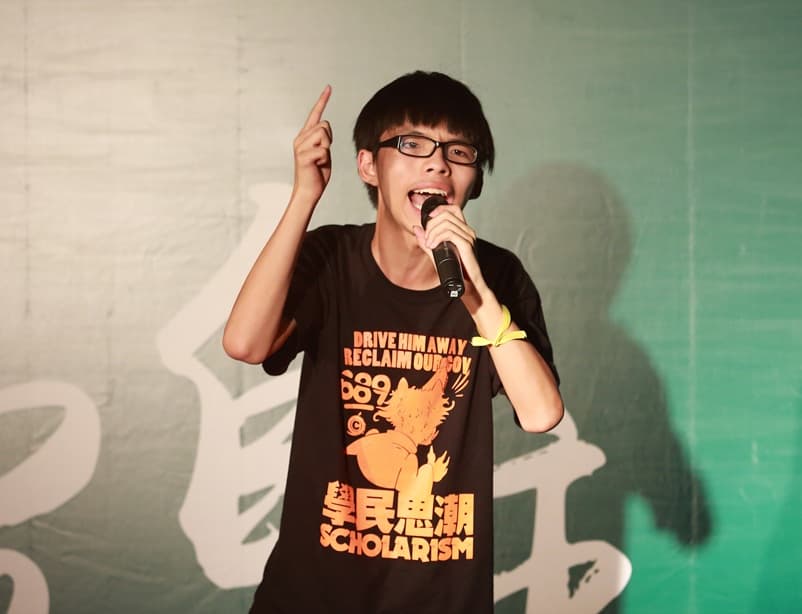
In court, Joshua Wong appeared to have lost weight as he nodded to friends and supporters seated in the public gallery. Among those present were former members of Scholarism, a now-defunct student activist group he had founded in 2011, when he was just 15 years old. Mr Chan also stated that Joshua, who will turn 30 next month, had had a “long opportunity to reflect on the path he has taken”, adding that “he has not wasted his time in prison”. The activist read over a hundred books written by figures across the political spectrum whilst in custody, Chan added, saying that he hoped to be able to look after his elderly parents once released.