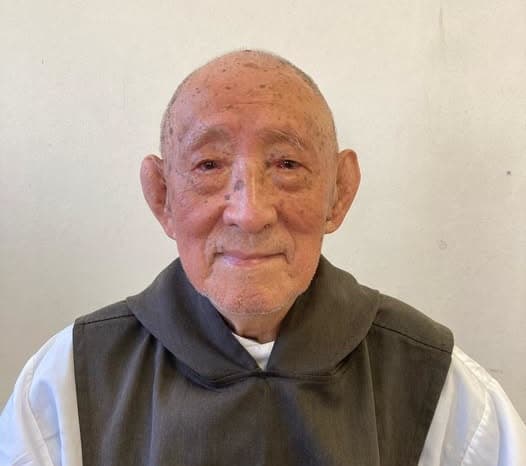
Milan (AsiaNews) – Kung Kao Po, the Chinese-language weekly of the Diocese of Hong Kong, reported the death on 31 July of Father Benedict Chao, a Trappist monk of the Abbey of Our Lady of Joy, the monastery on Lantau Island, Hong Kong.
At 108, Father Chao was the oldest Trappist monk in the world; a singular distinction he now leaves to an Asian nun, Sister Sebastiana Yamaguchi Teruko, of Imari Abbey in Japan, who is 107.
Age is not the only extraordinary fact that makes Father Benedict Chao’s 79-year religious life so significant.
With his funeral, on 14 August, the Hong Kong abbey will bid farewell to the last of the group of Trappist monks who survived communist persecution in China and were able to reestablish their community in the 1950s in the then British colony with the support of Bishop Enrico Valtorta, a PIME missionary.
Father Chao’s death provides a precious opportunity to remember a story of martyrdom that bears many similarities to that of the monks of Tibhirine, killed in the 1990s and proclaimed blessed among the martyrs of Algeria.
Father Chao was born in 1918 in Chengting, Hebei Province. In 1941, at the age of 23, he entered the original Abbey of Our Lady of Joy (also known by its French name, Liesse, meaning jubilation), which was located in that part of Hebei.
The monastic community had been founded in 1928 as a branch of the first (and only other) Cistercian abbey in China, Our Lady of Consolation, built in 1883 in the Yangjiaping Mountains (not far from the Great Wall, about 130 kilometres north of Beijing) by monks from the famous French Abbey of Notre Dame de Sept-Fons.
The Cistercian community that Father Chao joined in 1941 was a monastic fraternity that had already experienced the horrors of war despite being present in China for less than 70 years.
In 1937, the monastery of Our Lady of Joy in Chengting was occupied for the first time, by the Japanese, resulting in several monks imprisoned and killed.
However, it was in 1947, the year when Father Chao took his perpetual vows, that the most painful page in the Trappists' Calvary in China began.
Yangjiaping Abbey was the first to be targeted, this time by Mao's communist forces. Some 75 monks called it home, most of whom were by then Chinese given, not coincidentally, the abundance of local vocations.
The third abbot of Our Lady of Consolation, Dom Louis Brun, wrote on the subject: "It has been said that the Chinese have a certain aptitude for contemplation and are more predisposed than some other peoples to the contemplative life, and this is attributed to their sobriety, their hard life, the existence of many Buddhist and Taoist monasteries, the meditative nature of the people, less inclined to action than the Europeans... We could say, something that will be seen by many as a paradox, that the Rule of Saint Benedict seems to have been written for the Chinese.”
In 1947, Yangjiaping found itself on the front line of the war between the Communists and the Nationalists.
When the Communists broke through the enemy defences that summer, they encouraged the residents of nearby villages to sack the abbey, putting the monks on trial before a revolutionary court, using publicly beating and torture to force them to abandon their faith.
Then, on 30 August, the martyrdom began. After burning down what remained of the monastery, the communists deported all the monks, leading them along rugged routes through the mountains of northern China on a “death march”.
Hands bound with chains or wire that exposed their bones, under torrential rains, the elderly and infirm carried on the shoulders of the fellow monks, forced to forage for food like animals, prevented from communicating with one another, and whipped when caught half asleep or moving their lips in prayer. Up to three died from exhaustion and privation per day along the road.
In January 1948, after a final people’s trial in Panpou, Father Chrysostom Chang, the 29-year-old sub-prior of the community, and five other monks were shot.
Beforehand, Father Chang told his companions: "We die for the cause of God. Let us raise our hearts to him for the last time in the total offering of our being."
This is also why his name appears as the leader among the 33 martyrs of Yangjiaping (30 Chinese monks, a Frenchman, a Dutchman, and a Canadian).
The fate of Liesse, where the young Father Chao was staying, was no different. The other monastery in Hebei, too, was attacked by the communists at that time as well. Two monks were killed while the others were forced to seek refuge in Xindu, near Chengdu (Sichuan), then still under Nationalist control, where they moved their community.
However, the abbot understood that even this refuge would be only temporary. For this reason, he ensured that at least some monks, including Father Chao, left China for the Monastery of Notre-Dame-des-Prairies in Manitoba, Canada.
The elderly monk was right. In 1951, the Trappist community in Xindu was also liquidated as a result of communist persecution. Through the group of monks who had found refuge in Canada, the project to reestablish the community in Hong Kong was born.
As Trappist spirituality demands, Hong Kong’s British governor, at the request of Bishop Valtorta, assigned them an uninhabited plot of land on the heights of Lantau Island. Here, the eight monks of the reborn community built the monastery with their own hands, which was officially inaugurated on 19 February 1956.
Before returning from Canada, the Chinese monks stayed for several months at Holy Trinity Abbey in Utah, to improve their English and learn cheese-making techniques.
To support themselves through work, they brought cows to Lantau. The community began producing milk, butter, and cheese, which soon became famous throughout Hong Kong, making the Trappists and their “Trappist Haven Monastery”, as it was then called, well known.
In 1974, Father Benedict Chao was elected as the third prior of the reborn Chinese monastic community, a position he held until 1998.
The following year, finally, the Cistercian order recognised the Lantau community as an autonomous abbey, which resumed the name it had in Hebei in January 2000.
Today, it is the Abbey of Our Lady of Joy, which, thanks to Father Chao and his fellow monks, has kept alive the memory and prayerful presence of the Trappists of Hebei, despite the wounds of 20th century history.
ECCLESIA IN ASIA IS THE ASIANEWS NEWSLETTER DEDICATED TO CHRISTIAN COMMUNITIES IN ASIA. WOULD YOU LIKE TO RECEIVE IT EVERY SUNDAY? TO SUBSCRIBE, CLICK HERE.