Milan (AsiaNews) – Every summer, the United States and South Korea conduct an extensive 11-day military exercise involving thousands of soldiers and simulating a conflict with North Korea.
It is called Ulchi Freedom Shield and is prepared for months in advance, with units and logistics chains organised well before the manoeuvres begin. It serves as the main test of an alliance under which 28,500 US soldiers are permanently stationed on South Korean soil. This year, the exercise was halted whilst it was underway, following a unilateral decision by the US President – an unprecedented move.
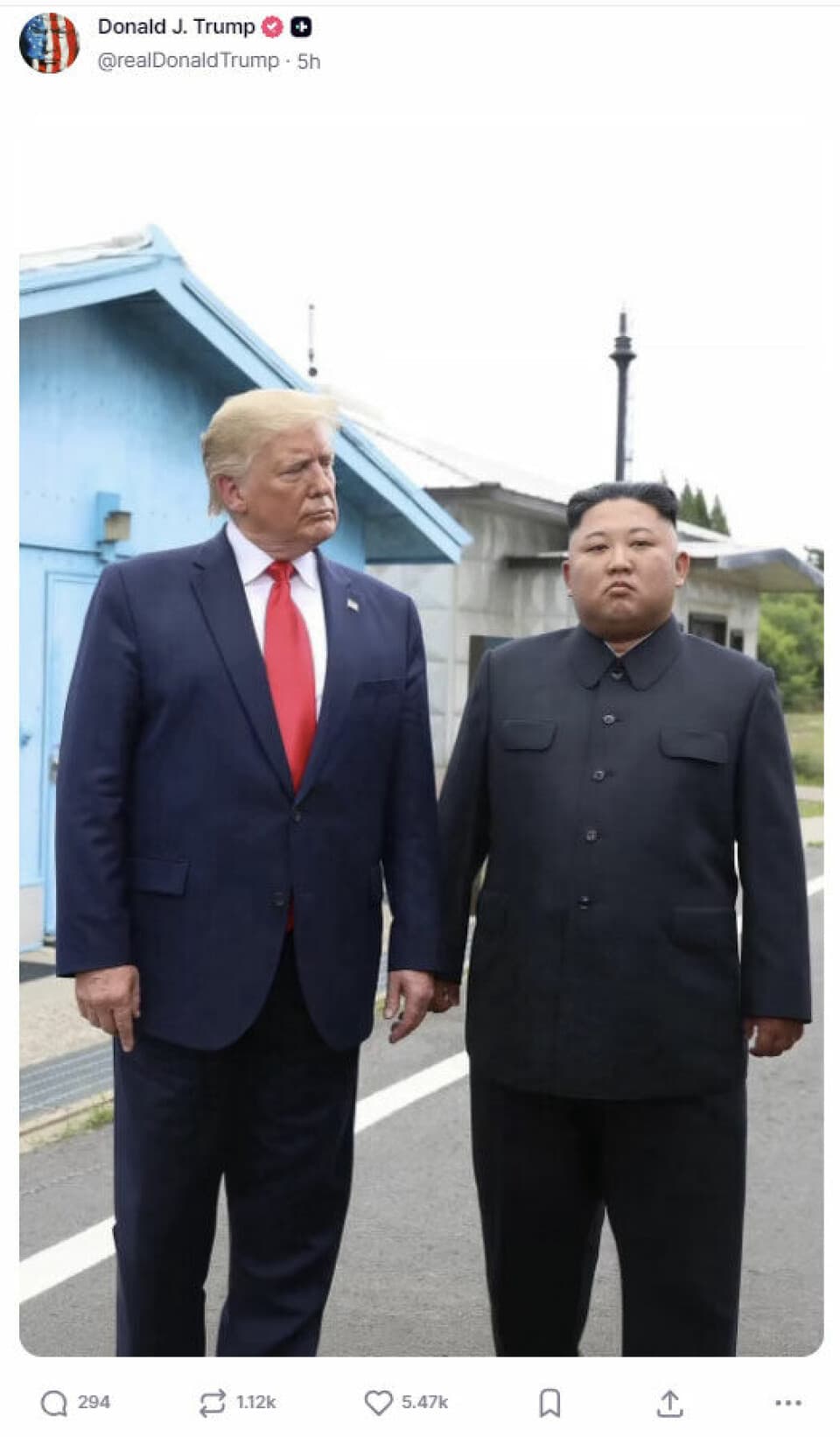
Donald Trump’s order was issued on 16 August, just a few hours after the US President had posted an old photograph on Truth Social of his meeting with Kim Jong-un at the inter-Korean border in 2019.
Trump asked the Pentagon to substantially scale back the exercises, deeming them too costly and stating that they sent ‘a completely inappropriate and hostile signal’ to Pyongyang.
The manoeuvres began on the 17th nonetheless, but two days later the South Korean Joint Chiefs of Staff announced that they would conclude on the 21st rather than the 27th, with the second phase – dedicated to the counter-offensive – being cancelled.
In explaining the decision, Trump cited two parallel factors which were interpreted in Seoul as being closely linked. The first is Pyongyang’s behaviour, which, according to the US president, has been respectful and non-threatening throughout his term in office.
The second is Seoul’s conduct, which has refused to support the US war against Iran and is proceeding slowly with the $350 billion in investments envisaged under the trade agreement signed with Washington in 2025. Within the administration, the South Korean government is regarded as the slowest-moving partner amongst those with whom the US has negotiated agreements.
The reduction in military exercises has therefore also served as a means of exerting pressure on an ally.
Trump’s most ambitious goal, however, is to secure a summit with North Korea this coming autumn. The war against Iran has now turned into a quagmire, becoming increasingly unpopular in the US, and a new meeting with Kim Jong-un would offer Trump the opportunity to stage a high-profile diplomatic success that could be put to immediate political use.
The price set by Pyongyang
The North Korean response came via Kim Yo-jong, the leader’s sister and one of the regime’s leading voices, who dismissed the reduction in military exercises as irrelevant, denying that there had been any recent contact between the two leaders.
The following day, she mocked the Seoul government, suggesting it had not even dared to protest against the early departure of American troops. As if that were not enough, on 20 August North Korea fired around ten short-range ballistic missiles into the sea from the Pyongyang area.
These moves raise the stakes for a possible return to the negotiating table without closing the door on talks.
Three years ago, Pyongyang enshrined the permanent nature of its nuclear arsenal in its constitution, formally ruling out any negotiations on disarmament, and last autumn the North Korean leader said he was willing to engage in dialogue with Washington only on condition that the United States abandon its demand for denuclearisation.
Compared with 2018 – the year of the first summit between Kim and Trump in Singapore, followed by the breakdown of talks in Hanoi in 2019 – the North Korean leader’s negotiating position is much stronger.
The dispatch of troops and ammunition to Russia in exchange for economic and technological support has mitigated the impact of Western sanctions, whilst the resumption of traThe dispatch of troops and ammunition to Russia in exchange for economic and technological support has mitigated the impact of Western sanctions, whilst the resumption of trade with China has further reduced the country’s isolation.
A summit could nevertheless secure him some concrete results, such as a formal declaration ending the state of war between the South and the North or new restrictions on allied military exercises, without calling the nuclear arsenal into question.
Pyongyang has also long been pursuing, in parallel, a broader strategic objective: to deal directly with Washington whilst sidelining Seoul, and the signal sent by Trump points precisely in that direction – particularly at a time when the alliance between the United States and South Korea is already fraught with economic tensions.
Lee’s unreciprocated overtures
The latest developments place South Korean President Lee Jae-myung in an increasingly difficult position. Since taking office in June 2025, he has reversed his predecessor’s line and offered Pyongyang the possibility of opening talks without preconditions.
In July, the South Korean Ministry of Unification declared an end to the policy of pressure aimed at dismantling Pyongyang’s nuclear arsenal, setting a freeze on its expansion as the immediate objective.
On 15 August, in a speech marking the anniversary of liberation from Japanese colonial rule, Lee proposed to the North that negotiations be opened between the parties directly involved to formally end the Korean War, which was suspended in 1953 by an armistice and never concluded with a peace treaty. So far, none of Lee’s overtures have received a response. Meanwhile, Pyongyang has continued to strengthen its military ties with Moscow, and Kim is expected to visit Russia by the end of the year.
Lee welcomed the scaling back of the military manoeuvres. In a post on X, he thanked Trump for helping to create space for dialogue, including through the scaling back of the exercises. However, the Foreign Ministry in Seoul was quick to clarify that the decision had been taken independently by Washington and not at South Korea’s request.
The government has thus seen one of its long-standing objectives – the scaling back of military exercises – realised, but through a unilateral initiative by the United States and without its involvement in the decision.
On the military front, South Korea’s response has been quite the opposite. Lee has called for the acceleration of both the nuclear-powered submarine programme and the restoration of wartime operational control – that is, command of South Korean forces, which in the event of a conflict would currently pass to an American general.
In his view, the more capable the country becomes of defending itself, the greater the value of the alliance. The risk inherent in this approach was highlighted by Yu Ji-hoon, a researcher at the Korea Institute for Defence Analyses, who noted in the Korea Herald that repeated reductions in joint exercises would ultimately weaken coordinated training and the coherence of the deterrence message directed at the North.
The affair has also been closely followed outside the Korean peninsula. In Tokyo, Sanae Takaichi’s government found itself once again questioning the reliability of US guarantees in Asia, whilst in Taipei and Manila the incident was seen as a sign of the speed with which Washington can unilaterally redefine its commitments.
Beijing, for its part, reacted swiftly. Chinese Foreign Minister Wang Yi arrived in Seoul on 20 August, where he met Lee and urged South Korea to maintain a neutral stance regarding the rivalry between China and the United States, describing Washington’s hostile policy towards the North as one of the main causes of the current tensions.
US military forces remain stationed in South Korea and neither side questions the alliance, but the exercises – originally designed to test the operational capability of the joint forces – have now become part of the political game between Washington and Pyongyang.
Against this backdrop, any resumption of dialogue with the North thus risks depending primarily on the decisions of the United States and North Korea, leaving Seoul with increasingly limited room for manoeuvre.