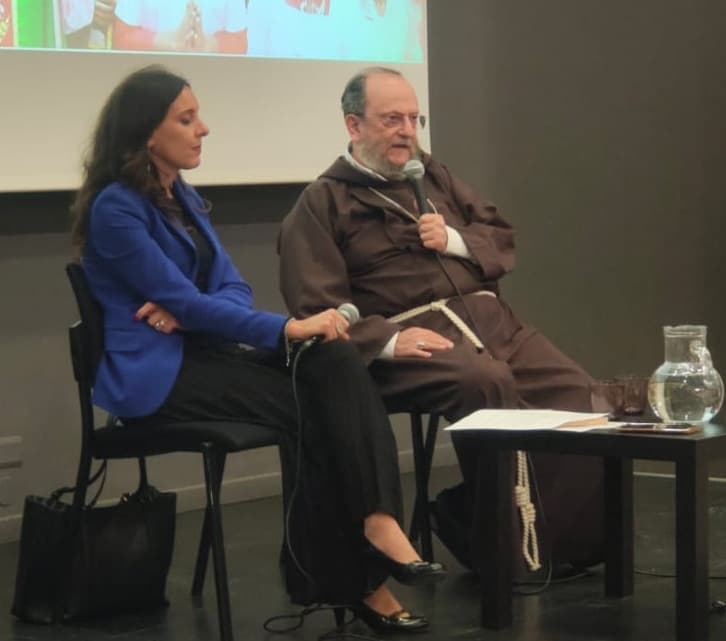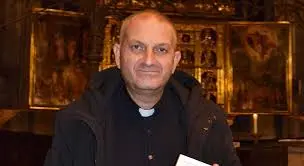
Rome (AsiaNews) - The Syriac Catholic Archbishop of Homs in Syria, Monsignor Jacques Mourad, is currently in Europe and attended the screening in Rome of Shahab Kermani’s documentary on Mar Musa, a community he helped found alongside Father Paolo dall’Oglio in the 1990s. Formerly in charge of the monastery of Mar Elian in Qaryatayn, from where he was kidnapped and held hostage by ISIS for six months, he now serves the entire diocese of Homs; a diocese comprising some 75,000 Christians (of whom roughly a third are Catholics), in a Syria that is still far from a genuine recovery, both economically and in terms of rights. And where the future remains “uncertain” even for the Christians themselves.
Below is Archbishop Mourad's full interview with AsiaNews:
Archbishop Mourad, the documentary “Mar Musa” shows Syria as it was two years ago, before the change of government. The city of Homs we see there was still largely in ruins. What is the situation like today?
The situation is the same as it was two years ago. Nothing has changed, as the sanctions have not yet been lifted and so there is no real reconstruction programme. In some of the more densely populated neighbourhoods, a few Syrians who have returned from abroad (for example, from Turkey or the Gulf) have opened new shops, but these remain sporadic and individual initiatives.
Many people are still homeless, both due to a lack of money and because their homes have not been rebuilt following the bombings. In fact, I hear that many have remained in refugee camps – although there are no official statistics or figures – and prefer to stay there because, as they say, at least there they have tents. The economy has not recovered and there is not enough work for everyone.
How is the current government responding to this situation? Is it capable of doing anything?
No, because it lacks sufficient experience. The current government has sacked many specialist officials from the previous administration, but they have not been replaced by specialists of the same calibre. Most of those officials were Alawites, but there were also some Christians and Sunnis who were sacked. In their place, people who had emigrated to Idlib and have now returned from that region have been hired, but the systems are not functioning properly.
And what about the education sector?
Generally speaking, schools are functioning; they are open and boys and girls can study, but the standard and nature of the teaching is another matter.
We often read about freedom of expression in Syria, which was previously stifled…
Yes, there is undoubtedly freedom to speak out and even to denounce wrongdoing, and this is important. However, if I were to describe the justice system in Syria today, I would speak of a transitional justice system that creates loopholes and justifies violent actions, providing the perfect framework for revenge.
At the start of this new political phase, there was much talk of the risk of Islamisation. What can you say about this today?
Islamisation is evident throughout society, from clothing to the running of government offices. For example, civil servants stop work during prayer times, and verses from the Qur’an have been displayed in various buildings.
As for schools, I understand that we have moved from one hour of religious education per week – offered according to the pupil’s religious tradition – to four hours of Qur’an study, which everyone is obliged to attend. The message we are receiving is that Islam is for everyone.
Does the Christian population feel discriminated against?
I would say so. Many Christians have been driven out, and various jobs – particularly in the civil service – are no longer available to Christians. But even in the private sector, people prefer to shop at a Muslim-owned shop rather than a Christian-owned one. People are afraid to go to Christians because the religious teaching that is being propagated urges Muslims to help other Muslims first and foremost.
Looking at the Syrian social fabric, what is society like today?
There used to be talk in Syria of coexistence between the various groups. Then, during the war, despite the tragedy and despair, there was a sort of closeness and solidarity. Today – and this is what worries me – we are witnessing a breakdown. Previously, fear was instilled in the people by the government; now it is also being instilled by the people themselves towards their neighbours.
Those who have returned from Idlib are convinced that Islam is the only true path and that everyone else is kuffār (unbelievers), and this is influencing the whole of society.
What opportunities, then, are there for Christians in Syria today?
The situation is clearly difficult and there are many Christians who are distressed – I would say desperate – and who want to leave. But at the same time, I see the strength of faith in so many of them. They always find a suitable way to persevere with courage and patience. The grace of faith is a grace that overcomes evil and suffering, and this is the witness we receive from Christians in Syria who need the Church’s presence and support. Without this, I do not believe there will be any Christians left in Syria.
What message do places such as Mar Musa convey in this context?
Mar Musa is in itself a sign because it is an example of an institution that has remained unchanged over the years and continues to serve as a point of reference, a source of hope and stability, and a refuge for all. Like Mar Musa, there are also other groups of people who seek to play a human, social, prayerful and hopeful role in the midst of a wounded society. For example, in Homs we have various groups of very courageous young people, both Christians and Muslims, who are carrying out initiatives to help the most vulnerable, such as street children or people with disabilities, or who are working to support the education of boys and girls from refugee camps who have not had access to schooling. These are important signs.
One final question: is there a particular passage from Scripture that sustains you in the midst of these situations?
The same one as when I was in prison. It is a phrase from one of St Paul’s letters that gives me the strength to look beyond difficult situations: “My grace is sufficient for you, for my power is made perfect in weakness” (2 Cor 12:9).