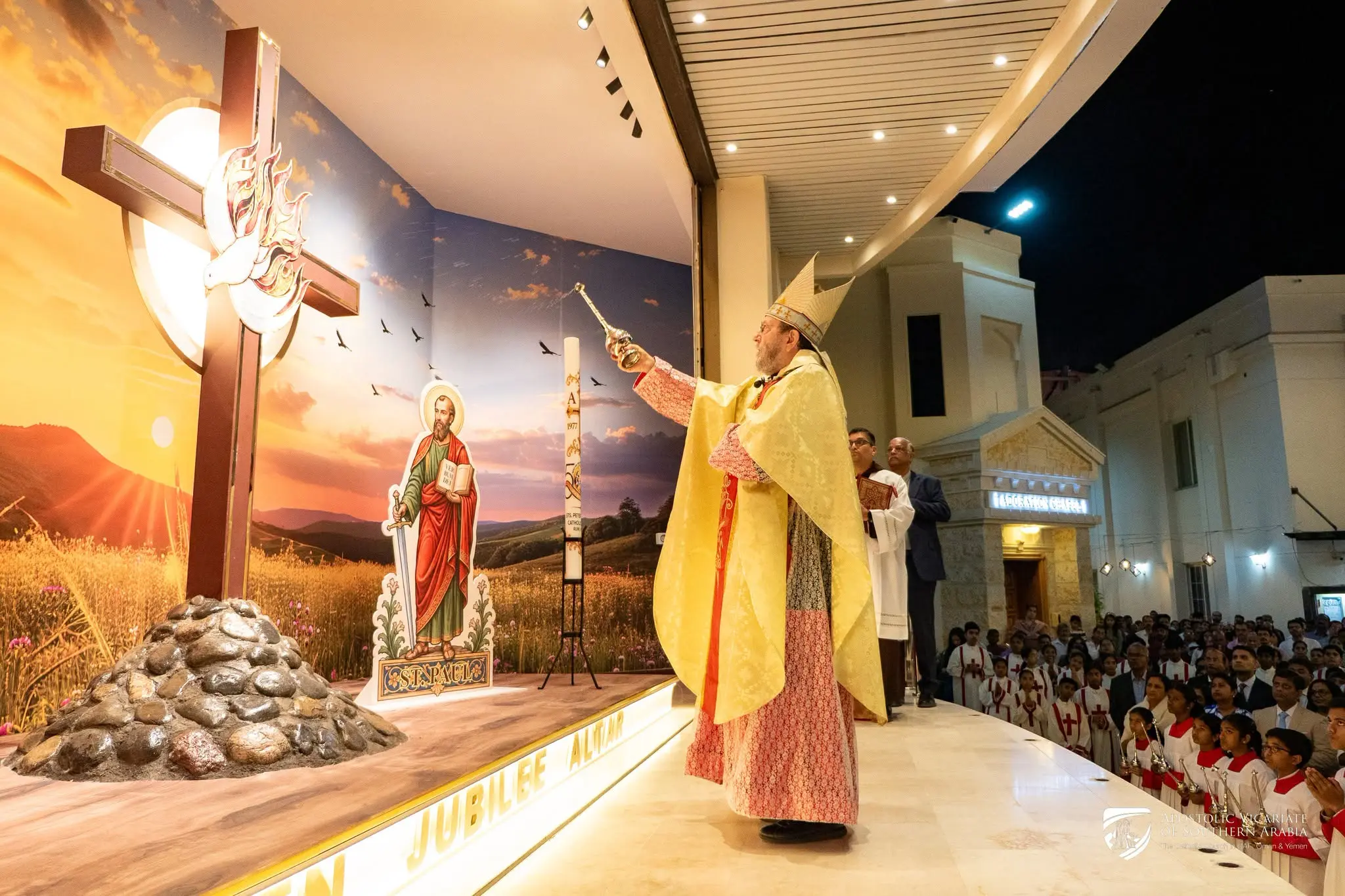
(AsiaNews) – “The Jubilee is a time to remember God’s gifts, in particular the gift of this church, where the faithful gather to celebrate the Eucharist, the sacrament of love and unity”. This was emphasised by Monsignor Paolo Martinelli, Apostolic Vicar of Southern Arabia, on the occasion of the recent start of the Jubilee Year marking the 50th anniversary of the consecration of the Church of Saints Peter and Paul in Ruwi, the financial heart of Muscat, the capital of Oman. On this occasion, the prelate continued, “we are invited to grow in faith, to recognise Christ and to base our whole lives on Him: thus, to be built on the rock” and to “allow ourselves to be ‘guided by the Spirit’.” (...) Let us commit ourselves to living out our faith; let us be a united Church, built on the rock” and with “Christ at the centre of our lives”.
First church in Oman
In recent days, the Golden Jubilee of the Church of Saints Peter and Paul in Ruwi, Muscat – the first Catholic church built in the Sultanate of Oman – was inaugurated.
The celebrations were inaugurated on 6 November by the Apostolic Vicar of Southern Arabia (United Arab Emirates, Yemen and Oman), Monsignor Paolo Martinelli, with a packed programme of events and activities. The Jubilee Year, which marks the 50th anniversary of the church’s consecration in 1977, will officially conclude on 5 November next year.
To mark this special occasion of celebration for the local Church, the Apostolic Penitentiary has granted a plenary indulgence to the faithful who visit the place of worship, provided they fulfil the usual conditions. On the evening of 5 November, Monsignor Martinelli presided over Vespers – preceded by the raising of the Jubilee flag – whilst the following day he concelebrated the Solemn Mass. During the opening ceremony, the Apostolic Vicar also blessed the Jubilee altar outside the historic place of worship and lit the Jubilee candle. The prelate also blessed the church’s entrance door, a symbolic gesture marking the beginning of this special year of grace for the parish community.
A year of thanksgiving and renewal
In a statement sent to AsiaNews, the Vicariate of Southern Arabia reports that the theme of the Jubilee, ‘Built on the Rock, Guided by the Spirit’, draws inspiration from the parish’s patron saints, Peter and Paul. It is also an invitation to the community to reflect on its foundations in the faith and on its mission in today’s world, which is full of challenges.
Throughout the Jubilee Year, each month will feature special celebrations dedicated to different groups, ministries and communities, encouraging all the faithful to take part in this important anniversary. For the local Church, the Golden Jubilee thus becomes a time to thank God for the past, to acknowledge the people through whom He has sustained the parish, and to renew the community’s mission for the future.
The anniversary, emphasises Fr Stephen Lewis, parish priest of the Church of Saints Peter and Paul in Ruwi, is not merely “a celebration of the parish’s achievements”. On the contrary, it is rather an “opportunity to recognise that the life and fruitfulness of the parish are gifts from God, to be placed at the service of the whole community”. “Following in the footsteps of our patron saints, Peter and Paul, we are called to bear witness to Jesus Christ through a renewed commitment to the sacramental life, to strengthening our communion, and to caring for those in need. The future of a parish,” the priest continued, “is not measured solely by its activities or its structures, but through the faith, charity and hope that its faithful live out and share” . Finally, he expressed his thanks to the rulers, government officials and the people of Oman “for their goodwill,” concluded Fr Lewis, “towards the Catholic community, as well as for the peace, security and freedom to practise our faith”.
Diplomatic Crossroads
Following the establishment of the Apostolic Vicariate of Arabia at the end of the 19th century and up until 1938, Catholics in Oman were visited once or twice a year by Capuchin or Carmelite missionaries stationed in the region. Following a hiatus during the Second World War, the Capuchins based in Bahrain began visiting Muscat every two months to meet with a community of around 50 people. In 1973, Sultan Qaboos granted permission to build the first Catholic church, together with a residence for the priest, on a plot of land near the capital. The Church of Saints Peter and Paul in Ruwi was the first Catholic church built in Oman and was consecrated on 4 November 1977 by Archbishop Duraisamy Simon Lourdusamy and Bishop Giovanni Bernardo Gremoli, then vicar. At that time, there were around 3,500 Catholics living in Oman, but rapid population growth made it necessary to expand the church, which was demolished and rebuilt in 1995.
Whilst 86 per cent of the population is Muslim, Christians account for 6.5 per cent of the population, comprising 100,000 Catholics, followed by Orthodox and Protestants; the remaining 11 per cent consists of independent groups or small communities. The faithful are almost exclusively economic migrants from other Asian countries, particularly the Philippines and India, and live in the major urban centres, from the capital Muscat to Sohar and Salalah. The territory forms part of the Apostolic Vicariate of Southern Arabia, based in Abu Dhabi, whilst there are four parishes – two in Muscat (Ruwi and Ghala), the capital, one in Salalah and one in Sohar – and 12 resident priests. In March 2022, the local Church celebrated its first priestly ordination: Fr Dickson Eugene, from the Salesian Province of Bangalore, who grew up in Oman itself.
The Sultanate is situated in the south-eastern part of the region; it is divided into 11 governorates and 61 provinces and has a population of around 4.5 million people; they are predominantly Arab, but there is also a significant proportion of foreign workers from other Middle Eastern countries, as well as from the Philippines, India and Pakistan. Like many nations in the region, its economy is based on hydrocarbons, particularly natural gas, combined with the tourism sector. Islam is the state religion and Sharia is the principal source of law, but the principle of religious freedom and the prohibition of religious discrimination are also enshrined. On the political front, it has played – and continues to play, amidst a period of conflict and tension in the Gulf – the role of mediator with Tehran, having built ties and relationships with both the Shia and Sunni worlds. In particular, with Saudi Arabia and the United Arab Emirates, as well as Qatar, which have for years been waging a bloody proxy war with Iran in Yemen.
In the past, Oman received recognition from the Vatican for its contribution to the negotiations for the release of the Indian Salesian priest Fr Tom Uzhunnalil, who was abducted in Aden in March 2016 during the jihadist attack on the Missionaries of Charity house in which four nuns were killed. This relationship has been consolidated over time and led the Holy See and Muscat to establish full diplomatic relations in February 2023, with the opening of a nunciature and an embassy, with the aim of promoting “greater mutual understanding” and “strengthening friendship and cooperation”.