Jerusalem (AsiaNews) -Rabbis for Human Rights (RHR),an Israeli advocacygroupdedicated to helpingPalestinian farmerstargeted invarious parts of the West Bankbysettlerattacks and violenceissued a statement today.
“Everyone in our Protect the Harvest delegation has been released,” the group said regarding the fate of those arrested. “The Israelis who were with us have also received 15-30 day bans from the West Bank, which unfortunately means they will be unable to participate in the olive harvest".
Settlers’raids andattacksthreaten to bring the harvest season to a halt, depriving the Palestinian economy of one of its primarysources of income, a resource essential not only for meeting the internal needs of Palestinian families but also for sales in regional markets.
The Christian village of Taybeh is a case in point. Targeted by Jewish extremists, the future of the entire community is under threat.
Activists arrested and expelled
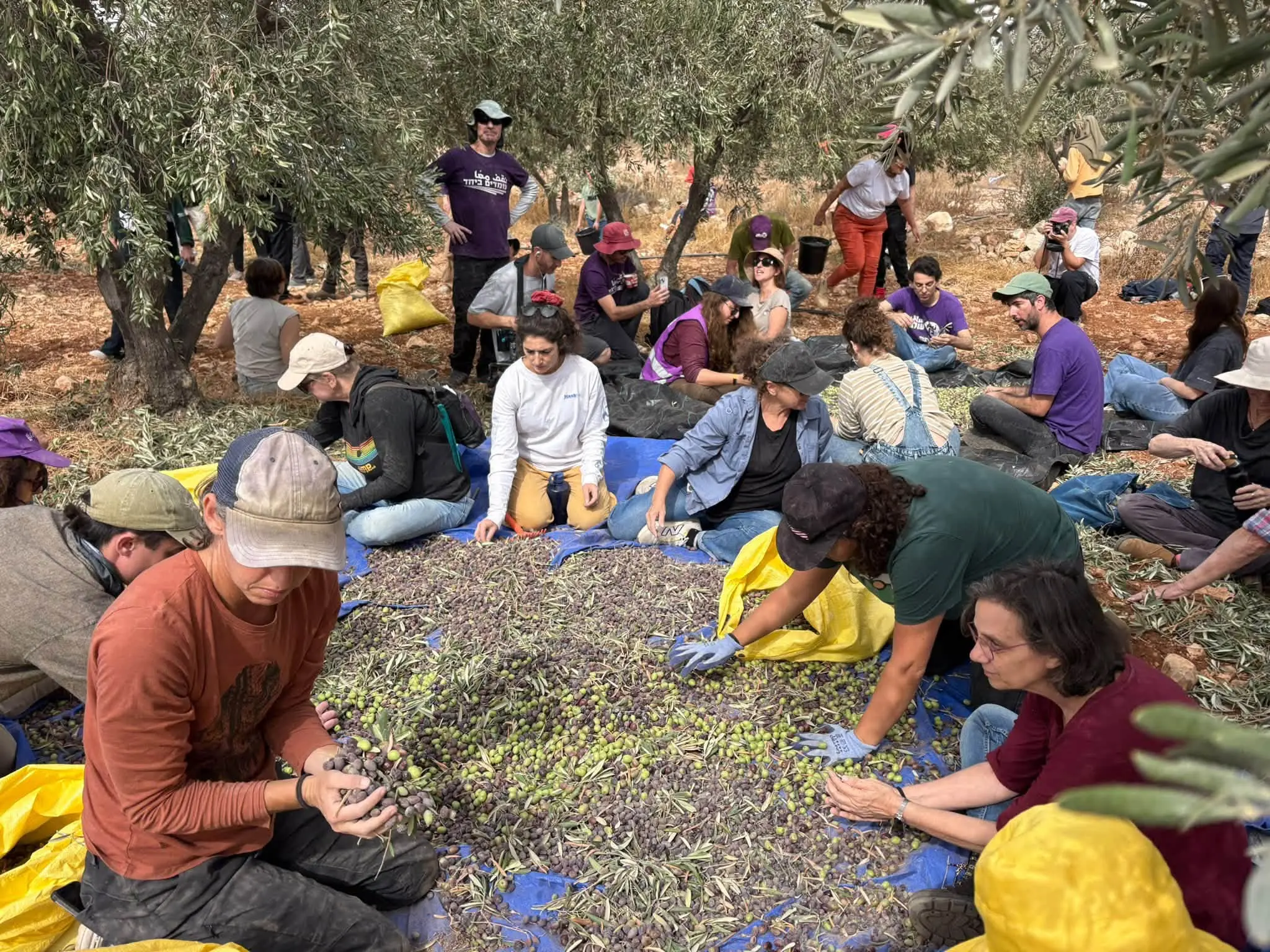
Some of the international activists and pacifist rabbis detained come from the United States. One of them is Rabbi Aaron Leven, from the Nefesh community in Los Angeles, California, who was arrested by the Israel Defence Forces (IDF) alongside a group of rabbis from T’ruah and 80 other activists (for a total of some 90 individuals).
The military moved in because the group was helping a Palestinian family with the olive harvest, an act that followed three years during which Jewish settlers had prevented the family from accessing their own land. Several Palestinians were also detained, including an elderly woman.
“As a rabbi, I cannot accept an interpretation of Judaism that invokes the sanctity of the land while disregarding the sanctity of the people who live on it,”Rabbi Levensaid. “For Palestinian families, olive trees represent far more than an agricultural resource. They connect generations to the land, sustain livelihoods, and preserve family traditions.
Two of those arrested were from Italy: Manuel Tartarotti, 37, and his father Alberto, 67, both from the South Tyrol. Held by Israeli police for more than 24 hours, they were forcibly repatriated following their detention in Masafer Yatta, in the West Bank.
The two were accused of “terrorism” for helping Palestinian farmers and have been barred from entering Israel. Speaking to South Tyrol’s Salto news portal, they said that they were “blindfolded and loaded into a military van,” with the younger of the two “beaten in the back of the vehicle.”
The United Nations has also addressed this wave of violence, noting that thousands of Palestinians are “unable” to carry out the olive harvest due to “settler attacks.” For this reason, the UN Office for the High Commissioner for Human Rights is calling on states and donors to intervene to “protect Palestinian communities” facing assaults and severe restrictions on freedom of movement, restrictions that have worsened over the past three years, following the war in Gaza.
Four of the dozens of activists detained and subsequently released are US citizens; one, congressional candidate Brad Lander, is Jewish, and was detained near Nahalin.
According to RHR, 28 other activists, Israelis, were issued orders to stay away from the West Bank for a period of 15 to 30 days, while 38 international activists were released without condition.
The detentions were based on allegations that the volunteers had participated in the olive harvest in an area that required coordination with military authorities, coordination which, in fact, had not taken place. However, military maps contradict this account since the area where the activists were working did not require any prior coordination.
On social media, Lander reported the incident, noting that hewasarrestedfor “simply harvesting olives”.For theUS congressional candidate, “The occupation is a crime under international law,” and “Harvesting olives isn’t a crime under any law I know. I’ve been released from IDF custody with a ‘warning’, apparently because of my public profile.”
What is more, “Palestinians face far worse consequences every day,” while interference with the harvest is “Yet one more element of escalating, and very clearly state-sponsored ethnic cleansing.”
Harvesting “is not a crime”
Reacting to the escalation, leaders of the New Israel Fund, an NGO that supports the initiatives of Protect the Harvest, a coalition that brings international volunteers to the West Bank, points out that, “Harvesting olives is not a crime.”
In a statement, interim NIF CEO Mickey Gitzin noted that “Detaining peaceful volunteers who are helping Palestinian farmers access their own land is an outrageous misuse of Israel’s authority in the West Bank.”
In his view, “These detentions are part of a system whose purpose is to make life harder for Palestinians in the West Bank to stay on their land, to make a living, and simply live.”
For this reason, he highlights the efforts of groups such as NIF and Protect the Harvest, which are crucial during the current phase of violence.
“Rather than protecting Palestinian communities from violent settlers who have been allowed to run roughshod over Israeli law, not to mention international law, Israeli forces have detained the very people who came to hold that violence at bay.”
This “sends a clear message: Settler violence can be allowed to continue - against Palestinians, journalists, and as we saw last weekend, even diplomats - with maximum impunity, but peaceful solidarity with Palestinians must be stopped.”
Rabbi Lana Zilberman Soloway is another critical voice who spoke out recently. The RHR co-president reflects on “our responsibility as Jews to protect the sanctity of human life” and protect farmers engaged in the harvest.
In an article in the Jerusalem Post, titled “Loving Israel must mean confronting West Bank settler violence, not ignoring,” she asks “why Palestinian farmers need protection simply to harvest their own olives”.
Speaking about a week that was as “brutal” as it was ordinary, she cited attacks by Jewish extremists against farmers, journalists, European diplomats (who were visiting Taybeh in a show of solidarity), and activists.
However,for her,“settlerviolence against Palestinians does not begin with the olive harvest,and itdoes it end when the harvestover”; rather, it is part of a “recurring reality” defined by threats, intimidation, and destruction.
“As an Israeli rabbi and co-chair of Rabbis for Human Rights, I encounter this reality not as an abstract political debate but as a moral challenge. I cannot accept that violence against Palestinians has become routine.”
“The Israeli government must ensure safe access to agricultural land, prevent attacks, investigate allegations, and hold perpetrators accountable. Condemnations alone are not enough. [. . .] I want to live in a country where Palestinian farmers can walk to their olive trees without fear”.
A Future at Risk
In recent years, the olive harvest has coincided with a peak in settler attacks against Palestinian farmers, while Israeli security forces have been more interested in obstructing farmers and activists than on stopping violent aggressors.
Earlier this month, Father Bashar Fawadleh issued an urgent plea. The parish priest serves in Taybeh, West Bank, the last remaining Palestinian town inhabited entirely by Christians of various denominations, which has been targeted in various raids.
In an appeal sent to AsiaNews, the priest emphasised that “this year, the losses have been particularly painful. Many families will produce far less olive oil than they need for their own households.”
In fact, over the past few years, “many families faced repeated difficulties in reaching their land safely and harvesting their olives,” he explained, and now “the same fears are returning”.
For some time, landowners have been unable to access their olive groves, while extremists roam freely through the fields and land, harvesting the fruit or, in extreme cases, setting the trees on fire and devastating entire plots.
For Taybeh, as for many agricultural areas in the West Bank, olives represent much more than just a crop. In the past, production not only met the needs of local families but also provided olive oil for sale beyond the borders of Palestine.
“Here, the olive tree,” Father Bashar notes, “symbolizes a family-based economy, an inherited tradition, and a daily connection to the land, passed down from generation to generation.”
“Here, the olive tree represents a family economy, an inherited tradition and a daily relationship with the land passed down through generations,” Father Bashar said.
“Today, families who own hundreds of olive trees may find themselves forced to buy olive oil for their homes because they cannot safely reach their trees and harvest the fruit.”
“As a parish priest, I see what this means not only in the fields, but in the homes and lives of the families entrusted to our care,”he added.
“They are losing not only their oil, but an entire year's harvest, seasonal income and the supply of olive oil they would normally keep for their homes, at a time when the cost of living continues to rise.”