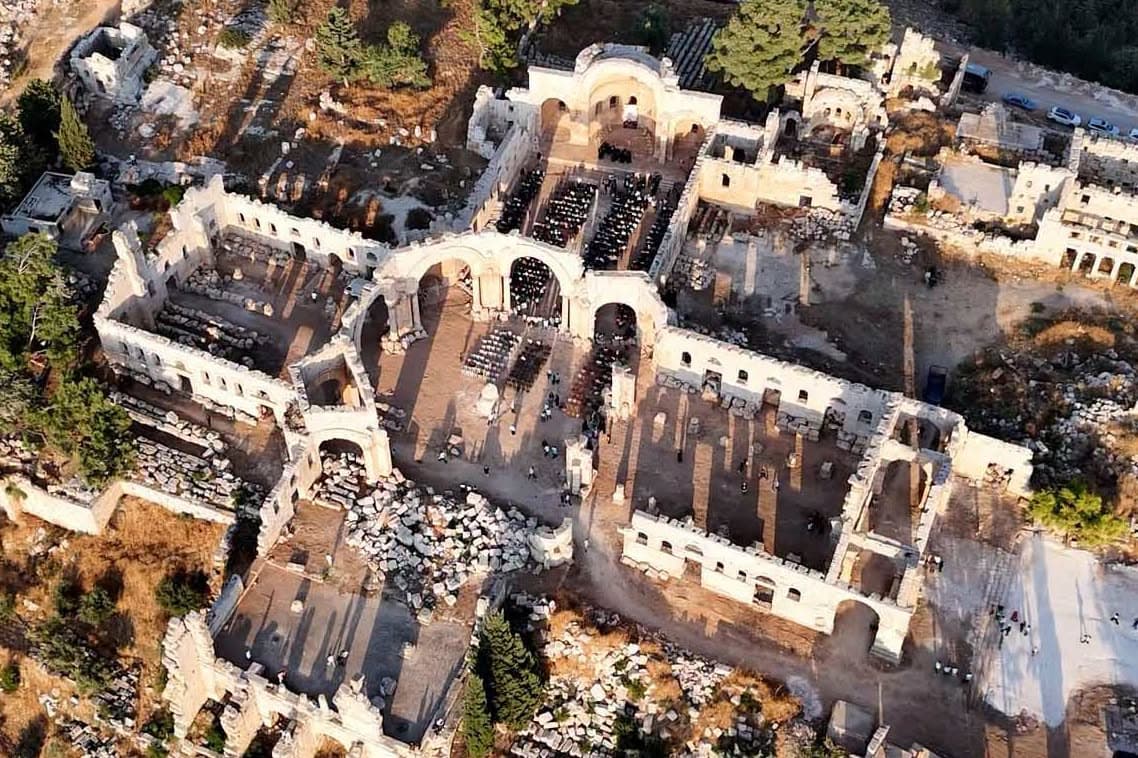
Milan (AsiaNews) - The stones still bear the scars of war. Some arches remain fragile; columns and capitals await reinstallation; all around, the traces of the violence suffered have not been erased.
Yet, in the late afternoon of 1 September – the day of the saint’s liturgical feast for the Eastern Churches – whilst the setting sun lent the place an even more evocative atmosphere, the great shrine of Saint Simeon the Stylite, on the hills north-west of Aleppo, came back to life.
After some fifteen years of enforced silence, a crowd of Christians from across the Aleppo region filled the ruins of the monastery for the solemn celebration.
Among them were the leaders of the city’s various Christian Churches: a shared prayer, in a place that for centuries had been one of the great centres of Christian pilgrimage in the Near East.
The reopening of the sanctuary does not mean that the restoration is complete. On the contrary. Much remains to be done.
But it is precisely this decision – to reopen to pilgrims without waiting for every wound to have healed – that gave the day a special significance. Saint Simeon once again welcomes pilgrims whilst its stones still bear witness to the war.
It is a tangible sign of hope, notes Brother Bahjat Elia Karakach, a Franciscan of the Custody of the Holy Land and Franciscan parish priest in Aleppo, in a Syria that is slowly trying to rebuild not only buildings and roads, but also its own memory.
A pillar that did not isolate, but united
The monastery, built at the end of the 5th century around the site where Simeon lived, is one of the most important monuments of early Christianity.
According to tradition, the saint spent more than forty years on a pillar, in prayer and penance. From that radical choice arose stylitism, a form of asceticism that spread throughout the Christian East.
Paradoxically, however, the pillar was not a place of separation from the world: pilgrims, the poor, the sick and people seeking counsel and consolation from the anchorite would gather around it.
After the saint’s death, the site became an extraordinary centre of pilgrimage and a vast monastic complex was built around the pillar. The most significant part is the basilica or martyrium, at the centre of which stood the pillar; from here, four basilical bodies radiated outwards, each in turn divided into three naves arranged in the form of a Greek cross.
Today, the site forms part of the ancient Christian villages of northern Syria, the famous ‘Dead Cities’, recognised by UNESCO as a World Heritage Site.
However, the years of the Syrian conflict, which began in 2011, have taken a heavy toll. The monastery remained inaccessible for a long time. Bombing, looting, illegal excavations and the use of the area by armed groups of the Islamic State have damaged the complex. According to Abdel Jalil Arabi, the site manager, between 30 and 40 per cent of the area has been damaged.
A western arch collapsed along with its columns; walls and structures have been damaged. In May 2016, an attack struck the sanctuary, prompting condemnation from UNESCO. Then, in February 2023, the earthquake that devastated Syria and Turkey further weakened the arches and masonry.
The challenge of restoration
The war had also scattered the remains of the famous Stylite’s column. Its base had remained in the centre of the church, but what was left of the shaft (albeit worn down by time and the devotion of pilgrims) had been moved and damaged. In recent months, the return of archaeologists has made it possible to begin a new phase.
A Franco-Syrian mission inspected the complex to document the damage and establish priorities for restoration work. Micheline Kurdi, a Franco-Syrian archaeologist who has dedicated her research to the site, spoke of the need to draw on ancient reliefs and preserved plans to reconstruct as much as is still possible.
France plays an important role in this process of recovery and restoration. Its chargé d’affaires in Syria, Jean-Baptiste Faivre, emphasised that this heritage is important not only for the past but also for the country’s economic and tourism future, announcing cooperation between the Syrian General Directorate of Antiquities and Museums and French cultural institutions. International partners and funders are also expected to contribute to the project, including the Aliph Foundation, which is committed to safeguarding heritage in war-torn countries.
“A Light from Aleppo”
The celebration on 1 September marked the first major return of pilgrims to the shrine after years of absence. The day had been organised by the Council of Heads of Christian Denominations in Aleppo and took place as part of the celebrations dedicated to Saint Simeon, under the theme “A Light from Aleppo”. Church leaders, priests and the faithful prayed together at the site which, for over fifteen centuries, has preserved the memory of the great ascetic.
The return of the fragments of the column to their original site was particularly significant. The recovery was jointly organised by the local authorities, the Directorate of Antiquities and the Council of Heads of Christian Churches.
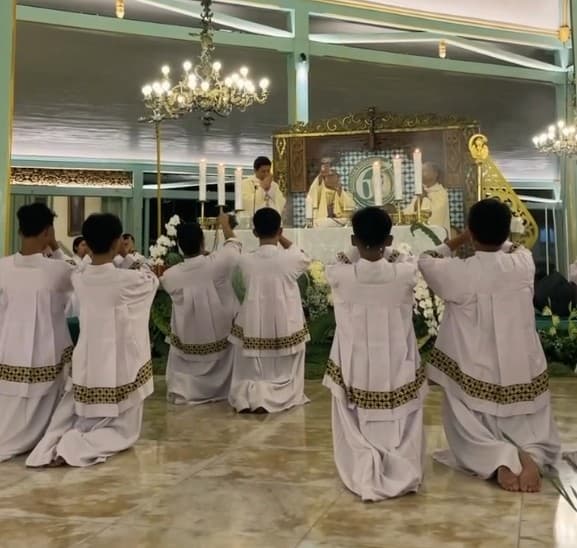
In front of the column, the Greek Orthodox Archbishop Ephrem Maalouli led the prayer, while the choir of the Saint Simeon School of Byzantine Music accompanied the ceremony with hymns from the Eastern tradition. The stone was sprinkled with holy water and venerated by those present.
For Christians in the Aleppo region, whose numbers have been tragically reduced by the war and the diaspora, this is not simply the recovery of an archaeological artefact. The Column of Simeon is a symbol of perseverance in the faith and the ability to withstand adversity. It is not difficult to see the link with Syria’s recent history. After years of flight and dispersion, returning to pray together in that place signifies an affirmation that Syria’s ancient Christian presence has no intention of disappearing. And that the various Christian denominations look to the Stylite to rediscover their roots together.
Photo: Greek Orthodox Archdiocese of Aleppo







.jpg&w=3840&q=75)