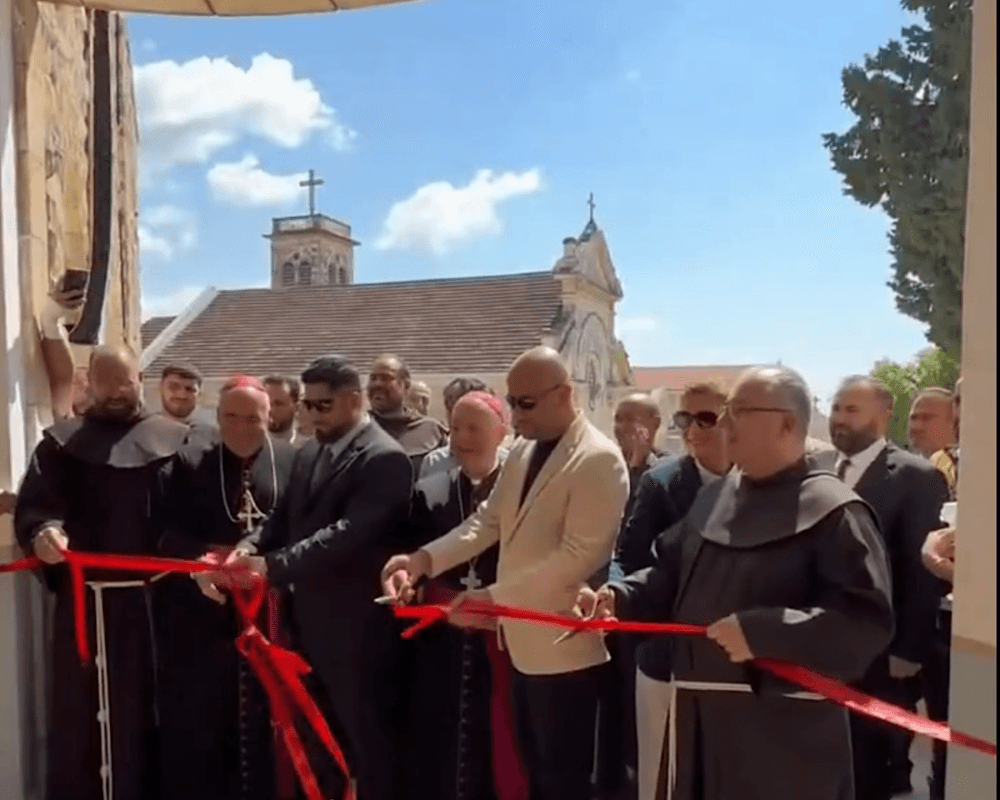
Milan (AsiaNews) – A school closed some 60 years ago by the former Assad regime has reopened its doors to pupils and teachers, with a view to reviving an educational programme and the education sector itself, which, following a decade-long conflict, is facing “serious problems and critical issues: the vast majority of young people cannot read or write”.
This is what Monsignor Hanna Jallouf, a Franciscan who has been Apostolic Vicar of Aleppo since July 2023, emphasised to AsiaNews, recounting the day of celebration experienced yesterday by the Christian (and non-Christian) community for the reopening of the historic Franciscan school in Idlib, in northern Syria.
“Over time,” the prelate continues, “we have come to realise the profound distress experienced by our young people, and the widespread lack of education among those attending both primary and secondary schools, due to the conflict” that has ravaged the country. “This,” he adds, “is a direct consequence of the war; we are now seeking to provide solutions and to relaunch the educational project together with the new government and with the help of the Holy See and the French organisation L’Œuvre d’Orient”.
Rebuilding schools
The event was attended by civil and religious authorities, including: the Custos of the Holy Land, Francesco Ielpo; the Syrian Minister for Emergency and Disaster Management, Raed al-Saleh; his colleague, the Minister for Labour and Social Affairs, Hind Kabawat, the only woman and Christian currently holding a senior position in Syria; the Governor of Idlib, Mohammed Abdulrahman; and the Apostolic Nuncio, Monsignor Luigi Roberto Cona. “What we are celebrating today,” Minister Saleh emphasised in his speech, “is part of the Syria we dream of, a Syria that is for all its people.”
The Franciscan school, better known as the Holy Land School, is situated in the Jisr al-Shughur area, in the northern province of Idlib – the region from which the uprising that led to the fall of the dictator Bashar al-Assad began. The building had first been confiscated, then closed in the early 1960s by officials of the former regime led by the Ba’ath Party, and had remained unused for a long time, reflecting an education system in a state of deep crisis due to conflict and poverty exacerbated by sanctions.
In December 2024, the resurgence of clashes between rebel militias led by the current interim president, Ahmad al-Sharaa, and the then government forces (backed by Russian air strikes) had dealt a severe blow to the area’s infrastructure, damaging the Franciscan school as well.
In recent months, the historic school has undergone extensive reconstruction work to enable it to welcome pupils once again, sending a strong signal of change to the Christian community and the local education system after decades of political and military deadlock. The reopening is part of a wider campaign to rehabilitate educational facilities throughout Idlib province (and the rest of the country), where dozens of schools have resumed operations since December 2024.
Last June, 50 schools renovated as part of the “Loyalty to Idlib” initiative reopened during a ceremony in Kafr Nabl, confirming the reconstruction efforts underway in the region. The school inaugurated yesterday is run by the Franciscans, whose long-standing presence in Syria has borne fruit in the educational, religious and humanitarian fields; it also sends a signal to the Christian community, whose numbers have dwindled in recent years due to the mass exodus. The presence of Muslim and Christian ministers, the Vatican representative and other dignitaries also confirms the Damascus leadership’s attempt to present a multicultural vision that is open to minorities.
“Educating for peace”
From primary to secondary school, in many cases the Syrian education system is now “a failure” due to the war and widespread poverty; amongst young people there is “widespread ignorance”. For this reason – emphasises Monsignor Jallouf – “we have asked the new government to return the school” in Idlib and, at the same time, to launch “a new project involving the reopening of a further 30 Catholic schools” across the country.
“These are buildings belonging to the Syrian Church,” he adds, “which we are seeking to have returned so that we can resume educational activities, which are more necessary than ever. Some have been demolished, whilst others are in a state of disrepair, partly due to the earthquake [in February 2023]. We have a committee currently assessing the requests. To date, a further 22 are operational, but we need to strengthen the teaching staff as there is a shortage of personnel.
“For me,” he emphasises, “this is a wonderful and important project, because we want to educate our children in peace, hope, brotherly love and also openness towards others.”
“Even during the war years,” the vicar continues, “the Church has been committed to supporting the education of young people, to enable them to sit their A-levels. We have spent as much as 5,000 dollars per pupil from the province of Idlib, who, in this way, were able to study in Hama or Aleppo and obtain their school-leaving certificates.”
“The government,” he adds, “wants us to commit to education, for the Church to make its contribution because it is a serious issue, and the collaboration that has developed is truly excellent. Moreover, it is also in our own interest to enable children and young people to study.”
What the country needs, says Monsignor Jallouf, is “stability, calm and peace, because many issues remain unresolved, starting with the matter of security. There is also a distorted portrayal of today’s Syria in the media, which often does not correspond to what is happening on the ground; news stories and critical issues are exaggerated, which is inevitable after 15 years of war.”
The same applies to Christians, many of whom have fled in recent years to countries of migration, whilst others “seem unable to accept the new reality and show a certain nostalgia for the past. However – the vicar concludes – we must look ahead and work together so that, over time, conditions improve, whilst also strengthening the labour market and economic and professional opportunities through projects – even small ones – that benefit the Christian community. And, looking to the future, the aim is to reopen other educational institutions in Aleppo, Latakia and Damascus, if we are able to do so”.
New friar in Damascus
The school in Idlib was not the only cause for celebration for Syrian Christians (and the country’s Custody of the Holy Land) last weekend. On 19 September, in fact, at the Church of the Conversion of St Paul the Apostle in Bab Touma, Damascus, the local Catholic community gathered to celebrate the solemn profession of Br Fares Mardini.
As a statement from the Custody explains, in the presence of the Custos, Br. Francesco Ielpo, “the young friar pronounced his definitive ‘yes’ to consecrated life in the Order of Friars Minor, taking the vows of obedience, poverty and chastity. And during this pivotal moment in his life,’ the statement continues, ‘Friar Fares was accompanied by the entire local community and the Franciscan fraternity. For Christians in the capital, and throughout the country, the event represented a great cause for celebration in a land that remains, even today, “wounded by war, divisions, violence and poverty”. A land where the Christian community experiences a deep sense of belonging but also great unease. Yet, precisely in a Syria full of suffering – as the Custody emphasises – but also the ancient cradle of Christianity, the seeds of hope continue to sprout’.
In his homily, Br Ielpo recalled the words of the prophet Isaiah: “My thoughts are not your thoughts, nor are your ways my ways”, before turning to Br Fares and reminding him how the life chosen in the footsteps of St Francis of Assisi may appear to the world as “a renunciation of happiness”. In reality, the Custos continued, “obedience, poverty and chastity” are the “three ways” to live one’s life “to the full, according to the Gospel”.
“Freedom,” he explained, “consists, in fact, in entrusting one’s will to the Lord with confidence. True wealth is having God as one’s only treasure. The fullness of love does not lie in keeping someone for oneself, but ‘in giving one’s whole life to God and to one’s brothers and sisters’. Finally, the Custos recalled the parable of the labourers in the vineyard, a story in which Jesus explains that ‘the greatest grace is not the reward we will receive in the end, but having been called to work in the Lord’s vineyard’.
Hence the final invitation addressed to Brother Fares and, by extension, to the whole Christian community. “Never lose the sense of wonder at having been called,” concluded Brother Ielpo, “do not regard your consecration as a burden to bear, but as a gift to be welcomed each day.”