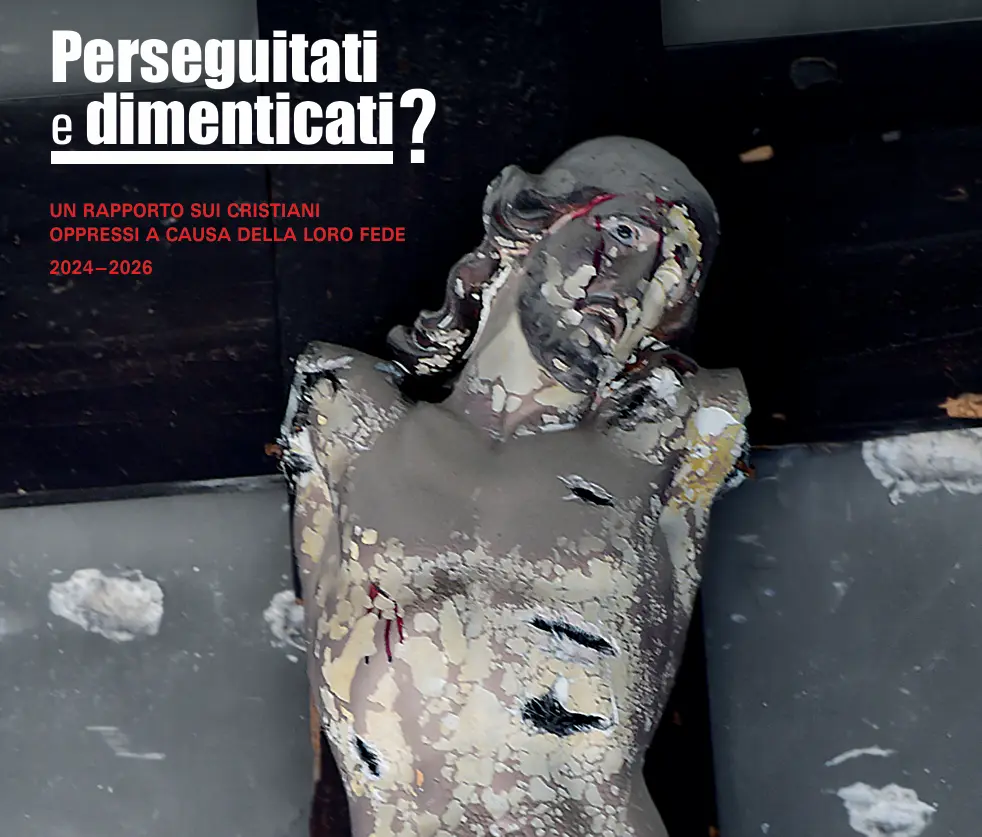
Milan (AsiaNews) – In 55 per cent of the 18 countries where the situation is dangerous for Christians, conditions have further deteriorated over the last two years, something that also affects many countries in Asia, this according to a new study, Persecuted and Forgotten? A Report on Christians Oppressed for Their Faith 2024–2026, released by the pontifical foundation Aid to the Church in Need (ACN).
The study examines countries marked by serious violations of religious freedom, home to 413 million Christians, approximately 220 million of whom are directly exposed to persecution. None of the countries have seen an overall improvement.
Instead, the persecution and oppression of Christians have intensified over the past two years, due to extremist violence, authoritarian governments, and religious nationalism, factors that exert mounting pressure on Christian communities.
Focus on Asian countries
Regarding East and South Asia, the report looks at the situation in six countries (Myanmar, China, North Korea, India, Pakistan, Vietnam), as well as four in the Middle East (Iran, Iraq, Syria, Turkey). AsiaNews is cited several times among the report’s sources.
The latter highlights the growing influence of religious nationalism, with the most striking case being India, where more than 700 incidents of anti-Christian violence were recorded in 2025.
The document links this rise to growing social hostility and the spread of so-called anti-conversion laws, which, according to Christian organisations, are increasingly used to crack down on minority communities.
Regarding North Korea, the report notes that religious repression is an integral part of the state system, and Christians are forced to live their faith in complete secrecy. A significant portion of inmates in prisons and labour camps are Christians.
In the case of China, ACN focuses on the underground Churches that have suffered intensified persecution, as new government regulations tighten state control over religious content and activities.
In Vietnam signs of openness and positive statements by the authorities go hand in hand with the rigid application of highly restrictive regulations, while Christian groups belonging to ethnic minorities, in particular in the highlands, continue to face harsh persecution.
Peter Bhatti: What are we willing to do?
The report warns against blaming all violence against Christians on religion alone. Instead, ethnicity, political instability, poverty, and competition for land and other resources are often intertwined with religious identity.
Still, ACN notes that the religious dimension is also frequently underestimated, especially outside the affected countries.
In the forward, Peter Bhatti, brother of the Minister for Minority Affairs, Shahbaz Bhatti, who was killed in Pakistan 15 years ago, highlighted the importance of remembering persecuted Christians.
“Shortly before his assassination, Shahbaz said, ‘I believe in Jesus Christ, who has given His own life for us, and I am ready to die for a cause.’ He remained faithful to those words until his final breath.
“As we reflect on his witness, let us ask ourselves: What are we willing to do for our persecuted brothers and sisters?”