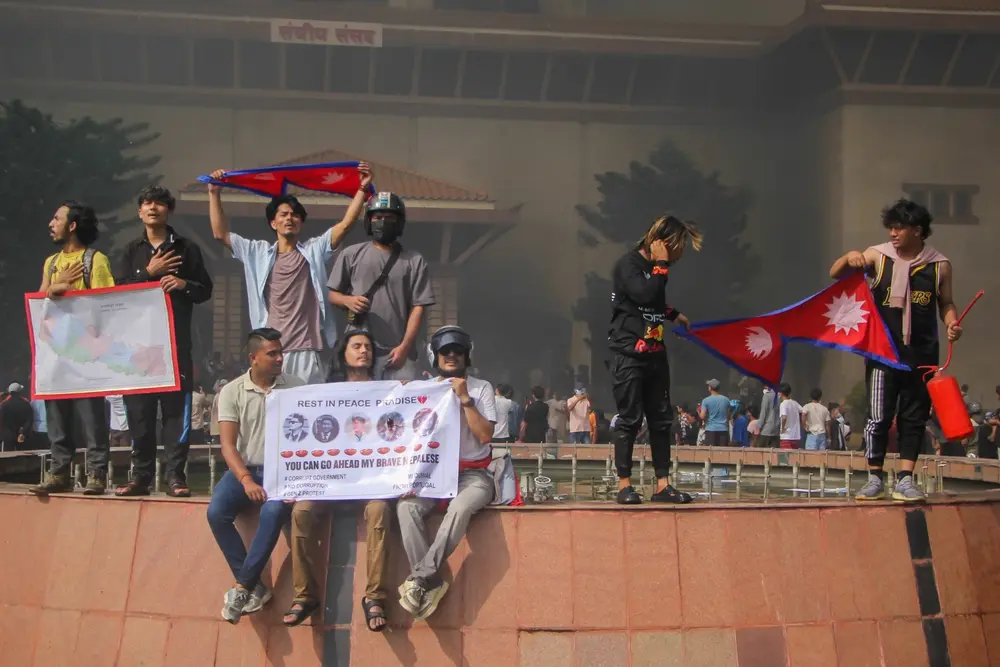
Damascus (AsiaNews/Agencies) – The Syrian government's decision to sharply raise fuel prices on Sunday sparked one of the largest protests since the fall of Bashar al-Assad’s regime, involving even Idlib, considered a stronghold of the current administration.
The protest movement spread to various parts of the country, from Al-Hasakah and Raqqa to Aleppo, Hama, and Homs, continuing into the following day.
For his part, President Ahmed al-Sharaa is attending the Arab Media Summit, a platform bringing together journalists, technology experts, and political leaders, which opened today in Dubai.
Speaking on the role Syria could play in the Middle East conflict, he stated that his country has become a “stable point” in the region, potentially serving as a “trade route and supply chain for energy between East and West,” particularly given the clashes affecting maritime routes.
Unlike past unrest that swept the country since Assad’s fall in December 2024, this time, the protest movement cuts across ethnic and sectarian lines and, most crucially, involves areas considered close to the new regime.
No clashes with security forces have been reported so far; however, many Syrians have expressed concern on social media, especially in rural areas, over rising energy prices ahead of the winter season.
In the country's northeast, protests against rising fuel prices have coincided with a Kurdish mobilisation that has been ongoing for several days.
In Al-Hasakah and other Kurdish-majority cities, students and teachers have protested the Ministry of Education's decision to limit Kurdish language instruction in schools to three hours per week.
The protests began in early September, in Qamishli, Girkê Legê, Amuda, Dayrik, and Kobane, and continued on 10 September and again yesterday, 14 September.
After years of self-rule, Kurdish-majority areas have been progressively reintegrated into Syrian state institutions through a process that began with agreements signed in March 2025 and continued throughout the year.
However, despite the recognition of Kurdish as a national language in areas where a significant portion of the population speaks it, the new school programme limits its use to three hours a week and currently permits instruction in Kurdish for only a few subjects.
Amidst all this, yesterday some protesters demanded the resignation of Energy Minister Mohammad al-Bashir, who previously served as prime minister of the Idlib-based National Salvation Government, a body that acted as the political front for Hay’at Tahrir al-Sham (HTS), the extremist jihadi movement led by Ahmed al-Sharaa.
Given the situation, parliament has summoned the minister for a hearing on Thursday, at the request of the Energy Committee chairman, to discuss the reasons for the price hike and the manner in which such a sudden decision was reached.
The price increase primarily affects diesel, which jumped by 40 per cent, up from 125 to 175 Syrian pounds per litre. The price of 95-octane petrol rose from 152 to 195 lire, while 90-octane petrol went from 147 to 185 lire. Domestic gas also saw a price rise, from 1,470 to 1,600 pounds per cylinder.
The impact on transport was immediate. In Damascus, some shared-taxi drivers raised their fares, with increases estimated at 35 and 70 per cent.
The Ministry of Energy maintains that the hike is temporary, necessitated by a combination of two factors: the surge in international oil prices caused by war, and a temporary reduction in Syria’s refining capacity due to maintenance work at the Baniyas refinery on the Mediterranean coast.
This issue highlights the country's heavy reliance on foreign sources to meet its energy needs.
According to Ministry of Energy data, Syria produced an average of approximately 82,000 barrels of crude oil per day during the first half of the year, whereas total demand is estimated at 300,000 barrels per day.
Regarding diesel, daily demand is estimated at 12 million litres, while domestic production covers only around three million.
The Baniyas refinery, the country's main facility, has a processing capacity of approximately 80,000 barrels per day.
The plant is currently undergoing major maintenance expected to last about two months, which further reduces Syria's capacity to produce refined fuels in the short term.
The goal of the upgrade is to eventually increase the plant's capacity to around 130,000 barrels per day.
As analyst Cédric Labrousse notes, the former Baathist regime used subsidies for decades as a tool of social policy, absorbing part of the cost of essential goods.
The new regime, however, no longer has the same financial leeway. Today, the cost of rebuilding post-war Syria is estimated at US$ 216 billion.
If the current government “subsidises fuel, it will again come at the expense of investment and reconstruction. If it does nothing, inflation could rapidly cause enormous damage,” Labrousse added.