Milan (AsiaNews) – A cross at the entrance to an underground, rock-hewn temple with an Aramaic inscription held a message that remained incomprehensible for a long time.
Today, its decipherment has revealed an important piece of the Mediterranean’s religious history, namely the moment when Christianity began to establish itself within the Roman Empire, coming into contact, and at times into conflict, with the cults that had shaped the spiritual life of the ancient world for centuries.
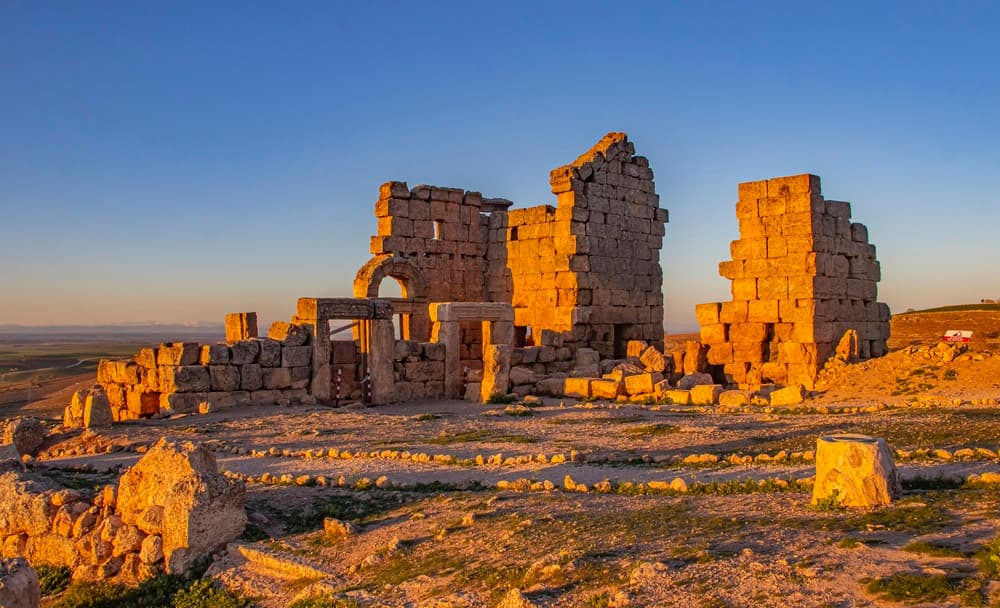
The discovery comes from Zerzevan Castle, in what is now southeastern Turkey, not far from Diyarbakir and the Syrian border.
Here, archaeologists identified a temple dedicated to Mithras, a deity of Iranian origin whose cult (centred primarily on the Sun as a cosmic power, a source of light, and an ordering rhythm for the world) became particularly widespread across the Roman Empire between the 2nd and 4th centuries AD.
The recent interpretation of an inscription found at the entrance to the temple suggests that the site was closed and symbolically sealed by local Christians approximately 1,700 years ago.
This is a rare piece of evidence, as it offers a glimpse not only of the presence of two distinct religious traditions in the same territory, but also of a tangible moment in the history of their coexistence.
The text (discovered in 2017) was deciphered by Professor Mehmet Sait Toprak, a professor of Syriac language and literature at Mardin Artuklu University.
Epigraphic and philological analysis made it possible to trace the characters back to forms of Old Aramaic and Syriac dating from the 3rd and 4th centuries.
Comparing the text with other inscriptions held at the Şanlıurfa Museum helped reconstruct its meaning.
The opening phrase (“In the name of the Holy Cross and of God, He who discerns [the true from the false], who restores, the merciful and compassionate”) suggests the Christian God as the true, invincible Sun.
The inscription, together with the cross placed at the entrance, should therefore be interpreted as a declaration marking the closure of the Mithraic sanctuary.
The cult of Mithras and the mystery religions
To understand the significance of this discovery, one must delve into the world of the mystery religions, an important component of spiritual life within the Roman Empire.
Between the 1st and 4th centuries AD, alongside the traditional public religion, based on the worship of gods and civic rituals, various cults emerged promising their initiates a more personal relationship with the divine.
Isis, Cybele, Attis, and Mithras are some of the figures around whom various religious experiences developed. They were termed “mystery” religions because they were not broadly directed at the population as a whole.
Access to their rites required a process of initiation, which involved participating in private ceremonies and learning symbols and practices that were not disclosed to outsiders.
These were not religions organised according to a single, unified model; rather, each cult possessed its own distinct traditions, sacred spaces, and requirements for membership.
Roman Mithraism, in particular, featured a unique characteristic: its temples, known as mithraea (sing. mithraeum), were often located underground or built to resemble caves. These intimate spaces, designed for relatively small groups, served as gathering points where initiates would perform rituals and share a ceremonial banquet.
The central iconographic motif depicted Mithras in the act of slaying a bull, a scene known as the tauroctony, which is rich in symbolic references to the cosmos, the celestial bodies, and the cycle of life.
This cult flourished particularly in military circles, among officers, but also merchants of the Empire. Its spread along the Roman frontiers, from the Rhine to the Danube and as far as the eastern provinces, attests to the ability of these communities to follow the movements of soldiers and administrators.
However, since it lacked a corpus of sacred texts comparable to those of the major religions, much of what we know today about Mithraism comes from archaeology, iconography, and inscriptions.
The Mithraeum at Zerzevan is, in many respects, an exemplary case. It was situated within a Roman frontier garrison, in a strategic territory crossed by diverse populations, armies, and traditions.
To date, it remains one of the most significant examples of a Mithraic temple discovered within a Roman military context.
The roots of Christianity in Turkey
The discovery, however, also tells another story: that of the roots of Christianity in present-day Turkey.
Long before Constantinople became the capital of the Christian Empire, Asia Minor was already a region where the new faith had sunk deep roots. Many of the Acts of the Apostles recount missionary journeys through these very lands.
Paul of Tarsus, a native of Cilicia (southern Anatolia), travelled extensively through the cities of Anatolia, founding or strengthening Christian communities.
Antioch, Ephesus, Iconium, Lystra, Derbe, and Tarsus are names that appear throughout the New Testament. Several of the Pauline Epistles are addressed to the communities in Ephesus and other cities in Asia Minor.
Furthermore, the Book of Revelation mentions the seven churches of Asia – Ephesus, Smyrna, Pergamum, Thyatira, Sardis, Philadelphia, and Laodicea – all of which are located in modern-day Turkey.
Christianity was therefore present in Anatolia as early as the first decades of its history, at a time when its followers were still a persecuted minority and had to contend with an extremely complex religious environment.
Christian communities shared cities, marketplaces, and social spaces with traditional cults, mystery religions, and various forms of spirituality originating from the East.
The growth of Christian communities was gradual and far from linear. It was only in the 4th century, following the Edict of Milan in AD 313 issued by Constantine and Licinius, that the situation for Christians changed radically.
Christianity gained freedom of worship and, progressively, an increasingly central role in public life. It was not until the time of Theodosius, in AD 380, that it would become the official religion of the Empire.
Aramaic and the religious culture of the Mediterranean
The story of Zerzevan unfolds during this transitional period. The closure of the Mithraeum should not be interpreted as an act of religious intolerance; rather, it serves as material evidence of a profound shift, a transformation in which Christianity evolved from the religion of a marginalised minority into the dominant religious reference.
Not all ancient temples met the same fate. Some were abandoned, others were converted into Christian places of worship, and some continued to be frequented for a time.
The gradual rise of the new religion did not erase earlier beliefs overnight. It was a long process, shaped by political decisions, cultural shifts, and, at times, conflict. Zerzevan reflects this very complexity.
Archaeological excavations, which began in 2014, have uncovered defensive structures, residential areas, necropolises, cisterns, and places of worship. In 2020, the site was added to the UNESCO World Heritage Tentative List.
The language of the inscription is, in itself, significant. Aramaic, in its various forms, was widespread throughout the Near East and continued to be used in religious and cultural contexts even after the Roman expansion.
It was the language spoken by Jesus and, through the Syriac tradition, would become one of the fundamental instruments for the spread of Christianity in the Mesopotamian regions.
Its presence at Zerzevan, therefore, bears witness to an environment where the religious culture of the Mediterranean met that of the Semitic world.
In short, nearly 17 centuries later, the cross at the entrance to the Mithraic temple and the Aramaic inscription serve as a reminder that early Christianity did not develop in a religious vacuum, but rather within a universe populated by diverse cults, symbols, and traditions.
And it was precisely in Anatolia, a land serving as a bridge between Europe and Asia, that a decisive chapter in the proclamation of the Christian message unfolded: the Good News which, by spreading far and wide, would go on to change the history of the world.