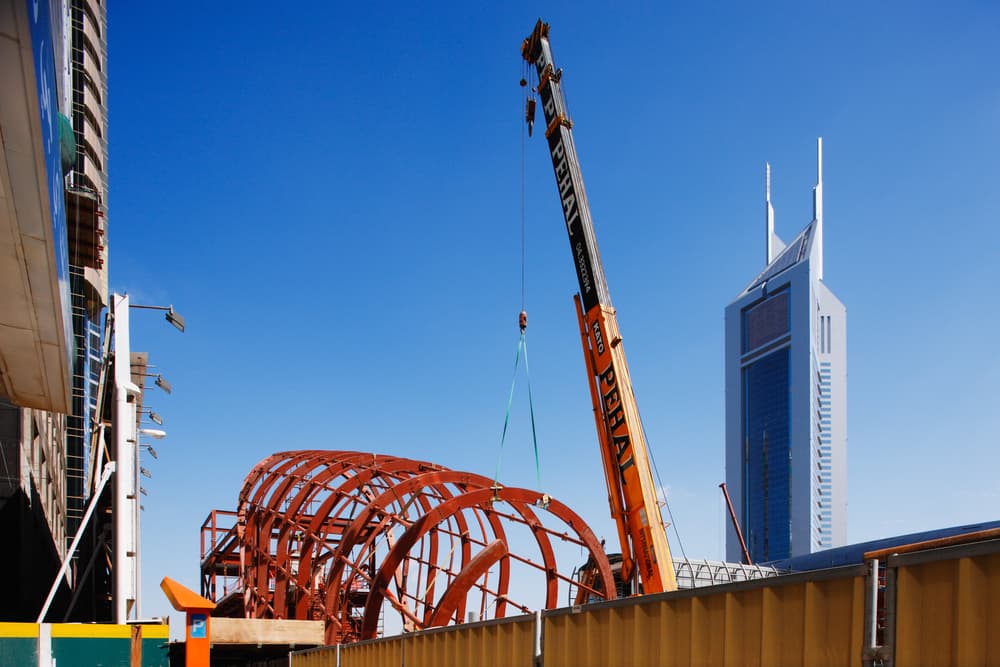
Milan (AsiaNews) - In Dubai, a new metro line is seeking to reshape the way the city functions, with the goal of greater environmental sustainability and a transportation system less reliant on road traffic. It is the Blue Line: 30 kilometers of track, 14 stations, and an investment of 20.5 billion dirhams (approximately 5 billion euros). The opening is scheduled for September 9, 2029—exactly twenty years after the inauguration of the first metro line.
The project will connect residential, university, and commercial areas that are currently distant from the main public transportation corridors: Mirdif, Al Warqa, International City, Dubai Silicon Oasis, Academic City, Dubai Creek Harbor, and Dubai Festival City. Fifteen and a half kilometers of the line will run underground, with the remainder running at ground level or on viaducts. Three transfer stations will provide connections to the Red and Green lines. The Roads and Transport Authority (RTA) projects 200,000 passengers per day by 2030, rising to 320,000 by 2040.
The D33 Economic Agenda
The new Blue Line is not a standalone project. It is part of the Dubai Urban Master Plan 2040 and the D33 economic agenda, the ten-year plan announced in January 2023 by Sheikh Mohammed bin Rashid Al Maktoum, which aims to double Dubai’s economic weight and position the emirate among the top three cities in the world to live, invest, and work in by 2033. Mobility becomes a planning tool: not just to move people more quickly, but to guide development, make new areas accessible, and bring homes, universities, offices, and services closer together. The idea is to be able to travel from one end of the metropolis to the other in twenty minutes, reducing dependence on private cars.
The technological aspect goes hand in hand with the urban planning aspect. The new trains will feature smart systems to monitor crowding and safety, adaptive lighting, wireless charging, and various travel classes—from Gold to Silver—as well as a space reserved for women and children. The project also includes artificial intelligence and robotics tools for track inspection and maintenance, with the goal of anticipating breakdowns and reducing risks for operators. A research and development center has also been announced, to be built in partnership with Casco Signal, a Chinese company specializing in technological signaling, communication, and control systems for rail and metro networks. The line is also intended to serve as a laboratory: an infrastructure where data, expertise, and management capabilities are accumulated.
The project, set to begin in 2025, has been awarded to a consortium comprising the Turkish firms Mapa and Limak and the Chinese firm CRRC, which will be responsible for civil works and railway systems, respectively. This collaboration reflects the economic landscape of the UAE: a country that brings together capital, technology, and companies from different parts of the world. The Turkish and Chinese presence also reflects broader economic and strategic relationships in a region where infrastructure, investments, and alliances are part of the competition for influence—and where the influence of traditional Western partners is, in fact, waning.
The Work of Immigrants
The figure that truly conveys the human scale of the project, however, is the number of workers: 14,000 people—including laborers, technicians, engineers, and supervisors—are involved in the project. This number encompasses a variety of professions, but on the large construction sites in the Emirates, the immigrant workforce is structurally dominant, coming primarily from South Asia and other countries. These are men who contribute physically to the city’s construction, often living far from the neighborhoods and services they are building.
The immigrant workforce comes mainly from India, Pakistan, Bangladesh, Nepal, Sri Lanka, and the Philippines, but also from various African countries. For many of these workers, their relationship with the host country is governed by the kafala system, a sponsorship mechanism that ties residence and work permits to a single employer. Although reforms have been introduced in the Emirates to ease these restrictions, this dependency can still result in significant vulnerability: from the difficulty of changing jobs to the risk of unpaid wages, from the withholding of documents to precarious living and working conditions. This reality remains hidden behind the facade of the Emirates’ modernity and efficiency.
Dubai’s new metro can change the lives of daily commuters, reduce travel times and congestion, and make neighborhoods that currently depend on cars less peripheral. It can also help boost property values and attract new businesses, though there is a risk that improved accessibility will lead to rising prices and that the benefits will be distributed unevenly. But sustainability, for a city that continues to grow, is not measured solely in kilometers of track or the efficiency of its systems: it also concerns quality of life, affordability, and the right not to be displaced from neighborhoods that become more desirable.
Dubai has chosen to invest in mobility as a lever for global competitiveness. Yet the crucial question remains—the one that accompanies every major urban project: Can infrastructure truly be a laboratory for the future if the future it promises is accessible only to a portion of those who build and live there?