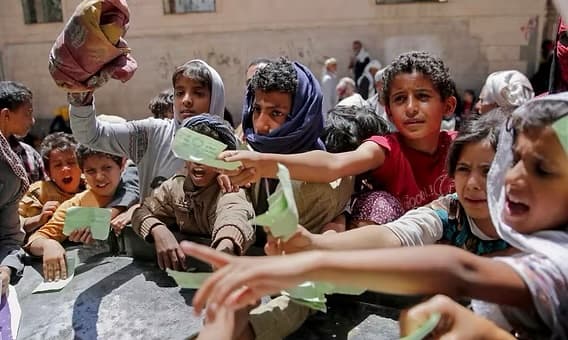
Milan (AsiaNews) – Since the start of September, 82,164 people have been displaced in Yemen’s western coastal areas due to the escalating conflict, this in addition to the more than 2,000 people who have reached the African nation of Djibouti in recent days, the International Organisation for Migration (IOM) reported.
The UN-related organisation has raised the alarm regarding the worsening humanitarian situation in the country, scene of a war between pro-Iranian Houthi rebels and the Saudi-backed, internationally recognised government.
Fresh clashes are currently being reported in the provinces of Taiz, al-Hudaydah, and Lahij, while Houthi forces have seized control of large sections of the Bab el-Mandeb Strait, effectively blocking the only alternative route to the Strait of Hormuz for oil and natural gas shipments.
Refugee crisis
Sources with contacts in northern Yemen spoke to AsiaNews on condition of anonymity for security reasons, reporting that “direct information is scarce and fragmentary” and that it is hard to get a precise picture of the situation on the ground, especially in the southern sector.
“Our local contacts are few in number and struggle to send out information,” the source said.
In the north of the country, where the Houthi-controlled capital, Sana’a, is located, a Catholic presence remains, thanks to the work of Mother Teresa’s Sisters and the chaplain serving the Missionaries of Charity.
“Their work of providing care and shelter,” our source reports, “continues as usual. The conflict, at least for the moment, does not seem to have altered the situation in the North.”
On a humanitarian level, Catholic NGOs still present in the south, an area controlled by Saudi-backed groups, include Caritas Poland and Catholic Relief Services (CRS), with the latter operating through local partners and groups.
“News from the area,” the source points out, “is even scarcer, and we have received no updates in recent days; however, I can say that the situation has been gradually deteriorating.”
This escalation has been underway “for weeks, if not months. The local population is facing progressive rationing of electricity and other basic necessities, while critical security issues remain a pressing concern.”
In recent days, the IOM highlighted that Taiz is the province hardest hit by the latest wave of displacement, with approximately 50,000 people fleeing the districts of Jabal Habashi, Al-Maafer, Maqbanah, Mawza, and Al-Waziiyah, while others are being displaced in Lahj and Al-Hudaydah.
The UN agency warns that their numbers are “rising rapidly”.
On the ground, the Houthis reportedly control the districts of Hays and Al-Khawkhah in Al-Hudaydah, as well as Al-Wazi'iyah, Mawza, Mocha, Dhubab, and the remaining parts of Maqbanah in Taiz.
Government forces have announced advances in the northern province of Al-Jawf, near the Saudi border, and stated that they have moved closer to Al-Hazm.
Overall, the Houthis control most of northern and western Yemen, including the capital, Sana’a, while government forces and allied groups control Aden, the interim capital, as well as Al-Mahra, Hadramout, Shabwa, and Abyan, along with the majority of Lahj, Taiz, and Al-Dhalea.
Terrible threat
The international NGO Oxfam is reporting that the resurgence of fighting in Yemen poses a "dire threat" to a population already struggling after more than a decade of civil war.
“The humanitarian impact is already severe,” Yemen country director Ferran Puig notes. “Two thirds of the population in Yemen needs humanitarian assistance, and thousands are facing famine. Further military escalations will deepen hunger and displacement and disrupt the humanitarian assistance millions depend on to survive."
More than 950 violations against civilians along the West Coast front lines have been documented recently following the Houthi entry into the towns, including more than 150 cases of killings or summary executions, the Yemeni Network for Rights and Freedoms reported.
Residents fled en masse to Aden and Lahj Governorate after the Houthis captured the towns of Mocha and Khokha, as well as al-Wazi'iyah.
The IOM reports a rapid rise in the number of internally displaced persons, which has reached 46,000 since fighting intensified last week, a figure that is “rising rapidly by the hour.”
"Families are being forced to flee for the second or third time in this conflict, with almost nothing left," said Amy Pope, director general of the IOM. “As fighting spreads, reaching people with lifesaving assistance is becoming harder.”
Previous UN estimates from 2021 indicated that more than 150,000 people have died in the war, while another 220,000 perished due to the war's indirect consequences, including hunger and disease. Approximately 22 million people in Yemen rely on humanitarian aid.
The recent Houthi advance along the western coast will enable the rebels to intensify attacks and block humanitarian aid shipments, amid rising tensions with Saudi Arabia.
Ongoing escalation
Yesterday, Yemen’s internationally recognised government decided to ban the entry and circulation of all Iranian goods and products, while the Houthi advance along the Red Sea coast is reshaping the balance of power in the Gulf.
US President Donald Trump’s refusal to heed Saudi calls for strikes against the Houthis, combined with rising costs, is reinforcing the view in some Gulf capitals that negotiations with Iran are not merely a choice, but a necessity for self-preservation.
Meanwhile, a meeting scheduled for today between Gulf Arab foreign ministers and their Iranian counterpart, Abbas Araqchi, to discuss the Strait of Hormuz, has been postponed due to disagreements over the terms of the talks.
Regarding crude oil, Saudi Arabia shut down its East-West pipeline following an attack last week, blocking a key outlet for Middle Eastern oil that had helped keep energy prices in check during the period of hostilities between the US-Israel and Iran.
“The pipeline was shut down as a precautionary measure," officials said in Riyadh, without specifying when it might reopen.
Meanwhile, Saudi Civil Defence issued alerts and emergency warnings yesterday regarding a “potential danger” in the southwestern city of Abha and the Khamis Mushait governorate.
This came in response to a morning attack by the Houthis, who launched ballistic missiles and drones at a military base in the kingdom.
According to sources cited by Al Jazeera, the distances involved in the raids, approximately 1,100 km from Madinah and 800 km from Riyadh, suggest the likely use of long-range, advanced drones, not tactical ones.