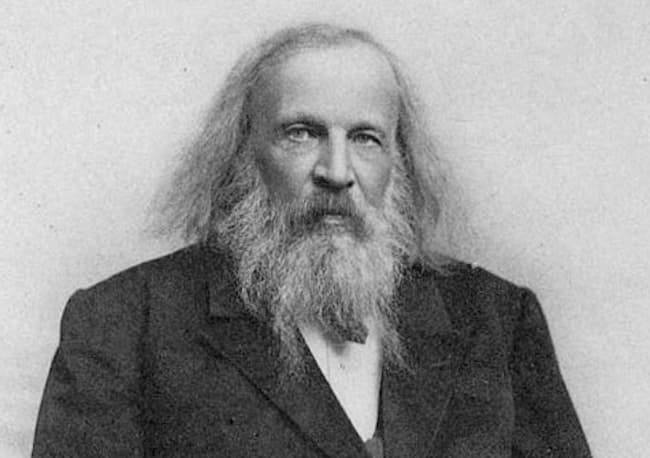
Moscow (AsiaNews) – Orthodox Metropolitan Tikhon (Ševkunov) of Simferopol and Crimea has proposed the creation of an educational centre named after the great Russian chemist Dmitri Mendeleev – the inventor of the periodic table of elements – to mark the opening of the contemporary Christian art exhibition “Christian Tradition. Our Time’ at the Manege Hall in Moscow. Russian President Vladimir Putin visited the exhibition, accompanied by Tikhon in his capacity as chairman of the Patriarchal Council for Culture, and his long-standing ‘spiritual father’.
Tikhon stated that “together with the Ministry of Education, we have drawn up a plan to establish an educational centre in honour of a deeply Orthodox man, our compatriot Dmitri Mendeleev”, explaining that the chemist had been a teacher in Simferopol and adding that he had been deeply committed to public education in Crimea. Metropolitan Tikhon – known to his friends as Georgy Shevkunov – is actively involved in Russia’s public and political life and has addressed the annexation of Crimea more frequently than many professional politicians and activists; for example, on 23 October he organised a conference at SberUniversity alongside German Gref, chairman of Russia’s Sberbank.
Shevkunov spoke at the session, criticising artificial intelligence, stating that “some of those who create artificial intelligence and use it correctly do indeed grow both intellectually and in terms of experience, but there are those who have no concept of mental hygiene; that is where the great danger lies… Soon we will have – and I can already see it – intellectual imbeciles: people who have perfectly mastered artificial intelligence, use it in every possible way and, in doing so, rapidly degenerate”.
Metropolitan Tikhon described Dmitri Mendeleev as “a deeply Orthodox man”, and cites this as one of the arguments in favour of establishing an educational centre named after him. However, historians and Mendeleev himself held differing views on the matter: according to the recollections of relatives and biographers, Mendeleev believed in a Supreme Intelligence and a Creator (“without the Spirit, matter is dead”), but he was not an openly devout man. In the final years of his life, an image of Christ was displayed in his office amongst portraits of great scientists, and Mendeleev knew the rector of the church at St Petersburg University, maintained a cordial relationship with him and occasionally participated in the sacraments of the Church (confession and communion), but he was critical of ritualism and superstition.
Over the past ten years, many Russian media outlets have portrayed Mendeleev as almost a pillar of the faith, highlighting his religiosity and his alleged support for Orthodoxy. According to an activist from Sevastopol belonging to the international #FreeCrimea movement, who shared his views with Krym.Realii on condition of anonymity, Tikhon’s initiative will become a sort of “Mendeleev propaganda centre”. He believes that Mendeleev’s name was chosen because he is known to virtually everyone, from secondary school pupils to pensioners: “In this case, Mendeleev is like a recognisable brand, under whose auspices the objectives of Russian war propaganda and, at the same time, Orthodoxy can be promoted.”
The Crimean peninsula is effectively becoming “a showcase for the ideology of Putinism”, says the Orthodox theologian and publicist Kirill Govorun. According to the Ukrainians, Ševkunov is one of the main ideologues of the Kremlin regime and is regarded as Vladimir Putin’s principal spiritual mentor; he was one of the first to support the Russian invasion of Ukraine and called for assistance for the aggressor state’s armed forces. And on 8 November, the humanitarian centre of the Metropolis of Crimea sent 100 camouflage nets to the Russian army at the front, as reported by the television channel Crimea 24.