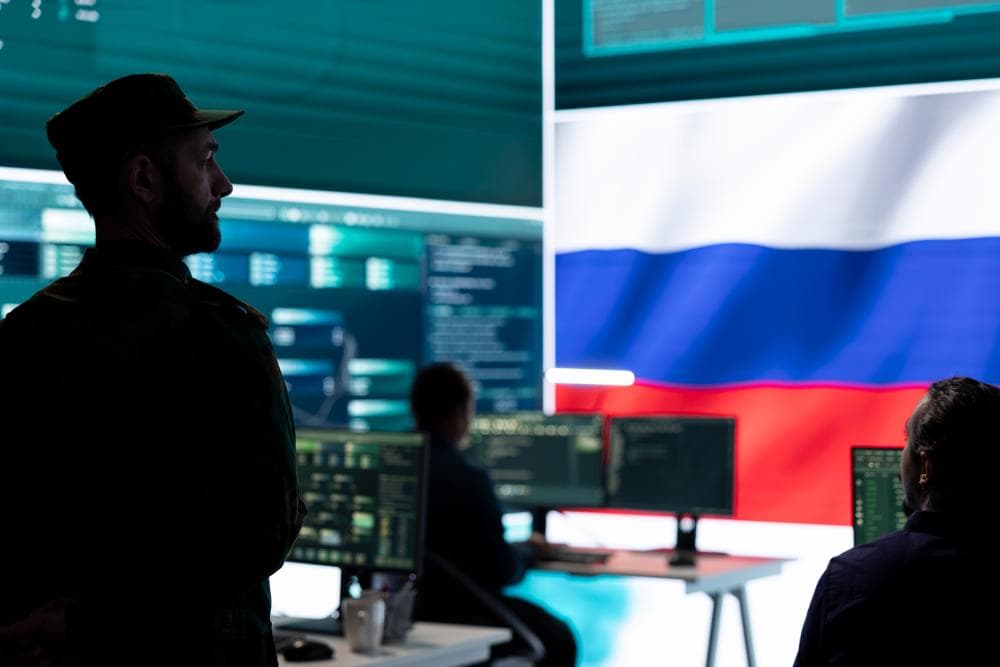
Moscow (AsiaNews) – Experts discuss the various approaches to warfare, which differ in terms of means and objectives. There is ‘kinetic warfare’: the Russian invasion of Ukraine, the battle for the Donbas, drones, bombs and missiles striking cities. Then there is ‘cognitive warfare’, a war over a worldview: this includes ‘troll factories’ and fake news sites, terabytes of online disinformation and the training of artificial intelligence. Whilst Russia is bogged down in kinetic warfare with Ukraine, it is, in contrast, achieving considerable success in cognitive warfare. Radio Svoboda commentator Sergei Medvedev discussed these issues with journalists Peter Pomerantsev, Ilya Klishin and Maria Valečkova.
The question arises as to whether parallels can be drawn between Goebbels’ propaganda and the Kremlin’s modern propaganda, and Pomerantsev observes that “propaganda compensates for personal shortcomings and provides a language for action”. The Russian system has always been built largely on the passivity of society: Vladimir Putin has struggled to find motivated personnel, and people had to be bussed in to attend protests. Nazi Germany was founded on the idea of a mobilised society, and in this sense these systems are very different, but they are very similar in another respect, according to the journalist: at the end of the Second World War, sociologists sought to understand the power of Nazi propaganda, and wrote of ‘collective narcissism’.
This refers to the idea that one’s own people have always been under-respected and humiliated by others, and that one now has the right to humiliate others in turn; through such propaganda, people feel more important and superior. Technology, ideology and the degree of public mobilisation may change, but the psychological principles remain largely the same: propaganda compensates for personal shortcomings and provides a language for action, a way of organising emotions and relationships with others. As Pomerantsev explains, “collective narcissism is not merely a form of analysis”; over the decades, sociologists have devised questionnaires to measure it, and even the Kremlin analyses society and political strategies to reinforce this resentment-based narcissism. It is no longer merely a theory; practical applications are evident.
According to Ilja Klišin, “it is important to distinguish between training a model and searching for information online: rewriting the perception of Alexei Navalny in a Western neural network is extremely difficult, because there are too many sources”. If we imagine a little-known pacifist activist with only two sources, and another twenty appear in the propaganda network, these can confuse the model whilst it is searching for information. A similar vulnerability exists in small linguistic segments of the internet: the sample size shrinks, paving the way for possible manipulation, for example by creating clones of local newspapers. Russian organisations often act inconsistently: the secret services, bodies close to the presidential administration, and the remnants of Prigozhin’s projects compete for budgets and contradict one another. This may appear to be a lively debate between different sources, but often the common goal is to sow chaos and create the impression that one will never know the whole truth.
According to Maria Valečková, “the Western world has simply not taken sides in this information war”. Russia has declared it and has been waging it for many years, sparing no expense, resources or time. This “preparatory bombardment” began a long time ago and has spread in various directions, affecting a wide range of people, far beyond Russia itself.
People living in countries with functioning democracies struggle to understand how life could be any different. There remains a climate of trust – including in the media – in which it is hard to imagine that an entire country has allowed itself to be dragged back into totalitarianism, and the Russian authorities are exploiting this vulnerability.