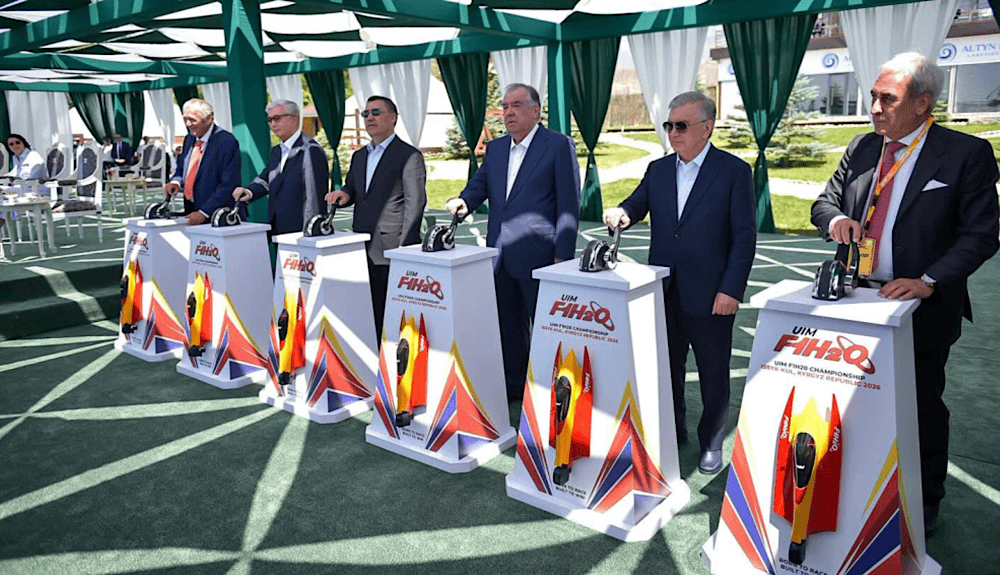
Moscow (AsiaNews) – As Russian political analyst Arkady Dubnov notes in Kaktus.Media, Russian news agencies ignored the recent informal, consultative meeting between the heads of state of Central Asia and Azerbaijan in Cholpon-Ata, in Kyrgyzstan’s Issyk-Kul region, with the exception of a brief report in Nezavisimaya Gazeta.
No one from Moscow was seen in Issyk-Kul; in fact, Russia was not even mentioned in the presidents’ speeches.
Two of these countries, Kazakhstan and Kyrgyzstan, are members of the Eurasian Economic Union (EAEU), and along with Tajikistan, they are also members of the Collective Security Treaty Organisation (CSTO).
According to Dubnov, one might naturally assume that the goals that once drove these countries to join Russia-sponsored political, economic, and military structures are no longer relevant.
This is partly true, but even the most obvious contradictions complicating relations with Russia among its partners have not forced them to pull out from former Soviet structures dominated by Moscow.
In his Facebook page, the analyst mentions a recent statement by Kazakh President Kassym-Jomart Tokayev who, during a meeting with Vladimir Putin in Omsk, said, “we do not understand the nature and origins of the military conflict between Russia and Ukraine," which, nevertheless, does not raise any organisational questions.
For Dubnov, the participants (the five Central Asian countries and Azerbaijan) at the C-6 summit in Issyk-Kul did not mention Russia or its war with Ukraine. In his view, this shows their willingness to protect their economic interests from the impact of Western sanctions on Russia.
For them, the goal is simple: ensure the functioning of the Middle Corridor, which connects the diverse logistical infrastructure of Greater Eurasia with Europe, bypassing Russia.
Azerbaijan's accession to the Central Asian Group of Five provides a crucial counterpoint to the Central Corridor in the South Caucasus.
This “brings our interaction to a qualitatively new macro-regional level,” said Uzbek President Shavkat Mirziyoyev, which “establish[es] a common space for development that brings together Central Asia, the South Caucasus, and our close neighbor, Afghanistan.”
Tokayev echoed this sentiment, noting that Central Asia is experiencing the most successful phase in its history, forming a “unified geopolitical and geo-economic whole.”
At Issyk-Kul, the gradual emergence of a “regional identity” was also discussed, while carefully avoiding the Turanian nature of this identity, so as not to alienate Persian-speaking Tajikistan.
For Dubnov, a longtime observer of the post-Soviet space, the C-6 meeting appears interesting in several respects.
“First, we are witnessing a certain dynastic legitimisation of power, which has consolidated in the region."
In Azerbaijan, Presidents Ilham Aliyev inherited his position from his father, Heydar Aliyev who died in 2003. In Turkmenistan, Serdar Berdimuhamedow became president in 2022 after his father, Gurbanguly Berdimuhamedow, decided to step down.
Both bear the title of "national leader" of their peoples, a similar title held by the region's longest-serving leader, President Emomali Rahmon of Tajikistan, in power since 1992.
The latter is also expected to hand over power in the near future to his son Rustam Emomali, who has served for many years as mayor of Dushanbe and speaker of the upper house of the Tajik parliament.
A similar prospect looms in Uzbekistan, where the president's daughter, Saida Mirziyoyeva, recently became head of her father's administration.
Nothing threatens the stability of the ruling dynasty in Azerbaijan, where First Lady Mehriban Aliyeva holds the office of first vice president.
No real opposition threatens the ruling regimes in these countries, which appear more stable than Russia, threatened by the wartime economic crisis and uncertainty over the succession to Tsar Putin.