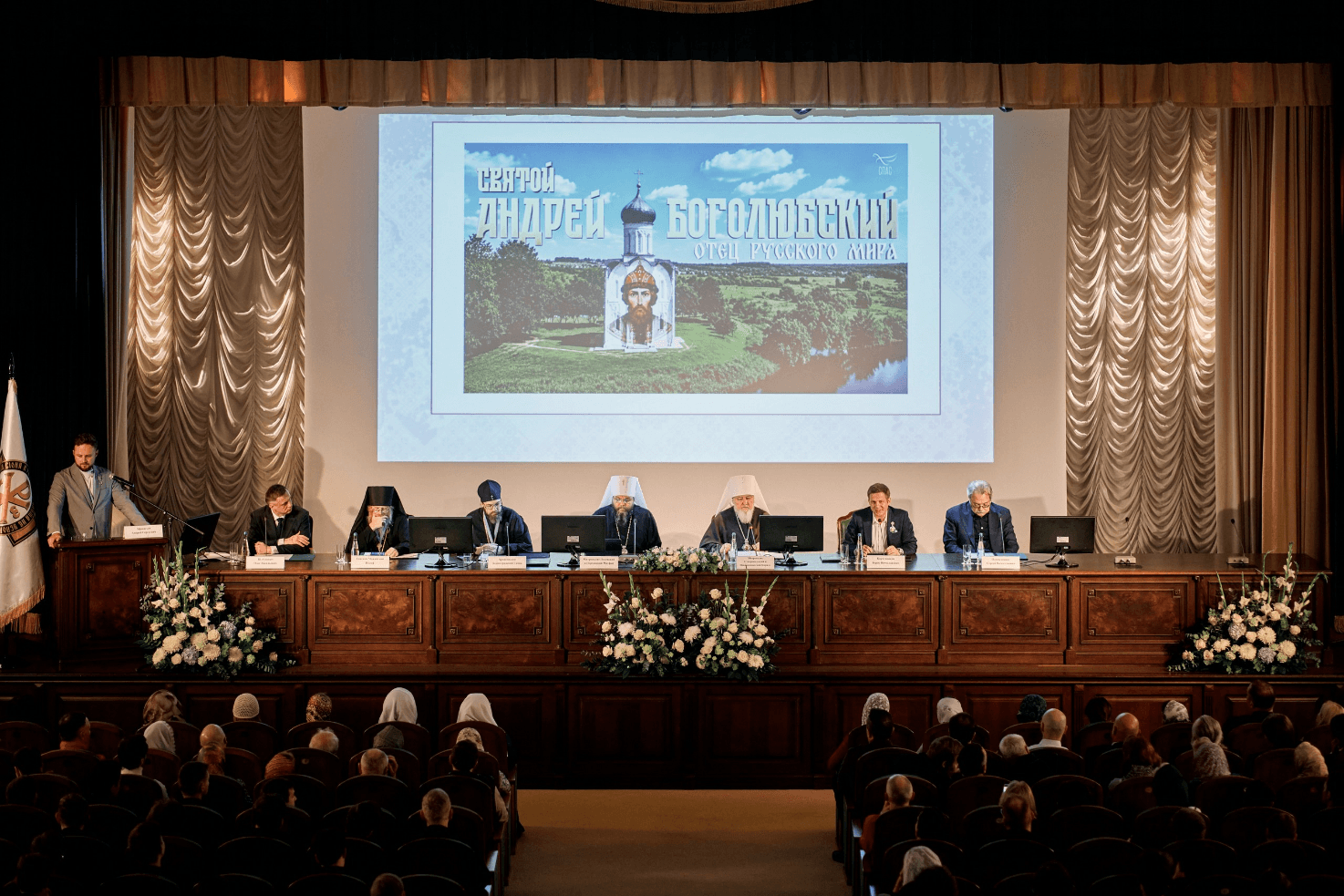
Moscow (AsiaNews) - The second open dialogue in the series ‘The Spiritual Significance of Russian Autocracy: from Prince Andrei Bogolyubsky to Emperor Nicholas II’ was held in the great hall of the Moscow Theological Academy, within the Holy Trinity Monastery of St Sergius. The choice of venue was no coincidence: the Monastery of St Sergius is the spiritual centre of Russia, where the Russian tsars would go to receive blessings for their reign, and during the 17th-century Time of Troubles, the monastery withstood a sixteen-month siege, becoming a pillar for the unification of the country.
The organisers were the Imperial Orthodox Palestine Society (Ippo), the Christian Charitable Foundation of Mercy, the Monastery of St Sergius, the Stavropegic Vvedensky Monastery of the Entry of the Mother of God at Optina Pustyn, the Stavropegic Convent of Sts Martha and Mary in Moscow, and the Spas television channel. The first open dialogue in the series took place last summer at Optina Pustyn and focused on the princely period; the second on the tsarist period, from the era of Ivan the Terrible to Peter the Great. The series of meetings is taking place in the run-up to the 145th anniversary of the Imperial Orthodox Palestine Society, which will be celebrated in June 2027.
Oleg Šabunevič, vice-president of the Ippo and chairman of the Co-ordinating Council of the Foundation for Christian Charity and Mercy, read out a message of greeting from Sergei Stepashin, president of the Ippo, followed by a presentation by Boris Korčevnikov, the young director of the Orthodox television channel Spas (“The Saviour”), which focused on the role of Saint Prince Andrei Bogolyubsky in the formation of the Russian state in the second half of the 12th century, and in the transition from the princely period to the kingdom and from Kyiv to Moscow. Archbishop Savva posed a question to the participants which became the focal point of the entire subsequent discussion: “Where does the Tsarist era begin and where does it end?”. In outlining its historical boundaries, the bishop pointed out when Rus’ recognised itself as a kingdom, and how the tsarist system eventually gave way to the imperial one. Metropolitan Matfej of Pskov devoted his address to the idea of ‘Moscow as the Third Rome’ and to the teachings of Hegumen Filofej in the early 16th century on the divinely ordained nature of Russian government. Following the fall of Constantinople, Rus’ took upon itself the mission of guardian of the Orthodox faith, and the government of the princes and tsars recognised its vocation to serve God and the people.
Metropolitan Kirill of Stavropol, chairman of the Synodal Department for Cooperation with the Armed Forces and Law Enforcement Agencies and head of the Committee for Cooperation with the Cossacks, traced the development of this idea throughout history, focusing on the coronation of Ivan IV in 1547 according to the rite drawn up by Metropolitan Makarij, on the recognition of his royal dignity by the Patriarch of Constantinople, and on the establishment of the Patriarchate under Tsar Feodor and the regent Boris Godunov. Each of these events “affirmed Russia as an Orthodox power and protector of the Orthodox East”. Sergei Perevezentsev, a professor in the Department of History at Lomonosov Moscow State University, presented important conclusions on the nature of Russian autocracy, noting that Russian society in the 16th and 17th centuries was rife with contradictions, and that only the Orthodox faith united all social classes: “Russian autocracy, as a political system, was the most appropriate and the only one possible given the circumstances in which Russia found itself at that time,” the historian emphasised.
The main conclusion of the meeting was that the Church and the State in the Russian Empire of the tsars were inseparable and acted in unison. The Tsar is “God’s anointed one”, called upon to preserve the Orthodox faith and to serve his people. Having inherited the Orthodox heritage from Byzantium, Moscow recognised itself as the Third Rome, and power “as a service, not a right”. Wherever this unity weakened, the country found itself on the brink of collapse, and was restored when the people and the Church reunited once more around the faith. The organisers regard this unity as the central theme of the entire series of meetings, which will lead right up to the present day.