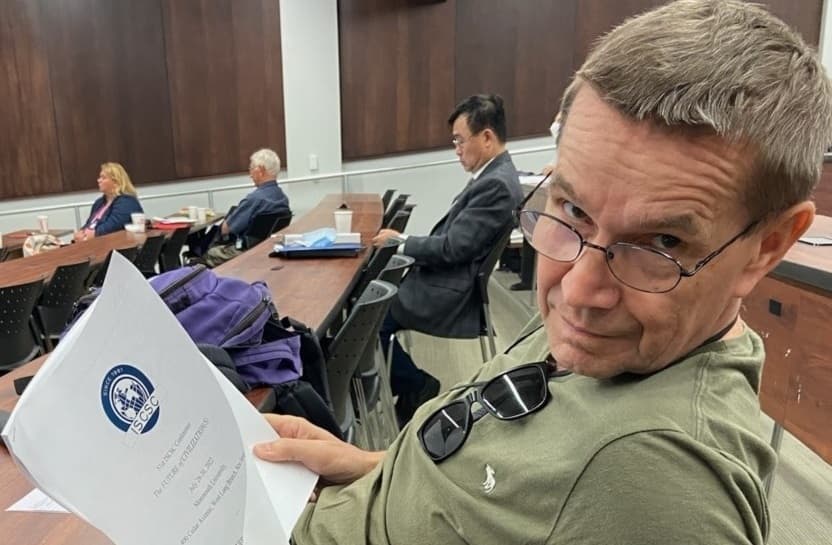
Moscow (AsiaNews) – The Supreme Court of the Komi Republic, in northern Russia, has sentenced the philosopher Nikolai Zjuzev to seven years’ imprisonment in a maximum-security labour camp for high treason. Zjuzev, a Russian and Canadian citizen, is a renowned scholar of the legacy of the Russian-American sociologist Pitirim Sorokin; after the war began, he left Russia, but in the summer of 2025 he returned to his home village in Komi, where he was arrested.
According to the FSB, the philosopher was training leaders of national liberation movements for Russia’s indigenous peoples and was receiving funding for his project from foreign organisations. In the summer of 2025, the professor travelled from Europe to his home village of Podelsk, in Komi, to visit relatives, and then disappeared. For about a month, there was no news of him; his relatives refused to speak to anyone, and his acquaintances knew nothing of his fate.
Some said he had probably returned to his village to go fishing, but a friend found information on the Komi court’s website regarding an extension of his pre-trial detention; it appears he had been arrested around mid-summer. In September 2025, information appeared on the Komi Supreme Court’s website regarding the opening of criminal proceedings against the scholar under the article of the Russian Criminal Code on ‘Confidential cooperation with a foreign state, an international organisation or a foreign organisation’.
Zjuzev spent more than a year in the pre-trial detention centre, suffering from depression caused by loneliness and uncertainty. On 10 June 2026, he celebrated his 70th birthday in his pre-trial detention cell. His friends still do not understand why the scientist decided to return to Russia; a former colleague, the journalist Nikolai Vokuev, suggests that “perhaps he thought no one was particularly interested in him, and that he could spend the summer in his village”.
Nikolai Zjuzev holds a PhD in philosophy, and prior to the Russian invasion of Ukraine he taught at the Komi State Pedagogical Institute, Siktivkar State University and Ukhta State Technical University, where he headed the Department of Philosophy. A significant part of Zjuzev’s academic work is devoted to the heritage of the Komi people. In 2008, Zjuzev moved to Canada, where he taught at a college affiliated with the University of Toronto, and in 2015 he obtained Canadian citizenship.
Following the invasion of Ukraine, he left Russia but continued to visit his home village of Podelsk from time to time; according to those who knew him, he missed home and the opportunity to teach in his mother tongue, that of the Komi people.
On 16 September, the Komi Supreme Court convicted him on charges of ‘training leaders of movements for the liberation of the indigenous peoples of the Russian Federation, and developing a project directed against Russian sovereignty’, whilst receiving funding from foreign foundations and organisations deemed undesirable in Russia. According to the FSB, the defendant pleaded guilty: in a video, Zjuzev states that he had initially planned to set up an educational website for teaching the humanities.
The European sponsors, however, were reportedly not interested in the project itself, but in “spreading false information about what is happening in Russia, inciting ethnic hatred, criticising the policies of the Russian government and destabilising Russia as a whole through the development of nationalist movements”. According to the FSB, Zjuzev is alleged to have received a total of 2 million euros from 12 foreign organisations based in Germany, the Czech Republic, Sweden, France and the UK.
Zjuzev had publicly expressed his views on the situation of the Komi people and on the relationship between Russia’s regions and the central government. In January 2023, the Canadian political magazine Maclean’s published an article in which he explained the reasons for his departure from Russia, criticised Vladimir Putin’s policies and recalled: “I come from the Komi people, a Finno-Ugric people whose republic, with a population of nearly one million, lies a thousand kilometres north-east of Moscow.
It has its own distinctive language and culture, and a history dating back at least two thousand years. However, under Putin, we run the risk of our culture and language disappearing, like so many others in Putin’s Russia.”