At the end of a year full of contradictions during which Russia’s main celebrations were effectively muted for fear of Ukrainian drones, which can now reach as far as Siberia, the Russian holiday of "People’s Unity" on 4 November (a surrogate for the Soviet-era October Revolution holiday of 7 November) was reduced to a projection of a vision of Russia 2026 on the façade of the White House, the main seat of the Russian government in Moscow.
President Vladimir Putin has suspended his grand speeches and Q&A with the public, stuck instead in his bunker on the outskirts of Moscow, or in one of his many luxurious villas in various regions, protected by anti-aircraft systems that are more numerous and costly than any other defensive equipment.
Putin could hardly explain to the population the reasons behind the current economic crisis, a crisis driven by the massive funding of the defence sector, the now-endemic fuel shortages caused by Ukrainian strikes on energy infrastructure, and the non-stop tax hikes imposed on all sectors, especially businesses, which are being urged to "contribute to the victory" in the "special military operation" in Ukraine.
On the war front, Russia is losing about 50,000 soldiers per month, both dead and severely wounded, and for every kilometre gained, it has lost at least three to Ukrainian counter-advances. This is particularly true in the Donbas region, where fighting has been going on since 2014, with no tangible results in sight and no signs of a potential armistice.
A year ago, the president solemnly established days dedicated to the “minor states” and “languages of the peoples” of Russia, in order to express the ideal of sobornost, the great, universal union that embodies the historical mission of Orthodox Russia.
However, the Caucasian, Finno-Ugric, and Tatar-Mongol peoples have shown little enthusiasm for this day, nor have the many small Siberian tribes in the Federation, currently forced to rely on improvised means to get food and warmth as the winter freeze sets in, following the region’s traditional weather patterns, regardless of the grand climate-change narratives that paint Siberia as the world’s “new garden”.
In a move that borders on the ironic, Kazakh President Kassym-Jomart Tokayev has proposed incorporating Russia into a union of Turanic peoples, effectively subordinating the “Russian world” to the “Turkic world”.
Meanwhile, the religious scene has also grown notably dim, with the 80-year-old Patriarch Kirill (Gundyaev) showing clear signs of exhaustion, and his support for Moscow’s imperial policy becoming increasingly repetitive and inconsequential.
Recently, Metropolitan Tikhon (Shevkunov) of Crimea, the patriarch’s primary rival for the country’s ideological and religious leadership, attempted to reinvigorate the discourse on Russia’s “moral and spiritual values.” In his capacity as head of the Patriarchal Council for Culture, he organised a major exhibition that, somewhat ambiguously, was dedicated to the 80th anniversary of Patriarch Kirill’s birth.
Titled Christian Tradition: Our Days, the exhibition opened in Moscow on Thursday and will run until 8 December. It invites visitors to “feel part of Russian history” as they explore sections such as “History of Humanity”, “God and Man”, “Preserving Heritage”, and “God’s World: Beauty Saves the World”. The exhibition, hosted in the central hall of Manege Square, near the Kremlin, features 524 works of art.
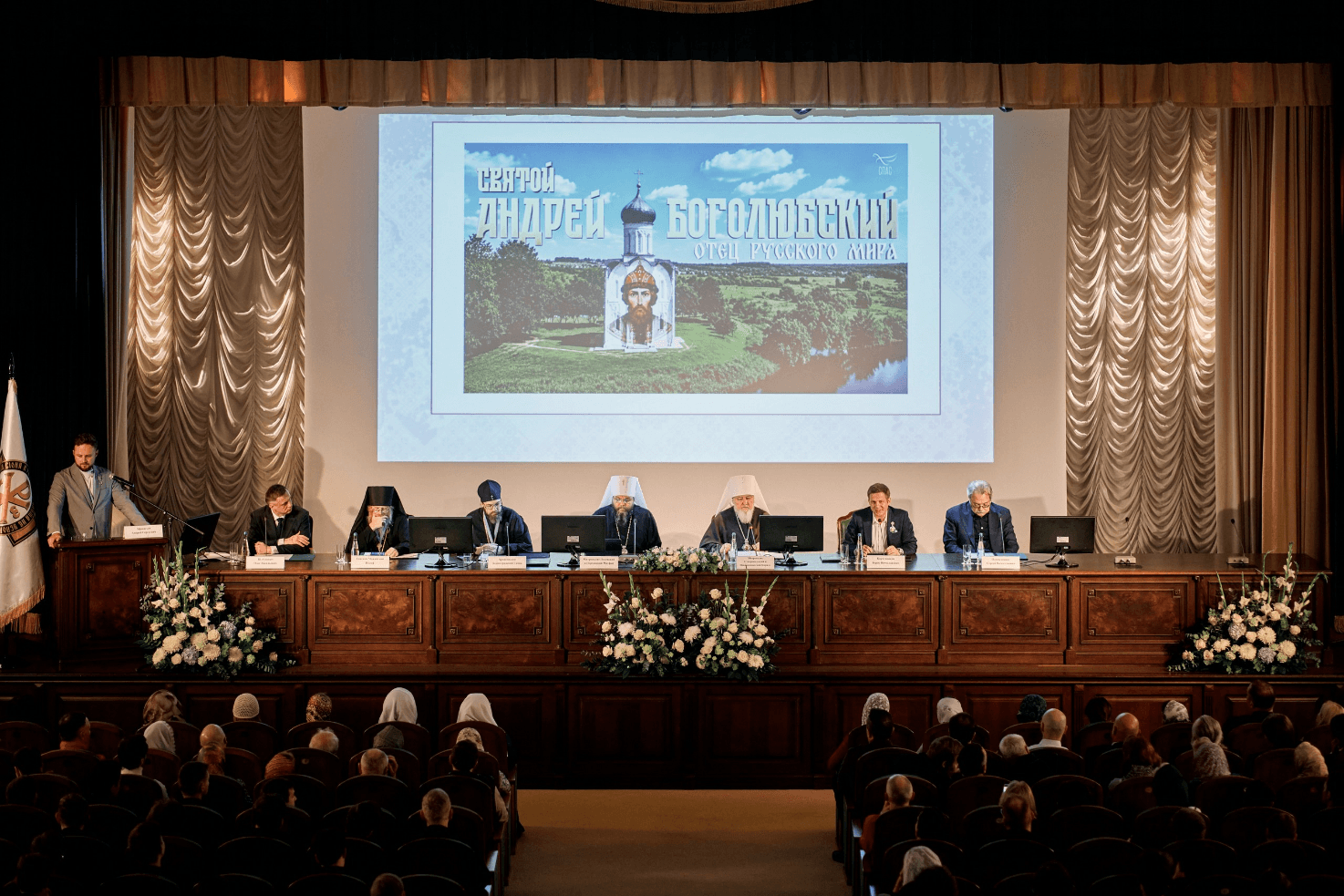
The decline of the Orthodox ideal of sobornost (spiritual unity/conciliarity) became particularly evident in late October, at a meeting of the Holy Synod of the Russian Orthodox Church in Moscow. The Synod reached two interconnected decisions, both of which, independently of one another, sparked a stir across media outlets and blogs.
The first decision established a procedure for the admission of members from various Ukrainian Orthodox churches, which operate with varying degrees of independence from Moscow (such as the Ukrainian Orthodox Church-Moscow Patriarchate, the Orthodox Church of Ukraine, and smaller groups) into the Russian Orthodox Church. This includes the possibility of re-baptising individuals who had already been baptised in those churches.
The second decision imposes further restrictions on members of the clergy appearing in the media and prohibits them from monetising their online activities. In doing so, the Moscow Patriarchate is increasingly turning inward, abandoning any prospect of reuniting or reconciling with other Orthodox Churches in Ukraine or among “smaller peoples”. Instead, it is limiting itself to welcoming only the most explicitly pro-Russian factions of the clergy and the laity, whose voices are then effectively silenced to prevent further internal contradictions or fragmentation.
A third decision, one directly linked to the previous two, was the invitation extended to the Synod by Aleksandr Shipkov, deputy head of the Synodal Department for Church-Society and Media Relations, who was elected in Mordovia on the United Russia ticket in the last parliamentary elections.
Effectively the primary ideologue of the “Orthodox Russian world”, the author of Patriarch Kirill’s speeches, and the Patriarchate’s lead specialist in lobbying government agencies, with a long background as an aide to politician Sergey Mironov during his time as Chairman of the Federation Council, this scholar, a layman, has now been elevated to a position that, in terms of asserting the “state” role of the Russian Church, ranks above that of the bishops and even the Patriarch himself.
Beyond the clear backing of the Patriarch, without which he could not have been elected in a region where Kirill holds particular authority, since it is his native region, Shipkov has also secured the support of the Chairman of the State Duma, Vyacheslav Volodin, for whom he had served as an unpaid advisor since 2017.
Another piece of news from the Moscow Patriarchate has garnered less public attention: One of its most influential officials, Archbishop Savva (Tutunov), who, among other responsibilities, oversees the nationalist militant groups Russian Community and Man of the North, has announced his intention to renounce his French citizenship.
He had held French citizenship after arriving in France as a child, the son of anti-Soviet dissident parents. Having worked in Moscow for many years, including in the Patriarchate, he had long held dual citizenship without any trouble, only to suddenly decide to relinquish it.
All these events are interconnected. We are witnessing a broader trend, which can be described as the consolidation of divisions within post-Soviet Orthodoxy into two stable camps, lined up behind the two patriarchates of Moscow and Constantinople.
Previously, the Russian Orthodox Church and the Patriarchate of Constantinople offered models of Orthodoxy that were conceptually, and to some extent, ritually, distinct; people living in the post-Soviet space, as well as Russian speakers in EU countries, could choose the one that best suited them.
On one hand, there was a “Russian” Orthodoxy, mystical, traditional, and authoritarian, oriented towards Russian culture and centred on Russia itself. On the other, there was a more modern, democratic, and understated form of Orthodoxy, independent of Russia, and, in fact, quietly opposed to it, under the oversight of the Greeks, which operated in certain post-Soviet states with the backing of their national governments.
Today, the divide between these two camps is total and irreversible; rather than a “union of peoples,” Russia increasingly champions a “division of the Churches,” embracing its own isolation.
Even in Russia’s domestic politics, the ideal of a grand union is becoming difficult to sustain. The official results of the State Duma elections on 18–20 September 2026, were intended to demonstrate that, in essence, public opinion in Russia was unchanged since September 2021, or rather, that support for government policy had actually grown over four and a half years of conflict, with the active segment of society standing united and firm behind the government.
The “formula for success” in these elections can be likened, metaphorically, to the classic ideal of feminine perfection, 60/60/90, where 60 represents the voter turnout (based on the reported results), 60 the level of support for the ruling party, and 90 (for the purists) the voter turnout as claimed by the government. Compared to the recent elections in the United States, with all the intense conflict between the opposing sides, it feels as though one were living on the Moon.
Optimistic figures regarding the state of the system sit on the desks of high-ranking officials; they serve to justify the firm conviction that state policies can be pushed forward, with the overwhelming support of a society in which there is no opposition, not a single critic of these policies to be found in the incoming Duma.
Russian authorities have, in effect, blinded themselves: a magnificent, carefully orchestrated, virtual fairy tale has been committed to paper. As some have observed, it is akin to a driver relying on a digital map that bears no resemblance to the rugged, uneven terrain they are actually driving through.
The most opaque electoral system in Russia’s recent history, the artificial selection of political candidates, and the unchecked power to ensure the government’s desired outcome across tens of thousands of polling stations simultaneously have altered not just the overall picture, but the very colours in which it is painted.
White is portrayed as black, black as white, and so on, across the entire spectrum. No matter how closely one looks, it is impossible to discern anything beyond a bizarre masquerade; in reality, Russia is increasingly dissolving and falling apart, and putting it back together will be no easy task.
RUSSIAN WORLD IS THE ASIANEWS NEWSLETTER DEDICATED TO RUSSIA. WOULD YOU LIKE TO RECEIVE IT EVERY SATURDAY? TO SUBSCRIBE, CLICK HERE.