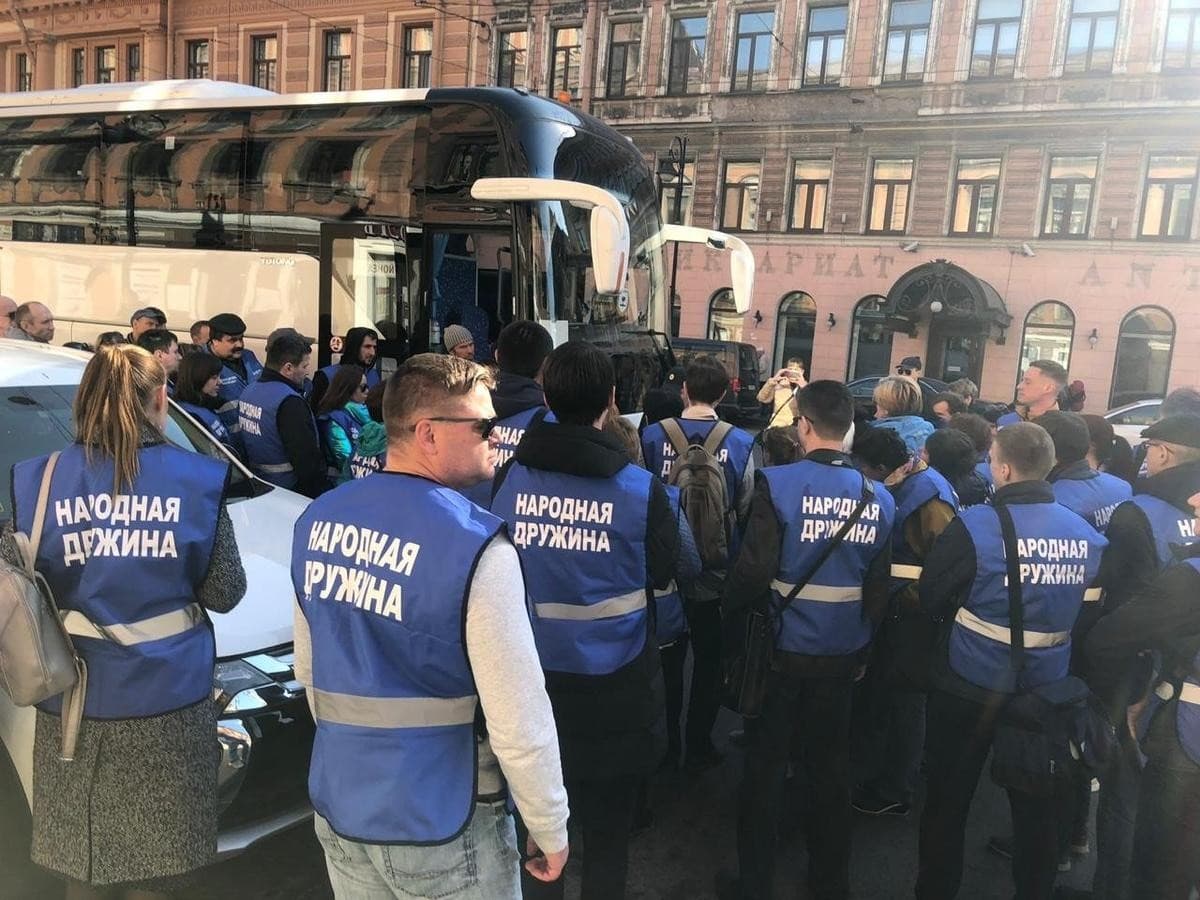
Moscow (AsiaNews) – Russia is actively working to revive the Soviet-era tradition of the People’s Guard groups, the Družina, street vigilantes used as a means of crime control and to “strengthen public morality”.
It is worth recalling that in the 1960s, the Communist youth newspaper Moskovskij Komsomolets published a letter from a group of Year 10 pupils who had been summoned to the headteacher’s office because their haircuts appeared to be too extreme.
Everything would have been fine, were it not for the fact that the young artist Ira Zaitseva, a rather eccentric character, had depicted this headmistress wearing glasses, with a challah on her head and a pair of enormous scissors resting on her shoulder, whilst embracing a poor, tearful final-year pupil. The headmistress was a member of the district party committee, the recipient of numerous medals, and upon seeing the portrait she suffered a heart attack, sparking a huge scandal.
At that time, the brilliant columnist for the daily newspaper *Soviet Culture*, Elena Bruskova, travelled to Rostov for an interview with the first secretary of the regional party committee, Sergei Bondarenko, a notorious tyrant. Elena was running late for the appointment and rushed to the regional committee, but the policeman would not let her in: trousers were forbidden.
Irena Andreeva, the leading art critic at the House of Fashion for the whole of the Soviet Union, had arrived to deliver the opening address at an important seminar wearing unprecedented sock-boots; she was thrown off the podium by the seminar’s moderator, a deputy minister. Trousers, boots and hairstyles are harmless things, but at the time they were regarded as factors predisposing people to the corrupting influence of the West.
The military principle was applied back then: if you don’t know how to do it, we’ll teach you; if you don’t want to, we’ll force you. Russia had all the tools for this: the army, the school system, the riot police, the courts, the Komsomol volunteer squads and much more.
Today, it is the State Duma – which is soon to be renewed through ‘democratic elections’ – that churns out a barrage of laws, each more draconian than the last. The ‘Foreign Agents Act’, which has also been copied by Georgia and the Central Asian countries, is a perfect example of a return to Soviet morality, but now we are even seeing a return to volunteer city militias.
In the USSR, vigilante task forces were responsible for maintaining order in student halls of residence and during public events at Moscow State University.
Initially, the work of members of the Komsomol, the Communist Youth Organisation, was governed solely by decrees and instructions from the Central Committee, but it became official with the adoption of the 1959 resolution ‘On the Participation of Workers in Maintaining Public Order in the Country’. By 1970, the Komsomol’s operational detachments had organised themselves into independent specialised units.
A set of regulations adopted in the same year cemented their specific specialisation: ‘work amongst young people and minors’. Over five million people served in these operational detachments during the years of their existence.
In St Petersburg, there are currently around 40 volunteer militias on duty, and many more are active in Moscow and numerous other cities across Russia. It is not entirely clear whether their activities extend to all city districts, but in any case every local authority budget must include funds for the work of the volunteers, who are prepared to patrol the streets and identify people dressed inappropriately or exhibiting ‘immoral behaviour’, not for personal gain, but solely for ideological reasons.
This, as NTV correspondent Daria Krivolapova points out, distinguishes modern vigilantes to some extent from their predecessors, who at least sought to climb the ranks towards the upper echelons of Soviet power.