Moscow (AsiaNews) – In an interview with Radio Svoboda, anthropologist Aleksandra Arkhipova sought to explain why Russian society passively submits to Putin’s dictatorial regime, a trend largely confirmed by last weekend’s State Duma elections.
The scholar observes that “sociologists study their own world through quantitative research, whilst anthropologists are more inclined to study not only their own culture but also others, usually employing more qualitative methods”.
Arkhipova does not believe in the existence of a uniquely Russian behavioural model, nor in any particular ‘genes of servitude’ that have been much discussed since the invasion of Ukraine in 2022.
The state can do terrible things to people; any state can do so – unfortunately, history is full of such examples – and now the state is conducting a rather cruel experiment on Russians, but apparently there is nothing so specific, no particular servile national character. One wonders how this can happen to enlightened and educated people, but in reality ‘it can happen to anyone, leaving aside pseudo-romantic and pseudo-intellectual pathos’.
It is surprising that people who read Chekhov, Dostoevsky, good books – right up to Harry Potter – are now succumbing to all this, but for the anthropologist ‘it is an intellectual illusion born in the mid-19th century, based on the idea that if the Russian people had removed Pushkin from the marketplace, everything would have turned out better’. Universal literacy – the ability to read and write – has radically changed so many things, but “studying certain literary works at school does not automatically mean being able to reflect deeply on one’s own life”.
Adaptation to violence has been taking place throughout hundreds of thousands of years of human evolution, ever since complex, hierarchical and non-egalitarian societies began to emerge. People are constantly adapting to what is happening, and a typically Russian attitude towards power lies in the fact that, in a certain section of society, children are brought up from a very young age to keep their distance from authority.
Don’t believe what they tell you at school; believe what they tell you at home. When the time comes for military service, one must avoid it as much as possible; within Russian society, some tend to use the state as a means of social advancement, whilst others strive to sever their ties with the state as much as possible and to keep their distance from it.
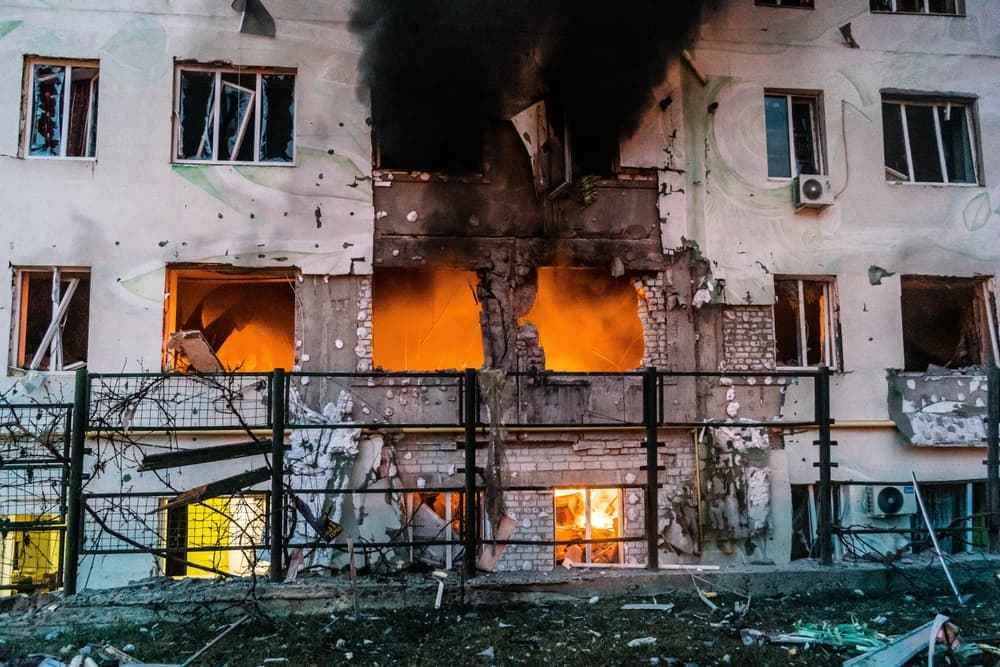
Now that war is looming, and Ukrainian drones are carrying out raids, killing people and setting warehouses alight, the propaganda continues to claim that Ukraine is weak, that ‘the Ukrainian state does not exist’ and that ‘we will defeat it very quickly’.
To cope with this cognitive dissonance, urban myths are beginning to spread claiming that Ukrainian drones cannot actually bomb Russia, and that these are in fact the work of internal enemies.
There are even accusations that the Roma are leaving drones in coffins and abandoned huts. The truth, according to Arkhipova, is that “living at odds with the state, living against the state, is incredibly difficult, and people do everything they can to prevent it.
That is why they constantly justify the authorities’ actions, so that their world can remain sufficiently comfortable. Unfortunately, this is normal human behaviour’. Just as in Stalin’s time the homo sovieticus emerged, living in terror, so today there is a new anthropological model: the homo putinianus, who lives in indifference and isolation from the whole world.