

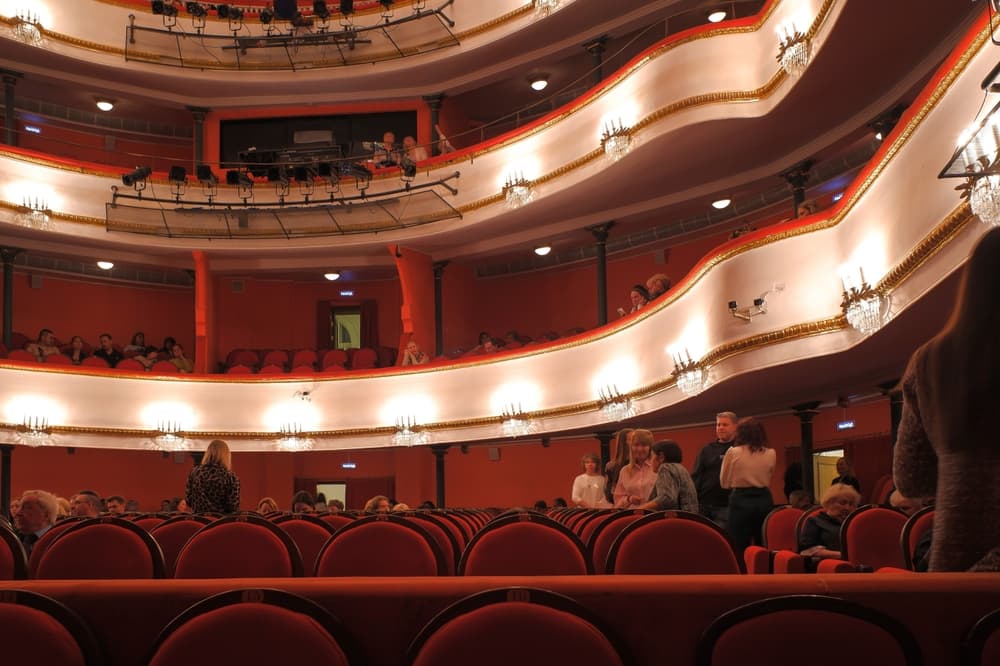
Moscow (AsiaNews) - For almost twenty years, the directors Kirill Serebrennikov and Konstantin Bogomolov were regarded as the leading figures of the new Russian theatre, equally beloved by opponents and officials of the presidential administration. The BBC set out to explore how the lives and works of these two directors have changed, and why their paths diverged after a long period of closeness and collaboration.
At the end of March 2026, the Deutsche Oper Berlin presented the most eagerly awaited premiere of the season: the ballet Nureyev. Tickets for this production – banned in Russia, which tells the story of a dancer who fled the USSR – were completely sold out.
The ballet had caused a major scandal in Russia under a regime hostile to sexual freedom when it premiered at the Bolshoi Theatre in Moscow in 2017, and was permanently removed from the repertoire a few years later, in 2023, on charges of ‘promoting non-traditional relationships’.
The fact is that to tell the story of Rudolf Nureyev, one of the greatest dancers of the second half of the 20th century, who died of AIDS-related complications in 1993 in a hospital on the outskirts of Paris, one cannot ignore his bisexuality.
German television broadcast the premiere live. When Serebrennikov, the show’s creator, took to the stage, the audience greeted him with a deafening ovation. Whilst Nureyev was being performed in Berlin, director Konstantin Bogomolov was preparing his previous production, “The New Optimist”, for a new run at the Moscow Theatre on Bronnaya Street.
In Bogomolov’s plot, a graduate of the FSB academy is sent to run an unnamed theatre where a liberal director has died. All the dancers in the company are men dressed as women. Some critics saw the production as an allusion to Serebrennikov’s Gogol Centre, the theatre that had been closed a few months before the premiere of “The New Optimist”, which took place in October 2022 at the Chekhov Art Theatre in Moscow – the very same theatre where Bogomolov and Serebrennikov had worked side by side for years.
The two directors were the most acclaimed figures in Russian theatre, celebrated far beyond the country’s borders, but since then their paths have diverged. Serebrennikov left Russia after the war began and now works in Europe, whilst Bogomolov has remained, urging the intelligentsia to “set aside their contempt for their own people” and to “work, live and believe”.
In the 2010s, when the theatre critic and Meduza journalist Anton Khitrov was studying at Gitis, the Russian Institute of Theatre Arts, his lecturer Natalia Pivovarova introduced a new term into the theatrical lexicon: “the fashionable director”.
Pivovarova believed that Serebrennikov, originally from Rostov-on-Don, fitted this definition perfectly: at the time, he was working in both theatre and television. Later, Bogomolov, a Muscovite and son of the renowned film scholar Yuri Bogomolov, who was trained as a philologist, became an equally fashionable director.
The theatre at that time “lay in ruins”, recalls a BBC source from the theatre world. The Soviet tradition, according to which everyone should “go to the theatre at least once and then die”, was by then a thing of the past, and although people were already “listening to the right music and reading the right translated books”, they proudly declared that they had never been to the theatre.
Against this backdrop, Russian theatre unexpectedly began to flourish, says Khitrov, largely thanks to Serebrennikov and Bogomolov, who were able to “tune in to their times, the context and the new generations coming of age”. Now theatre in Russia is dying once more, and it is only abroad that its memory can be preserved.







.jpg&w=3840&q=75)







