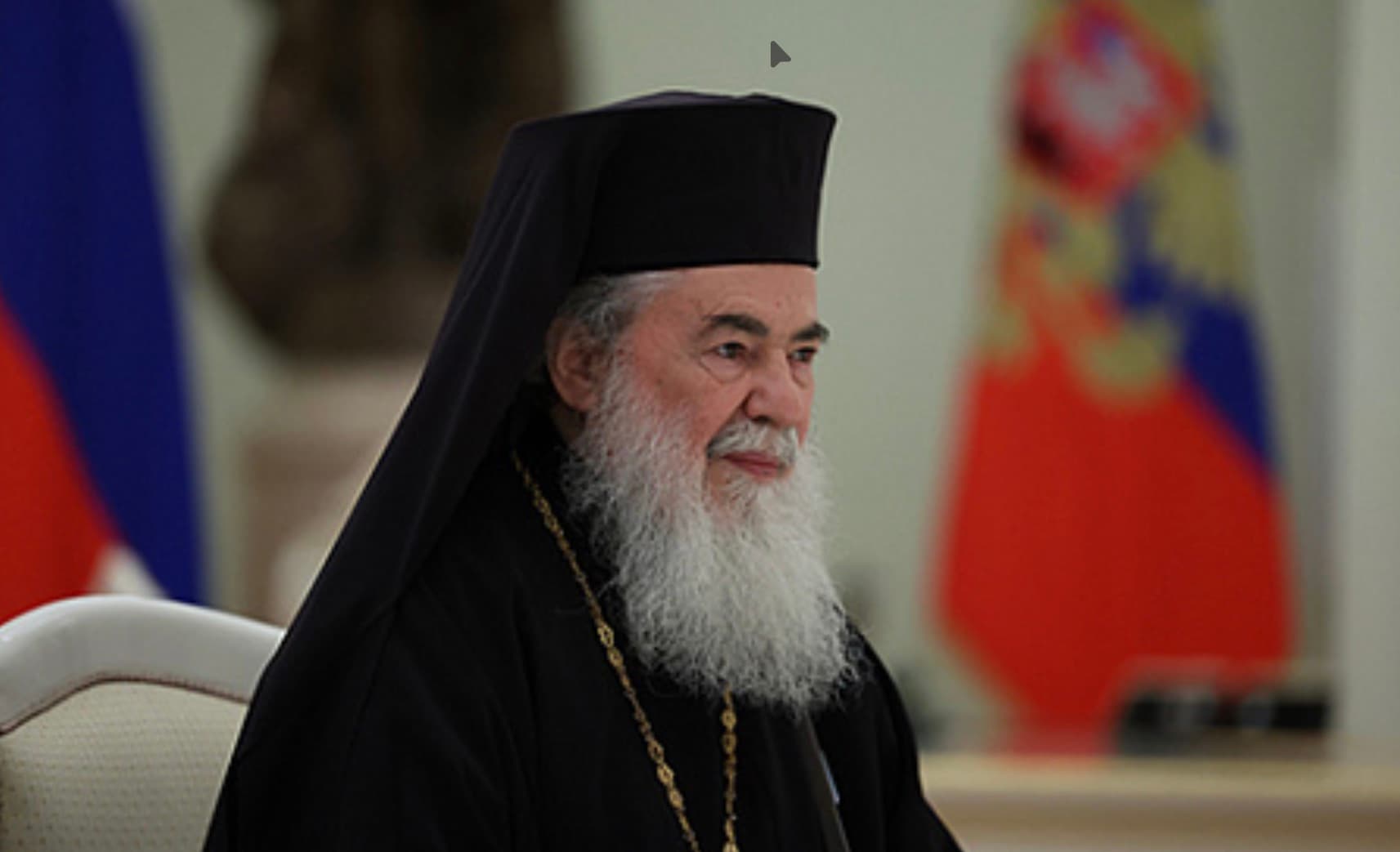
Moscow (AsiaNews) – Patriarch Theophilos III of Jerusalem visited Moscow during the celebrations for the Day of the Unity of the Peoples of Russia. His arrival had been eagerly awaited; as early as June, US President Donald Trump had asked the head of the Orthodox Church in the Holy Land to act as a mediator between Russia and Ukraine.
It was expected that the Patriarch of Jerusalem would begin his peace efforts in the summer, but time passed and nothing happened. On the last day of August, the American website Breitbart published an interview with Theophilos III, in which he stated that he was working on organising meetings with Putin and Zelenskyy in the near future.
Theophilos III arrived in the Russian capital on the evening of 4 November without fanfare; his visit had not been announced, and the following morning the guest visited the stauropegic monastery of Pokrovsky in the capital, attending a religious service at the relics of Saint Matrona of Moscow, before meeting Patriarch Kirill. According to the official website of the Russian Orthodox Church, the two patriarchs “discussed current issues in inter-Orthodox relations and possible solutions”.
During their fraternal meeting, Patriarch Kirill spoke about the development of ecclesial life in Moscow and of the Russian Orthodox Church as a whole; for his part, Patriarch Theophilos outlined the life of the Orthodox Church of Jerusalem and the situation of Christians in the Middle East. The conversation also touched upon the forthcoming celebration, in 2030, of the anniversary of the Baptism of Jesus Christ in Jordan.
Subsequently, both patriarchs went to the Kremlin, where they were received by Russian President Vladimir Putin. Theophilos was awarded the Order of Friendship: Putin assured his guest that the Churches of Russia and Jerusalem enjoy excellent and cordial relations, and assured him that “Russia traditionally pays particular attention to the situation of Christians and the Christian population in the Middle East”.
In his reply, Theophilos spoke of the difficult times his Church is facing, operating “in a complex region, where organised prayers are needed for the continuity of Christianity in the Middle East”. The primate then gave assurances that every effort was being made to ensure that Jerusalem remains a multi-faith city, and also recalled the descent of the Holy Fire in the Holy Sepulchre.
Only at the end of his address did he state that “we know that various proposals for negotiations to resolve the situation on your country’s western borders are currently on the table, and my task, as the spiritual leader of all the Christian denominations represented in Jerusalem, is to listen to those around us, those who aspire to live in peace. We are ready to offer our help and to encourage any effort to achieve peace amongst brothers”.
It would be strange to expect Patriarch Theophilos to arrive in Moscow with ready-made solutions or proposals; it is, however, possible that he had already examined reports on the Vatican’s ongoing efforts towards a peaceful resolution of the conflict.
Cardinal Matteo Zuppi, the papal envoy to Ukraine, had visited Moscow at the end of September, and Archbishop Paul Gallagher, the Vatican’s secretary for relations with states and international organisations, had visited the Russian capital at the end of August.
As for Theophilos, he met no one in Moscow apart from Patriarch Kirill and Vladimir Putin, and left for Jerusalem on 6 November. It appears he will not be attending the celebration of the 80th birthday of the head of the Russian Orthodox Church on 20 November.
On 30 November, the Patriarch of Jerusalem is expected to be in Istanbul, where a synod of the four patriarchs holding the highest offices in the hierarchy of global Orthodoxy – those of Constantinople, Alexandria, Antioch and Jerusalem – will take place, as well as a joint meeting with the delegation from the Holy See.
Patriarch Bartholomew of Constantinople had spoken of this at the end of the summer, explaining that this meeting “will enable the four patriarchates, bound by a historical and theological duty inherited from the Holy Fathers and the Ecumenical Councils, to act together to collectively identify the major and urgent problems facing the people of God in our rapidly changing world”.
The head of the Ecumenical Patriarchate then reiterated his hope for the restoration of full communion with the Roman Catholic Church, so that “the Pentarchy may once again be united” and “the five-stringed lyre of the universal Church may resound once more in the fullness of its ancient harmony”.