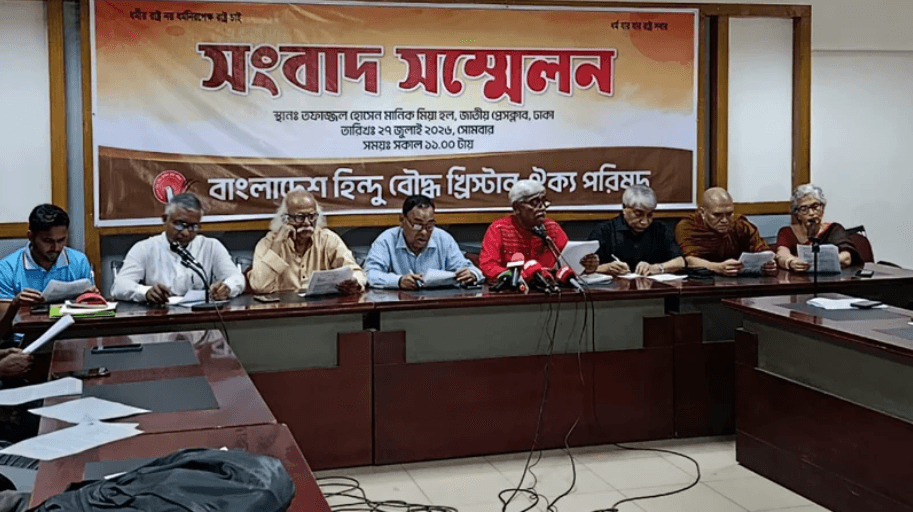
Dhaka (AsiaNews) – Attacks against religious minorities in Bangladesh have decreased compared to the wave of violence that erupted following the change of government in August 2024, but the nature of the persecution has changed, becoming more targeted and persistent. This is according to new data released by the Bangladesh Hindu Buddhist Christian Unity Council during a press conference held on 27 July in Dhaka.
According to the report, between January and June 2026, 257 incidents of sectarian violence were recorded, including murders, attacks on places of worship, illegal land occupations, threats, assaults and harassment, some of which were linked to allegations of blasphemy. Council officials emphasise that, although large-scale attacks have decreased, minority communities continue to suffer persistent forms of persecution that fuel fear and economic insecurity.
During the six-month period under review, 44 people were killed in 40 separate incidents of violence. The report also documents assaults against women, abductions, extortion, acts of vandalism against religious buildings, occupations of land belonging to religious institutions, and attacks on homes and businesses owned by families belonging to minority groups.
Behind these figures, the Council notes, lie thousands of people who are still trying to rebuild their lives. Between August 2024 and June 2026, in fact, 2,055 incidents affected homes and businesses linked to religious minorities. Many families have lost their livelihoods and continue to live in conditions of severe economic hardship, with no certainty about the future.
The consequences, the report adds, go far beyond material damage. Repeated acts of violence have fuelled internal displacement, heightened a sense of social insecurity, weakened mutual trust between religious communities and undermined confidence in the judicial system. Minority leaders fear that, although mass violence has subsided, targeted intimidation continues to pose a real threat to security and religious freedom.
A comparative analysis of the period between August 2024 and June 2026 reveals a marked shift in the pattern of violence. Of the 2,963 incidents recorded over 23 months, almost 74 per cent occurred in the five months following 5 August 2024, when the homes, businesses and places of worship of minority groups were extensively targeted. In 2025, such incidents fell to 17.6 per cent of the total, whilst in the first half of 2026 they accounted for 8.7 per cent.
However, the Council warns against interpreting this numerical decrease as a genuine improvement in the situation. Compared with 2025, the first six months of 2026 saw an increase in murders, attacks on places of worship, acts of vandalism against religious symbols, looting, arson, physical assaults and attempts to seize land belonging to religious institutions. According to the organisation, sectarian violence “has shifted from large-scale collective attacks to a more targeted and sustained form of persecution”.
Particularly worrying, according to the report, is the number of attacks on places of worship, which remains disproportionately high and raises questions about the ability of minorities to practise their faith freely.
During the press conference, the case of Haridas Chandra Tarani Das was also discussed. He is a Hindu religious leader who has been campaigning for the construction of an 81-foot-tall statue of the god Rama at a temple in Palashbari, in the district of Gaibandha. Arrested on 12 July on charges of money laundering, Das is, according to the Council, the victim of a wider campaign of opposition to the temple project, fuelled by extremist groups that have long sought to exacerbate religious tensions. The organisation described his arrest as “deplorable” and called for his immediate release, arguing that the measure has heightened anxiety within the Hindu community.
For representatives of the interfaith coalition, the issue is not merely about statistics, but about “the dignity, security and full citizenship” of communities that have contributed to Bangladeshi society for generations.
Speaking at the press conference, the Catholic leader Nirmol Rozario, vice-president of the Unity Council, expressed confidence in the government’s actions. “We want peace. We do not like to protest constantly. But if attacks against minorities continue in this way, we will be forced to announce wider protest initiatives. We want the government to conduct thorough investigations into incidents of persecution against minorities. We have this confidence in the government,” he stated.
Finally, the Council called on the authorities to adopt a ‘zero-tolerance’ policy towards sectarian violence, by stepping up legal action against hate speech and religious incitement, and by ensuring greater protection for minority communities. According to the religious leaders, the challenge for Bangladesh lies not only in preventing further attacks, but also in rebuilding trust, justice and the principle of equal rights for all citizens.