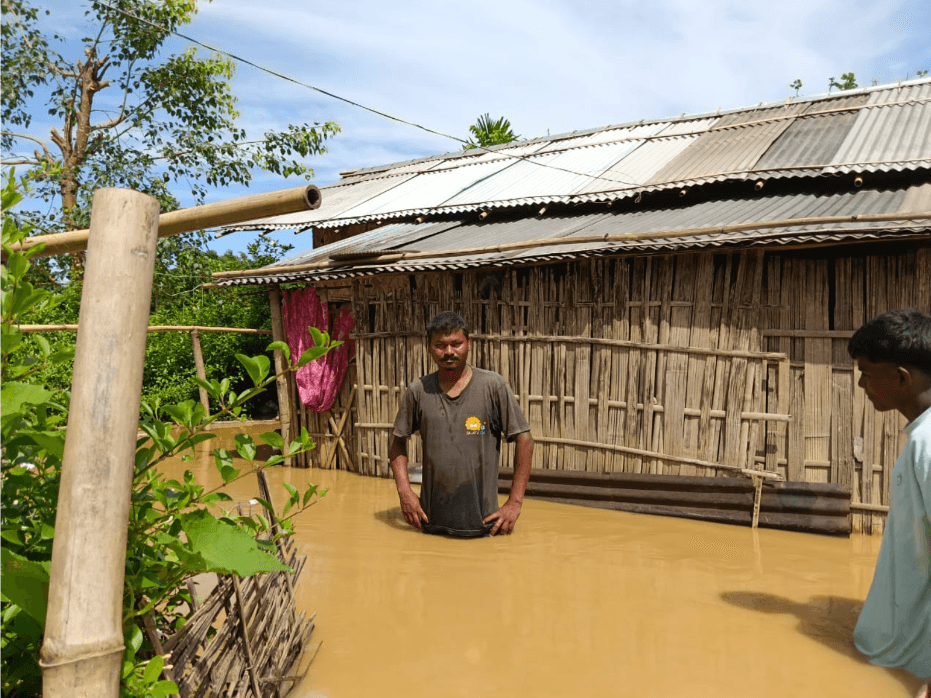
Dibrugarh (Assam) – The northeastern Indian state of Assam has recently been hit by some of the worst floods of recent years. Days of incessant monsoon rains have devastated the districts of Charaideo, Sivasagar, and Jorhat, in Upper Assam.
Between 19 and 24 July, the Dikhow, Disang, and Dhansiri rivers overflowed, submerging hundreds of villages, sweeping away homes, crops, roads, and public infrastructure.
Thousands of families have been forced to abandon their homes and take refuge in refugee camps, on riverbanks, or in makeshift shelters.
Although the floodwaters have now receded, the humanitarian crisis continues with many people left homeless without the means to rebuild their lives.
The Diocese of Dibrugarh responded quickly to the emergency, mobilising parishes, priests, religious, volunteers, and benefactors to support the affected communities.
Inspired by the Gospel principles of solidarity and compassion, the diocese organised an initial phase of aid distribution in Kona, Lakwa, and Nahorhabi, three villages in Charaideo district, providing necessities to families who had lost almost everything.
A second phase followed, reaching 106 families in the villages of Bihubor, Chutia Basti, and Nepali Gaon. The aid included rice, lentils, mustard oil, salt, potatoes, and mosquito nets.
The parish of Rajabari also supplemented the aid with milk, biscuits, sanitary napkins, soy, personal hygiene products, cleaning supplies, and drinking water.
The diocese expressed its deep gratitude to the priests, religious, benefactors, and volunteers who made the assistance possible, as well as to the operational team coordinated by the local curia.
In response to the bishop's appeal, many parishes and diocesan commissions, including the Diocesan Women's Commission, the Youth Commission, and the parishes of Doomdooma, Duliajan, Nilmoni, and Rajabari, actively participated in the relief efforts, handing out food, water, clothing, and hygiene supplies without distinction of caste, religion, or social class.
Now that the emergency phase is over, the priority is the rehabilitation of the affected communities.
Many families returned to find their homes destroyed or severely damaged: Household utensils, food supplies, school supplies, and livestock were lost, while agricultural land is covered in mud and debris.
Without concrete support, thousands of people risk remaining trapped in poverty and precarious conditions. For this reason, the Diocese of Dibrugarh has launched a new phase of its humanitarian intervention, focused on rebuilding homes, restoring living conditions, and recovering livelihoods.
Construction materials such as roofing sheets, bamboo, wood, cement, tarpaulins, doors, windows, and tools are needed; as are kitchen utensils, beds, blankets, water containers, clothing, solar lamps, filters, and hygiene kits.
It is also essential to support economic recovery with seeds, agricultural tools, fertilisers, livestock, and small business assistance, as well as providing students with backpacks, books, notebooks, uniforms, and school supplies.
The diocese has appealed to charities, organisations, businesses, and donors to support this crucial phase of reconstruction.
The goal is not only to rebuild homes and provide essential goods, but to restore hope, dignity, and the ability to look to the future with confidence.
“Together,” writes Bishop Albert Hermon, “let us be instruments of God’s compassion, enabling our brothers and sisters to rebuild their homes, restore their livelihoods, and look to the future with renewed hope.”
Let us “‘Carry each other’s burdens, and in this way, you will fulfil the law of Christ.’”