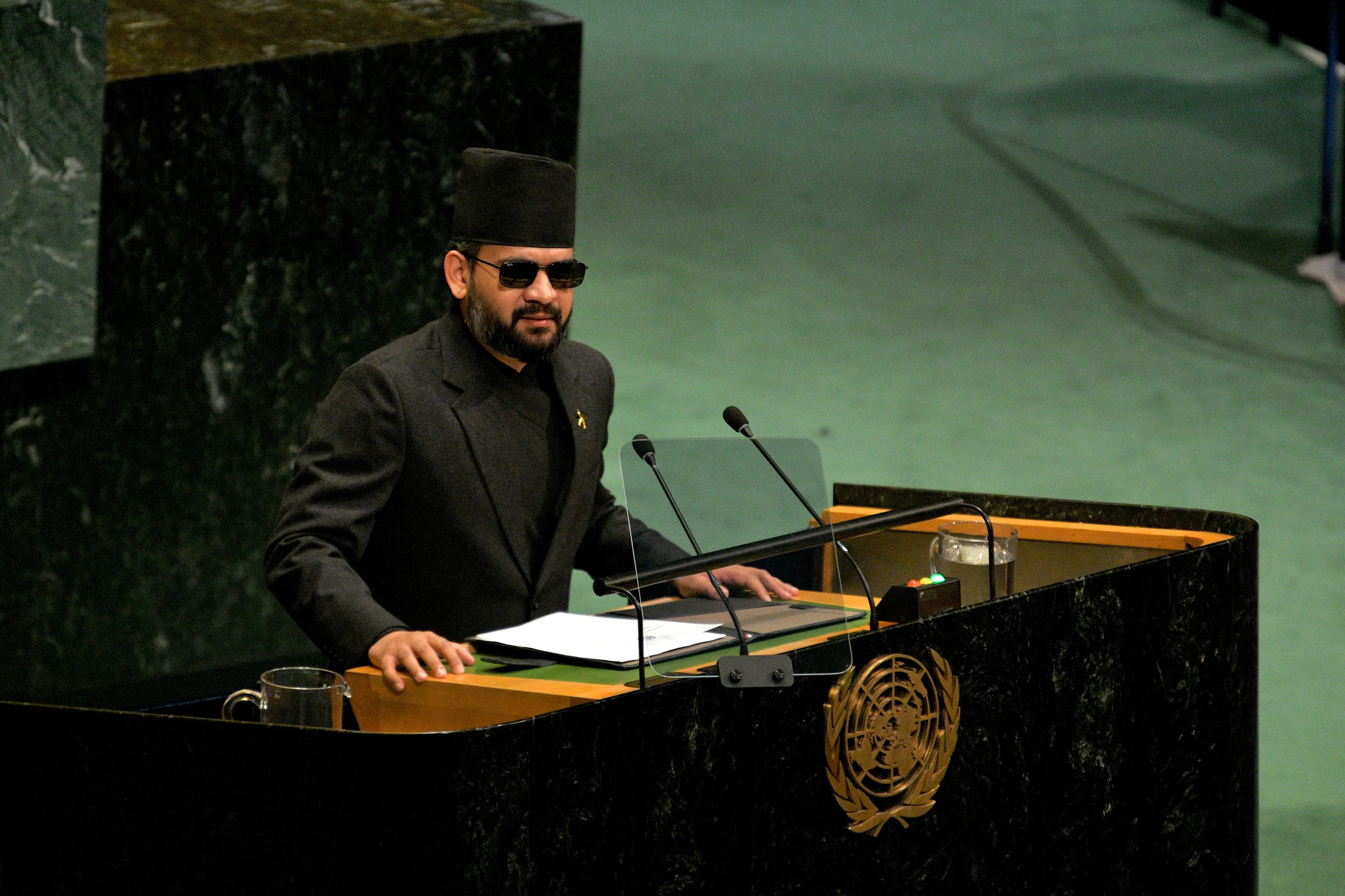
New York (AsiaNews) – “The Bhotekoshi-Trishuli disaster was not just a local tragedy: it was a warning to the world”. Addressing the United Nations General Assembly, Nepal’s Prime Minister, Balendra Shah, chose to speak first and foremost about the floods that devastated the country’s mountain communities on 26 August, killing at least 1,400 people and leaving over 6,000 still missing.
“I wish I could be here today simply to speak of development, democracy, peace and the hopes of a young nation,” he said. “Instead, I must speak of death and destruction on a massive scale.”
“Of families waiting for loved ones who will never return home. Of communities searching through the mud, among the rocks and in the water for people whose bodies may never be recovered,” the Prime Minister continued. “Of bridges, roads, schools, homes and livelihoods swept away in a matter of minutes.”
But in Shah’s speech, the disaster also became the starting point for calling for a new form of regional cooperation: “To this end, as an urgent first step, we propose establishing a Climate Resilience Mechanism for the Himalayas, led by Nepal, India and China,” he announced. The Nepalese Prime Minister’s proposal involves sharing satellite data, monitoring dangerous glacial lakes, strengthening early-warning systems and, when a disaster strikes, coordinating relief efforts across national borders.
“Let us make the Himalayas a laboratory for international cooperation, rather than a frontier of fragmented information,” said the Prime Minister. The floods also swept through Tibet, although China has provided data on the situation there that seems implausible. Shah’s proposal also calls for cooperation between India and China, which share borders in the Himalayas but have complex diplomatic relations.
Shah then emphasised the need for compensation mechanisms. After pointing out that Nepal accounts for less than 0.1 per cent of global greenhouse gas emissions, the Prime Minister argued that the country cannot be forced to take on ever-increasing debt to rebuild infrastructure destroyed by a climate crisis to which it has contributed only minimally: “We need adequate support based on grants from the international community,” he said, emphasising that the mechanisms proposed so far by the international community “remain woefully inadequate”.
And it is not so much a question of quantity as of accessibility: “Climate finance must not become a bureaucratic maze through which vulnerable countries spend years proving they need help,” said the Prime Minister. “When the house is on fire, we don’t ask the family to fill in fifty forms. We take action. This is what climate justice must mean.”
The Nepalese Prime Minister then broadened the scope further, highlighting the inefficiency in managing the difficulties of the global economy – themselves caused by the emergence of new conflicts – in contrast to the efficiency in the production and transfer of weapons. “We have built a world with impeccable logistics for war and dysfunctional logistics for food.”
“Intercontinental missiles arrive on time. Rifles and ammunition cross borders, overcome every obstacle and meet every deadline. But a farmer in Nepal cannot get hold of fertiliser or fuel at market price when he needs it,” said Shah. For the Prime Minister, however, this is not a problem exclusive to Nepal: “Ask Bangladesh. Ask Bhutan. Ask India. Ask the Maldives. Ask Pakistan. Ask Sri Lanka.”
“Ask any other country in our region and you’ll hear the same story: hit by a climate emergency we didn’t contribute to, and hit a second time by wars we didn’t start.”