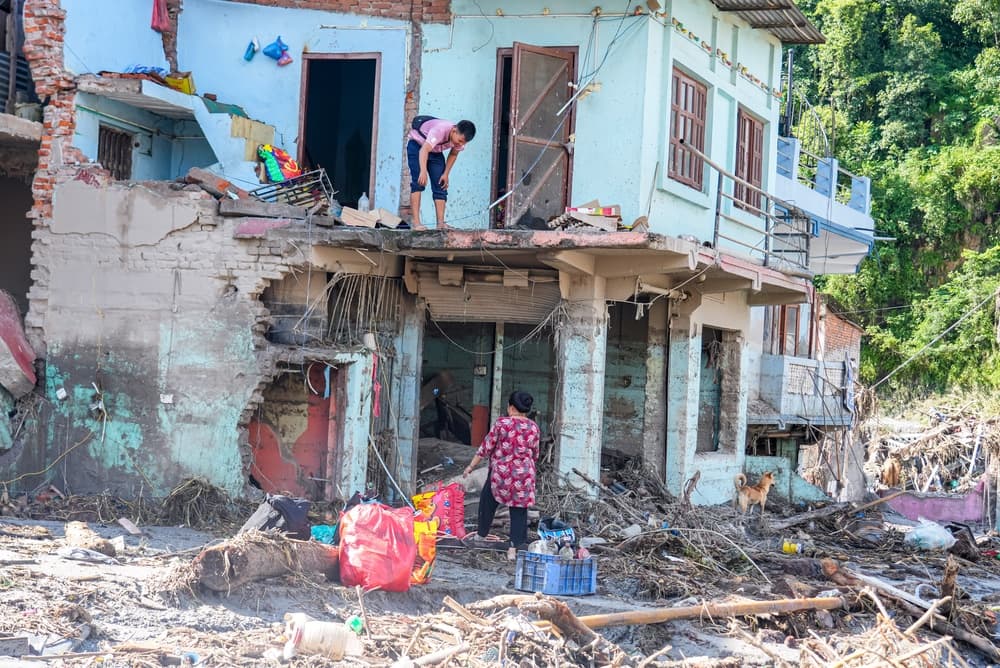
Milan (AsiaNews) – As the grim counting of deaths from the Gyirong crossing and the race to save at least some of the 600 workers still missing in the hydroelectric plant tunnels continue, Nepal is also starting to openly discuss the aftermath, i.e. what policy legacy the great tragedy that this part of the world has experienced for days should leave to the Himalayan region.
While the collapse of a glacier was a natural phenomenon, the devastation of the infrastructure network built in recent years in the valley affected by what Nepali authorities now readily call a high-altitude tsunami is symbolic of a development model that has proven completely unsustainable.
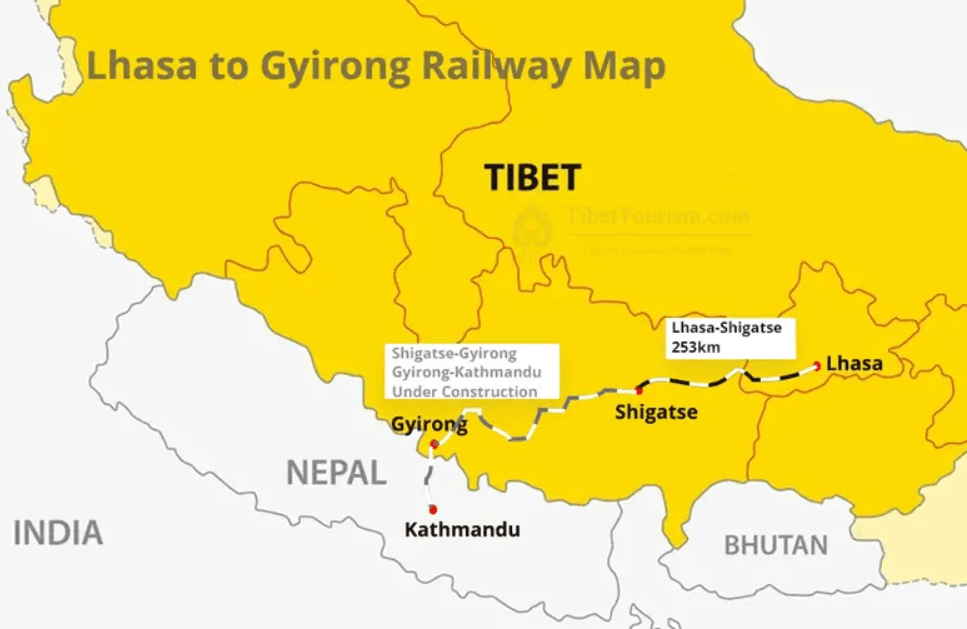
Perhaps the most eloquent symbol are the maps that still adorn Tibet's tourism promotion websites of the future high-speed railway line that, according to China’s plans, was supposed to connect Lhasa to Kathmandu, passing through the port of Gyirong and the valley below.
This was supposed to be an extension of the train that has connected, since 2014, Lhasa to Shigatse, Tibet's second-largest city, located at over 3,800 metres above sea level, in two and a half hours.
From there, China planned a 500-kilometre extension to the Nepali border, the final stretch of what would have passed through until the area was completely obliterated by the fury of ice, water, and rocks.
China said that it was ready to help Nepal build the last 120 kilometres to the Nepali capital. Fortunately, the high costs of the project had already effectively stopped the idea in its tracks, which, had it actually been realised, would have raised the number of victims of the tragedy.
The point is that the recent catastrophe requires a qualitative leap in relations between Himalayan countries, with the adoption of coordinated and shared policies.
Much talk has been made in recent hours over the lack of shared data from alarm detection systems in an increasingly fragile environment in the Himalayas. But the problem is much broader.
The International Centre for Integrated Mountain Development (ICIMOD) was set up in 1983, headquartered in Kathmandu whose members include eight countries in the Hindu Kush-Himalaya region (Afghanistan, Bangladesh, Bhutan, China, India, Myanmar, Nepal, and Pakistan).
Yet, its warnings about sustainability have regularly gone unheeded. As early as 2020, one of its studies, for example, had identified 47 potentially dangerous glacial lakes, 21 in Nepal, 25 in China, and one in India. But instead of addressing the problem, infrastructure has been built uninterruptedly in recent years in areas exposed to risks.
Now, faced with the tragedy it is experiencing, Nepal is openly discussing how to change course.
In an interview with the Kathmandu Post today, Foreign Minister Shisir Khanal, for example, announced his intention to raise the issue at the global level, calling for "climate compensation" for the disaster.
“Nepal’s greenhouse gas emissions are virtually negligible. Yet, we are paying the ultimate price for a global crisis we did not create,” he said. “The rapid melting of glaciers and these catastrophic mountain tsunamis are direct consequences of global climate change.”
In light of the situation, “We are shifting our diplomatic framework from ‘aid’ to ‘justice and compensation’.” And “This is not a matter of charity; it is a matter of legal and moral liability.
“The major industrial emitters – such as China, which is the world’s top emitter, the United States at number two, and India at number three – have a historical responsibility to compensate vulnerable nations like Nepal.”
“If our Himalayan glaciers disappear, the water security of over two billion people in South Asia – dependent on rivers like the Ganges and the Trishuli – will be permanently compromised. We are advocating not just for Nepal, but for the survival of South Asian civilisation.”
In an article in the Himalaya Times, Nepali entrepreneur Rajendra Bajgain criticised the excessive reliance on hydroelectric power plants, urging his country to move beyond a vision of energy centred almost exclusively on hydropower and consider instead rivers, glaciers, glacial lakes, sun, forests, and mountains as a single strategic asset.
For him, the goal is to focus not only on the number of megawatts produced, but also on a renewable, resilient, and diversified energy system capable of generating regional trade.
Development, he contends, must not be halted, but rethought.
In the mountains, alternatives to roads, such as cable cars and ropeways, must be explored, and the entire river basin, not the individual project, must be considered as the fundamental planning unit.