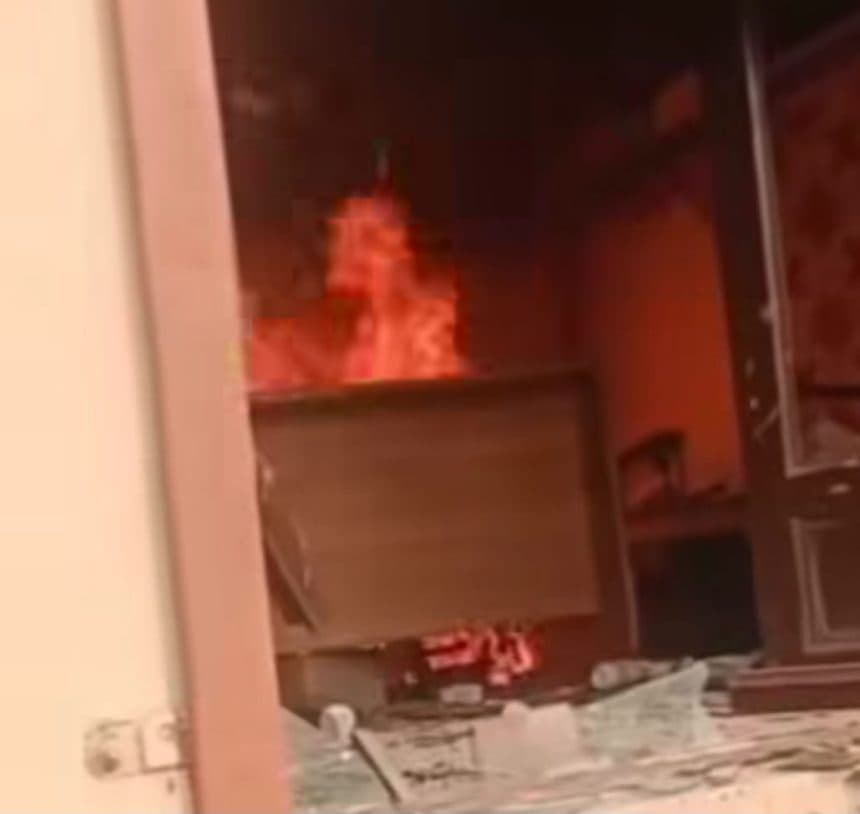
Narang Mandi (AsiaNews) – More than 35 Christian families have reportedly fled their homes in Gharyal Kalan village, near Narang Mandi in Punjab’s Sheikhupura district, after a mob allegedly set fire to the house and pharmacy of Kamran Masih, a 40-year-old Christian father of three accused of sharing blasphemous content on social media.
The incident has heightened fears among local Christians, who reportedly began leaving the area after Masih’s arrest on Thursday night, 8 October.
An eyewitness told Voicepk.net that members of the crowd threatened to return the next day after Friday prayers and target other Christian families.
Police have registered separate criminal cases against Masih and those accused of participating in the violence. Five suspects have reportedly been arrested in connection with the attack.
The case has once again raised concerns about the vulnerability of religious minorities in Pakistan, where blasphemy allegations can provoke mob violence before the courts have established the facts.
Two criminal cases registered
Kamran Masih, son of Muneer Masih, operated a small pharmacy in Gharyal Kalan village. Police arrested him at approximately 9:30 pm on 8 October and subsequently transferred him to a safe location.
Local residents accused him of sharing a video deemed offensive to religious beliefs in WhatsApp groups.
Police registered FIR No. 1070/26 against him under several provisions of the Pakistan Penal Code and the Prevention of Electronic Crimes Act.
The allegations have not been established in court. Masih is entitled to a fair trial and the presumption of innocence.
Following Friday prayers, a crowd allegedly gathered and attacked his premises, damaging property and setting fire to the clinic and its contents.
Police subsequently registered FIR No. 1071/26 concerning the alleged arson, damage to property, unlawful assembly and related offences, including provisions of the Anti-Terrorism Act. Five suspects were arrested for the arson.
The separate case against the alleged attackers is significant because an accusation of religious offence cannot justify violence, destruction of property or threats against an entire community.
The reported displacement of more than 35 Christian families has also raised urgent questions about their safety, access to shelter and the conditions required for a secure return.
Minority representative intervenes
Falbous Christopher, a member of the Punjab Provincial Assembly representing religious minorities and chairman of the Standing Committee on Human Rights and Minority Affairs, took immediate notice of the incident.
According to the information provided, following his intervention, district police chief Bilal Zafar Sheikh led a police contingent to the village to help contain the situation.
Christopher also contacted local community leaders, appealed for calm and called on police to take strict action against extremist elements.
His intervention reflects the importance of political representatives and law-enforcement authorities acting quickly when religious tensions threaten the safety of vulnerable communities.
However, the longer-term response will depend on effective protection for threatened families, an impartial investigation and accountability for those responsible for any criminal acts.
The incident also calls for the voices of Christian leaders and human-rights advocates to be heard as Pakistan confronts recurring cases in which allegations of blasphemy expose entire communities to fear and intimidation.
Pakistan’s Constitution guarantees equality before the law under Article 25, protection of life and liberty under Article 9, and religious freedom under Article 20, subject to constitutional provisions.
These guarantees require authorities to investigate the allegation against Masih according to the law while independently pursuing the case against those accused of attacking his property. Neither public anger nor a religious accusation can replace a judicial process.