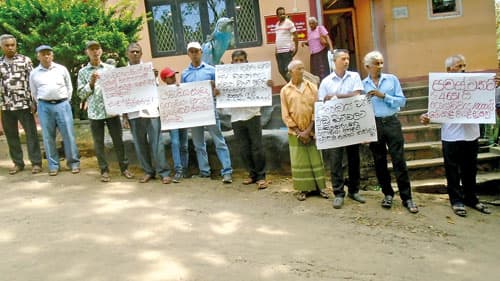
Colombo (AsiaNews) – Farmers from Welimada – in the Badulla district, Uva province (in the Central Highlands region) – who lost their land in 2011 due to the Puhulpola reservoir, have taken to the streets to protest and seek compensation, albeit 15 years late.
In the past, as part of a joint project between Sri Lanka and Iran, two dams were built at Mathetilla and Dyraaba at a cost of 76.3 billion rupees (just under 199 million euros) to divert water through two tunnels. More than 15 years have passed, but compensation payments have been delayed or postponed without any justification.
According to the complaint lodged by local farmers, their economic situation has collapsed as a result of the project – which for them represents a long-standing problem – and, for this reason, they have decided to join forces and protest in an attempt to secure compensation.
The local population has already benefited from the projects, although payments of the promised compensation have been delayed to this day. However, despite the positive aspects, the project is said to have caused significant displacement of people and damage to property, with many residents still grappling with unresolved issues.
The initiative by the farmers of Welimada therefore aims to provide an effective response to the claims arising from the loss of land and property caused by the implementation of the joint project between Colombo and Tehran. Sunil Wijedasa (66), Kamani Rupasinghe (64) and Neetha Damayanthi (58) explained the basis of their grievances to AsiaNews.
At the time, “a document was submitted to the Council of Ministers regarding the payment of compensation for the rice fields expropriated for the project, and two and a half acres were promised in Handapanagala, in Wellawaya District (Uva Province), as well as a payment of 8,000 rupees each (just under 21 euros) for 12 months for the cultivation of that land”.
“We were also promised,” the farmers continue, “a water supply through the Uma Oya project. However, to date, we have not been allocated the promised land. Our livelihoods have collapsed and we are unable to provide our children with a proper education; we therefore demand that we be paid the compensation.
At present, most farmers have given up farming. Young people have left for abroad in search of greener pastures. The elderly continue to wait for compensation and still live in the area. Several governments have come and gone over the last 15 years, but our issue – they conclude – has not been resolved despite the promises made during the election campaign.”
According to T.M.M.P. P. Tennakoon, treasurer of an organisation representing farmers whose land has been expropriated, cultivation had already been underway for three years when the land was forcibly seized by the authorities.
“We had been promised two and a half acres of land in Wellawaya and were subsequently told that, instead of the land, we would receive compensation. According to the calculations, they will pay only 4,500 rupees per perch, which is equivalent to the price of 25 kg of rice – an amount insufficient to cover the loss suffered. The land expropriated from the residents,” warns the expert and activist, “was worth 100,000 rupees per perch. Although the government’s estimates fall short of the land’s actual value, we have not yet received any payment.”
As revealed by R. M. Dhanapala, secretary of the farmers’ organisation, “18 acres of land belonging to 139 families were expropriated with the assurance that we would each be allocated two acres in Handapanagala”. Subsequently, he continues, “we were told that the land was not available and that we would be paid compensation of 1.2 million rupees (over 3,100 euros) per acre. An appeals committee was supposed to have been set up at the Badulla District Secretariat, but this did not happen.
“We have also brought the matter,” he concludes, “before the Human Rights Commission, where government officials acknowledged that a higher level of compensation should have been paid, but this has not been put into practice.”
Finally, according to officials at the Uva Paranagama Divisional Secretariat, “a new appeal by those affected will be submitted to the sub-committee of the Council of Ministers set up to resolve the issue.”
According to senior officials at the Ministry of Agriculture, “a public meeting will be held in Welimada next month, during which officials will gather complaints and concerns from those affected. Consequently,” they conclude, “they may receive compensation before the end of the year.”