Phnom Penh (AsiaNews) – At a time when overall tourism figures are plummeting, the authorities in Phnom Penh are stepping up their campaign to attract more Muslim tourists. International visitor arrivals in Cambodia fell by 47.9 per cent in the first half of 2026, dropping to 1.75 million from the 3.36 million recorded in the same period of 2025.
The slump was largely caused by the closure of the land border and military clashes with Thailand. Added to this are the scandals surrounding the widespread phenomenon of cyber fraud, which have damaged the country’s reputation. International tourism revenue also fell by 31.5 per cent, eventually standing at $1.4 billion.
The government is targeting Muslim tourists to help keep the sector strong. As part of the 2023–2027 master plan for Muslim tourism, the government and industry leaders have stepped up training for tourism operators and set up prayer rooms at the two main international airports and in public buildings such as large shopping centres.
Some leading hotels provide prayer mats and indicate the direction of Mecca, whilst an increasing number of restaurants offer halal food and alcohol-free areas. “Looking back over the last three years, you can see a real change on the ground,” says Chhay Sivlin, president of the Cambodian Association of Travel Agents (CATA). “It is no longer just a niche concept, given that local businesses,” he explains to AsiaNews, “are actually adapting.”
“The government’s ‘Assalamu Alaikum Cambodia’ campaign has provided local businesses with a clearer framework, so a growing number of operators,” adds Sivlin, “are actively participating rather than simply observing from a distance.” As for the catering sector, whilst the process of obtaining official halal certification across the board is still ongoing, there is a substantial and growing number of certified, Muslim-owned restaurants in Phnom Penh and Siem Reap. These establishments offer a wide range of cuisines, from Indonesian to Malaysian, and from Middle Eastern to Indian.
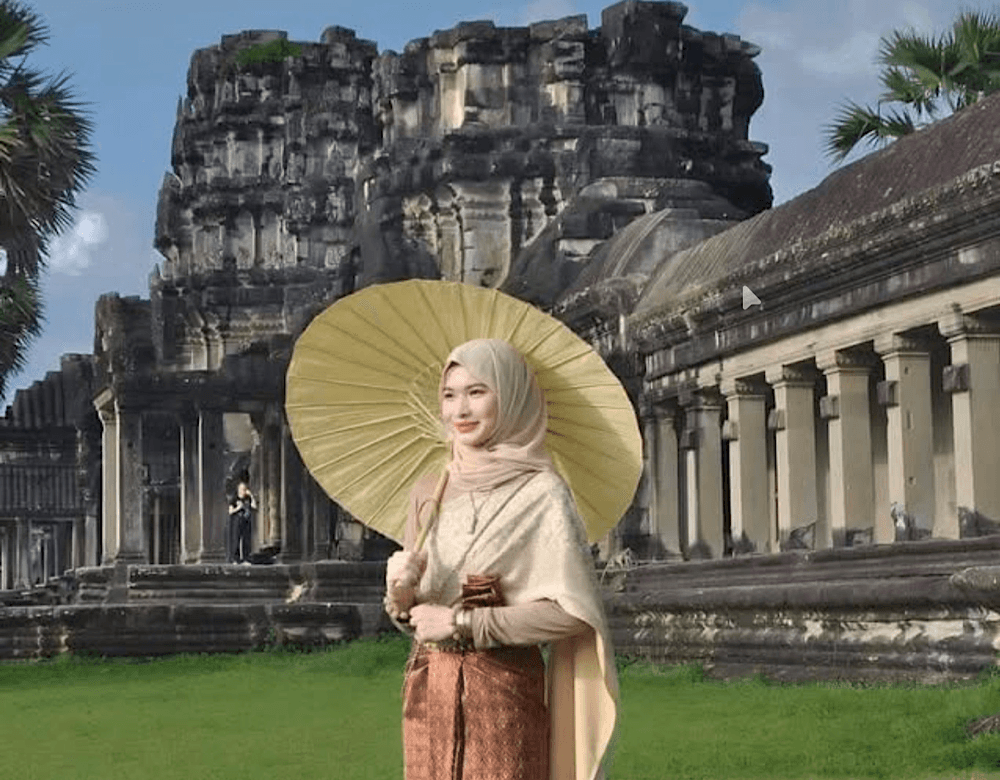
According to the Global Muslim Travel Index, in 2025 around 196 million Muslims travelled abroad, exceeding the levels seen in 2024 and pre-Covid-19 figures. Three years ago, Cambodia launched the ‘Assalamu Alaikum’ initiative (a traditional Muslim greeting meaning ‘Peace be upon you’) to attract Muslim travellers: primarily from Middle Eastern countries, but also from neighbouring ASEAN nations such as Indonesia and Malaysia, who spend more than other tourists, according to the Cambodian Ministry of Tourism.
For some time now, many shopping centres, hotels and restaurants have been catering to Muslim visitors; however, efforts are now being stepped up in response to the government’s campaign and the decline in visitor numbers. A few weeks ago, around mid-July, Cambodia promoted and organised its third Forum and Fair on Tourism tailored to Muslim travellers. The government has also published a ‘Handbook on Muslim-Friendly Tourism Standards’, aimed at providing guidance to businesses in the tourism sector.
After all, tourism is one of the ‘four pillars’ of the Cambodian economy: it ranks behind agriculture and the clothing, footwear and travel goods industries, but ahead of construction and the property sector. “Muslim tourism is not only a potential market, but also an opportunity to demonstrate that Cambodia is a safe, welcoming, reliable and hospitable tourist destination for visitors of all nationalities and religions,” said Tourism Minister Huot Hak. He spoke in person at the forum, an event that brought together government officials, industry experts from Cambodia and around the world, business leaders and diplomats.
“Cambodia,” the minister continued, “is seizing opportunities to diversify its tourism markets.” The aim, he added, is “to strengthen and expand the sector’s potential, ensuring sustainable, inclusive and resilient growth through access to the Muslim tourism market, complementing existing international markets”. “This fair will act as a catalyst, encouraging tourism businesses and the Cambodian public to further improve their services,” concluded Huot Hak, “in order to best welcome visitors of all nationalities and religious beliefs.”
The number of Muslim tourists visiting Cambodia has risen significantly, from 180,000 in 2022 to 440,000 in 2024. Around 2 per cent of Cambodia’s 17.5 million inhabitants are Muslim, mostly belonging to the Cham ethnic group, descendants of refugees from the Hindu-Buddhist kingdom of Champa, in present-day Vietnam. Sivlin argues that the closure of the land border with Thailand presents an opportunity for Cambodia to restructure its tourism sector, making it more sustainable and broadening its base.
“Rather than promoting Cambodia as merely a land-based extension of its neighbouring countries, it should be regarded as a unique destination in its own right,” said the president of the Cambodian Association of Travel Agents (CATA). However, according to industry experts, challenges remain because, to give just one example, whilst Phnom Penh and Siem Reap – home to Angkor Wat – have international-standard infrastructure, other major cities lack it. Furthermore, there is little awareness among tourists of Cambodia’s long Muslim history. “Abroad, there is still a widespread perception that Cambodia is a purely Buddhist destination, so much of the work,” concludes Sivlin, “simply involves raising public awareness of our local Cham heritage and the nearly 1,000 active mosques across the country.”