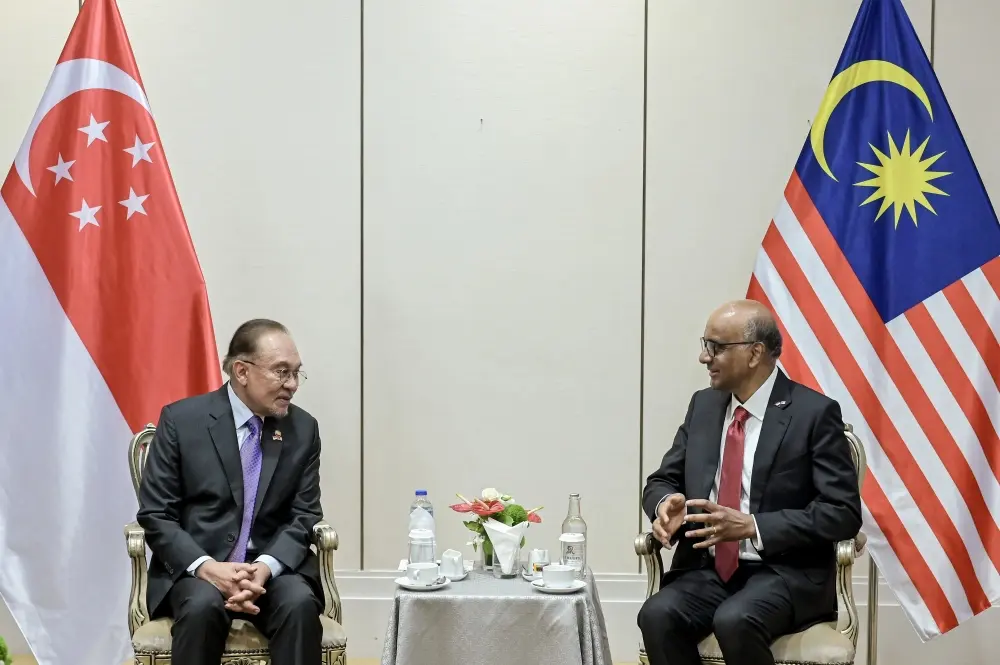
Kuala Lumpur (AsiaNews) – Singapore and Malaysia have reaffirmed their commitment to deepening cooperation in the areas of food security, energy and other strategic sectors, as both countries aim to strengthen regional resilience in the face of growing geopolitical and economic challenges. This commitment was reiterated by Prime Minister Anwar Ibrahim during Singaporean President Tharman Shanmugaratnam’s first visit to Malaysia, which took place from 12 to 15 July.
According to Singapore’s Ministry of Foreign Affairs, the two leaders exchanged views on geopolitical developments, including the evolving conflict in the Middle East. They reaffirmed the importance of respecting international law, in particular the United Nations Convention on the Law of the Sea (UNCLOS), whilst safeguarding freedom of navigation.
The reference to UNCLOS reflects the growing concern among South-East Asian nations regarding the protection of a rules-based international order at a time of mounting maritime tension in the South China Sea, one of the world’s busiest shipping lanes. Although the statement does not directly mention this body of water, both Singapore and Malaysia have consistently advocated respect for international law and the peaceful resolution of disputes.
Beyond bilateral relations
The visit comes as ASEAN countries face multiple challenges, including protracted conflicts in the Middle East, intensifying competition between the United States and China, upheavals linked to climate change, and concerns over food and energy security.
The COVID-19 pandemic has highlighted the vulnerabilities of regional food supply chains, whilst recent global conflicts have driven up energy prices and underscored the need for closer cross-border cooperation.
Malaysia and Singapore have placed increasing priority on food resilience through agricultural innovation, diversification of imports and joint investment in sustainable technologies.
President Tharman and his wife, Jane Ittogi Shanmugaratnam, were received on 13 July at an official welcome ceremony at Istana Negara by King Sultan Ibrahim and Queen Raja Zarith Sofiah. Yesterday, the President of Singapore was received in audience by the Sultan of Selangor, Sultan Sharafuddin Idris Shah, and subsequently met with the Chief Minister of Selangor, Amirudin Shari. During the talks, Tharman welcomed a strengthening of trade ties between Singapore and Selangor, one of Malaysia’s most industrialised states and a key destination for investment by Singaporean companies.
This emphasis on collaboration reflects a broader effort to deepen cooperation beyond the federal government level, by encouraging partnerships at state level as well.
An evolving partnership
Singapore and Malaysia share one of the closest economic relationships in South-East Asia. Singapore consistently ranks among the largest foreign investors in Malaysia, whilst Malaysia remains one of Singapore’s main trading partners. Annual bilateral trade exceeds 120 billion Singapore dollars (over 81 billion euros editor’s note), reflecting the deep economic interdependence between the two neighbouring countries.
The two countries are also pursuing several major initiatives, including the Johor-Singapore Special Economic Zone, launched earlier this year to boost investment, improve cross-border connectivity and turn the southern part of Peninsular Malaysia into a regional hub for manufacturing and innovation.
According to observers, President Tharman’s first state visit since taking office in September 2023 is of both symbolic and practical importance. Unlike in previous decades, when bilateral relations were often overshadowed by disputes over water, territorial boundaries and infrastructure projects, both governments have increasingly focused on economic integration, digital innovation, renewable energy and climate resilience.
Whilst differences remain on certain issues, analysts believe that the current emphasis on cooperation reflects a shared awareness that many of the region’s most pressing challenges – from food insecurity to climate change and geopolitical instability – cannot be tackled by individual countries acting in isolation.
For Kuala Lumpur and Singapore, the visit signals a commitment to pragmatic dialogue and closer collaboration at a time when ASEAN is facing one of the most complex strategic scenarios of recent decades.