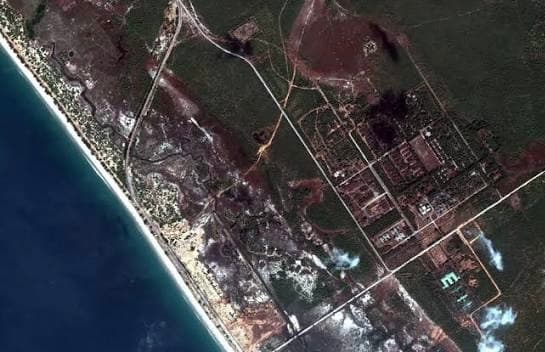
Yangon (AsiaNews) – The Myanmar military has deployed hundreds of troops to areas in the south of the country that have been forcibly liberated, burning villages and sealing off the surrounding land, on which it is establishing a Special Economic Zone (SEZ) backed by Russia as part of a growing alliance between the two countries. The offensive in Dawei, which includes a deep-water port and a power station on the Andaman Sea, shows how the Myanmar government – backed by the army – is prepared to use force to relaunch a project touted as a strategic alternative to the Strait of Malacca.
Economy and diplomacy
This push also coincides with a diplomatic offensive: the former head of the junta and current president, Min Aung Hlaing, regards Dawei as a potential gateway to South and West Asia, as he emphasised during a recent visit to Thailand. He also discussed the project with his Russian counterpart, Vladimir Putin, during his trip to Moscow last week.
According to reports from Reuters sources in July, the army deployed hundreds of soldiers to the southern Tanintharyi region, on the border with Thailand, where Dawei is located, sparking clashes with local resistance groups who were forced to retreat.
Local sources speak of advancing military columns and burnt villages, with the killing of three aid workers involved in assisting displaced local communities.
The push into Dawei reflects a broader strategy by the military to reclaim territory deemed strategic and border areas that fell under the control of opposition groups in the wake of the coup in February 2021, which triggered the civil war. In over five years, around 100,000 people have died, and more than 3.5 million have been left homeless.
Myanmar’s new government is now seeking to revive the Special Economic Zone project with the support of Russia, a key ally of Min Aung Hlaing and the military.
At a business forum in Moscow last week, Zaw Naing Oo, Chief Minister of the Tanintharyi Region, said the project could enable cargo to travel four to six days faster than if it were to pass through the Strait of Malacca.
The port is also expected to be situated close to Myanmar’s main offshore gas fields. Russian companies intend to operate in Dawei with the aim of expanding trade and creating new jobs, including in small and medium-sized enterprises, as announced by Russian Prime Minister Mikhail Mishustin during his meeting with Hlaing. Finally, the project could secure Moscow greater access to the South-East Asian market and a port base in the Indian Ocean region.
Moscow–Naypyidaw axis
The special economic zone project is just one piece of the renewed alliance between Moscow and Naypyidaw, sealed last week by the visit of Myanmar’s coup leader – now president – Min Aung Hlaing to the Kremlin, where he met Vladimir Putin. Russia was the fifth country visited by the Burmese leader since his appointment as president, following official trips to India, China, Laos and Thailand.
In the past, the former general – who is subject to numerous Western sanctions and seeking international legitimacy – made four visits to Moscow as head of the junta, the first in June 2021 to attend a security conference, five months after seizing power in a coup. He travelled to the country twice in 2022 and again in March 2025, when he held formal talks with Putin.
The relationship between the two countries is also of interest to Russia itself, which hopes to strengthen its presence in the Southeast Asian nation and offer new opportunities for energy companies to make up for lost revenue linked to the effects of the war in Ukraine.
The two countries have already signed an agreement for the construction of a small-scale nuclear power station in Myanmar following the meeting between Min Aung Hlaing and Putin in 2025.
In addition, a memorandum on investment cooperation was signed for the strategically located Dawei Special Economic Zone, which includes the construction of a port and an oil refinery. The latest visit also included a business forum between Myanmar and Russia, marking a further strengthening of ties which also encompass military training and university scholarships for thousands of Burmese soldiers in Russia, alongside the sale of arms and fighter jets.
Monastery struck
Finally, on the domestic conflict front, at least 14 people were killed over the weekend in air strikes that once again targeted a place of worship. This time, the military’s target was a Buddhist monastery in the town of Myaung, in the central Sagaing region, some 70 km west of Mandalay, which was struck at 9 am on 21 August.
Local witnesses report that all the victims were elderly, whilst several monks are said to be among the injured, adding that the site was struck twice.
Civilians had gathered at the site for a meditation retreat but were hit by bombs dropped from fighter jets; so far, the Myanmar military has declined to comment on the operation, which resulted, amongst other casualties, in the deaths of three women.