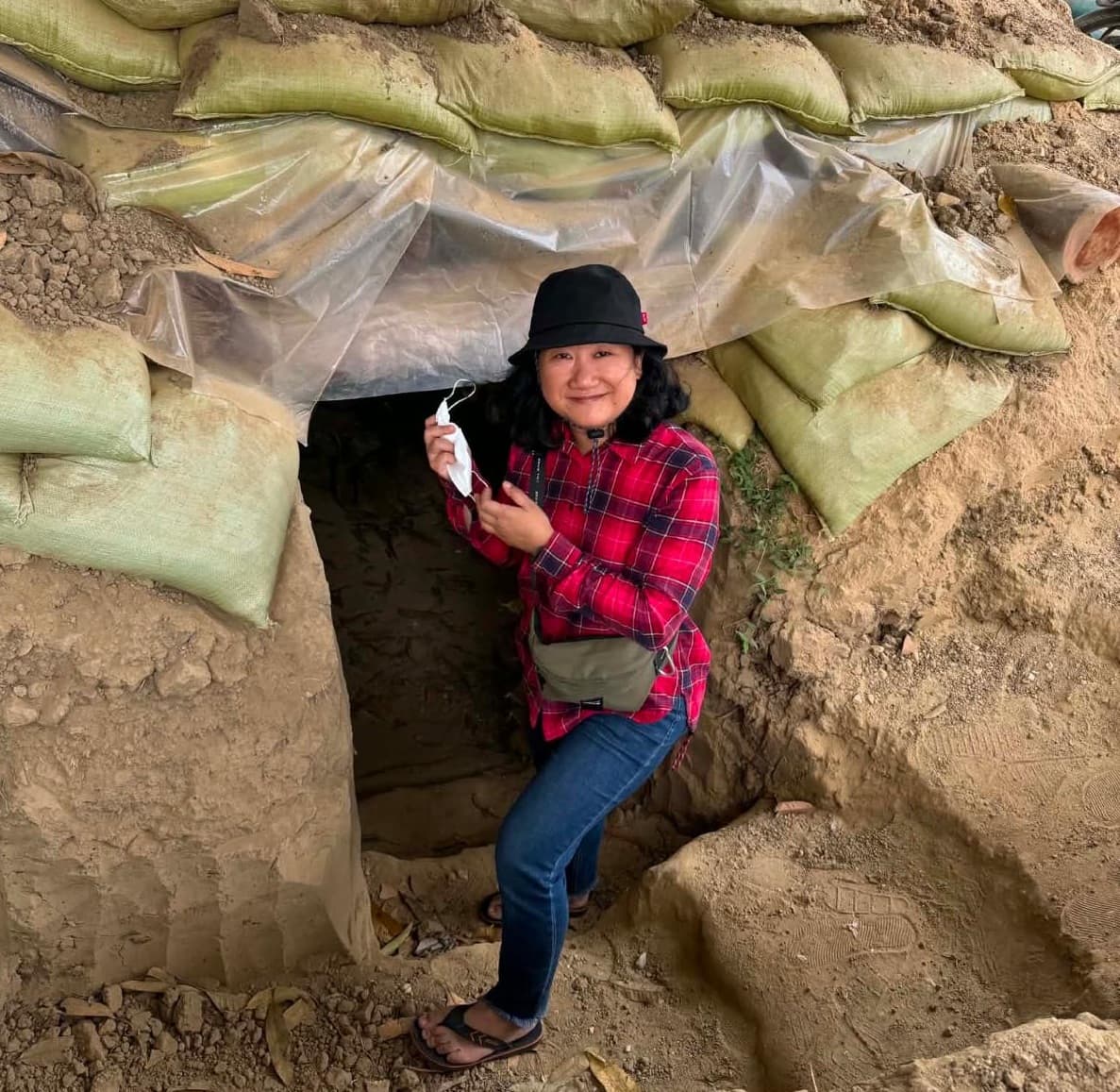
Rome (AsiaNews) – Flimsy bamboo walls stand in stark contrast to heavy sandbags and churned-up earth that protect them from bombs raining down from the sky. Schools and air-raid shelters should never have to coexist; yet, this is the reality of "education for survivors" in Myanmar, noted Ja Htoi Pan speaking to AsiaNews.
As the Minister of Education in the National Unity Government (NUG), in exile since the 2021 coup (which paved the way for civil war), Ja Htoi Pan is a key point of reference for a faction of Myanmar’s anti-military opposition.
Aged 42, she represents the Kachin Political Interim Coordination Team (KPICT), a group actively opposing Myanmar’s military junta.
A social anthropologist by training, the political leader is at the forefront of supporting and reforming parts of the country's education system; her work includes coordinating thousands of makeshift schools and overseeing national educational curricula.
She previously served as Deputy Minister of Education and held various positions at academic institutions and research centres in Myanmar’s Kachin State.
Young people without basic education
“We are hanging by a thread," she said several times during the interview. "So far, that thread seems very strong. But the feeling never goes away."
The data paint a picture of the dire state of education in a country that has been at war for more than five years.
For the 2026–2027 school year, enrolment stands at 6.7 million, but recent censuses indicate a school-age population of 13 million, which means that more than 6.3 million young people and children lack access to basic education.
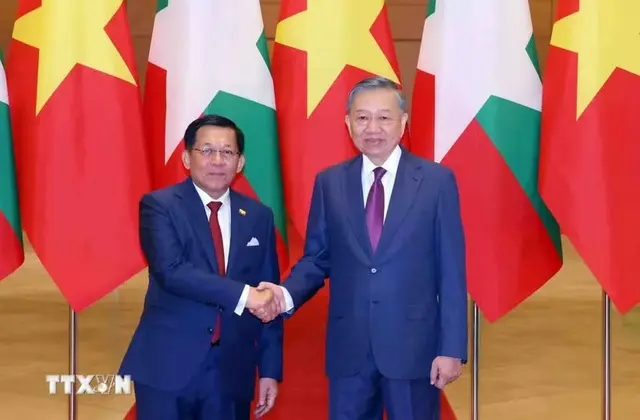
Min Aung Hlaing – who led the 2021 coup and was sworn in as president in the spring of 2026 following elections held earlier this year (elections widely criticised by humanitarian groups for excluding the main opposition party) – promised increased funding for education. Yet, current allocations are below those of 2020–2021 (when education accounted for 8.07 per cent of public spending).
“We are constantly being bombed,” said Ja Htoi Pan. “They target schools, universities, monasteries, and even hospitals. Young people have no peace of mind, always on alert and in fear.”
Amid this tragedy, the National Unity Government (NUG) is working to ensure an “alternative education system.”
Today, the NUG Ministry of Education oversees approximately 800,000 students and over 60,000 teachers in territories liberated from the military junta by the People’s Defence Forces (PDF), the armed wing of the NUG.
Following the coup, doctors and teachers joined the Civil Disobedience Movement, the initial peaceful protest against the return to dictatorship, and remain on the military’s blacklist. According to the minister, about 5,000 schools operate under the NUG.
Across the country, schools were attacked 217 times between 2023 and 2024 alone; in 141 cases, they were used for military purposes.
“Amid the war, it is crucial for young people to experience a sense of normalcy, to have a point of reference amid the chaos,” she added.
Schools and anti-aircraft shelters
In recent years, safety has become a pressing priority. “Safe schools, safe education” is the guiding principle, shared by other ministries as well.
“We provide safety drills and air-raid shelters; last year, we even raised funds to build them. We have devised a school safety system,” the minister explained.
Although the NUG operates primarily from exile, Ja Htoi Pan regularly conducts on-site visits. She shows us a photo of herself at the entrance to a stark underground shelter, a mound of golden earth and sand.
“To qualify as a matriculation exam centre, schools must meet safety requirements, including the construction of a shelter,” she said. “This is how we have been conducting education for some time now.”
In liberated areas, resistance is maintained through “great innovation and creativity. To resist, we need more support, as long as the armed struggle is backed by the population.”
Support for education is “fundamental to rebuilding communities” forced to move. More than 3.5 million people are internally displaced in Myanmar.
“In addition to safety, we handle teacher training, define guidelines, and manage exams,” she noted.
“The rest of the educational activity, such as service delivery and practical support for teachers, is provided by the communities themselves,” an essential contribution to ensuring a semblance of normality for the children.
“At school, there is a shelter and there are teachers; if something were to happen, there is an escape route. Safety might not be guaranteed in their own homes.”
Aung San Suu Kyi: "Hope for the people"
In Myanmar, the regime is preparing a complete return to dictatorship. For the minister, the only “hope for the people” is Aung San Suu Kyi, the 1991 Nobel Peace Prize laureate.
Only recently, under external pressure, did the military junta release a photo of her, confirming that she is still alive, after ousting and detaining her.
“It is crucial that she is in good health and is released to resume her work as the people's leader. The international community should exert more pressure,” Ja Htoi Pan said in an appeal she shared with AsiaNews.
Instead, Myanmar’s neighbours are trying to “support the military and establish closer relations with them, legitimising them; for them, there is no president other than the military leader,” the minister lamented.
“We must stop them (the military), first and foremost by blocking fuel supplies, which enable the air raids to continue,” she said.
As for the NUG, talks with the military junta have ceased entirely. “We have specific conditions: now is not the right time,” she explained.
“Our goal is clear: we do not want to keep fighting. We must do everything possible to achieve peace, not a fake, artificial, or superficial peace. We want real peace; that is our political stance.”
Ja Htoi Pan points to the Steering Council for the Emergence of a Federal Democratic Union (SCEF), a political coordinating body established in March 2026 with the aim of achieving unity through federalism, moving beyond the central role of the NUG itself.
“To make things work, we have to think outside the box,” she said, “starting with the education of young people and children, who want to learn. While resisting military attacks, we are simultaneously building the nation.”