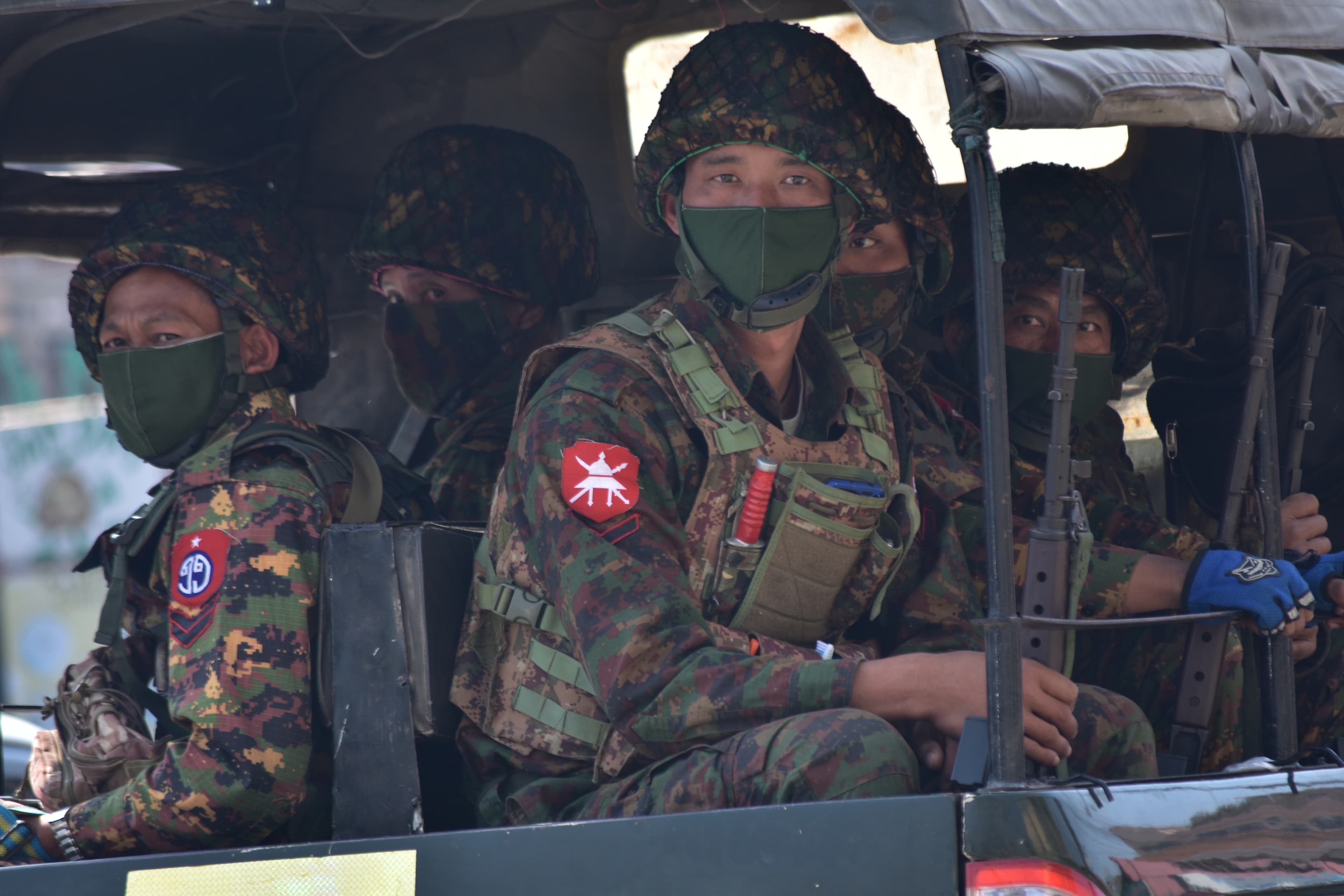
Bangkok (AsiaNews) – Myanmar’s military regime has rejected accusations that its forces caused damage and wounded people inside Thailand, blaming instead opposition groups.
In a statement issued on Tuesday and broadcast on the state-run channel Myanmar International Television, the regime accused the Karen National Union (KNU) and its armed wing, the Karen National Liberation Army (KNLA); along with the National Unity Government (NUG), the Committee Representing Pyidaungsu Hluttaw (CRPH), and the People’s Defence Forces (PDF), of deliberately firing across the border to undermine relations between Myanmar and Thailand.
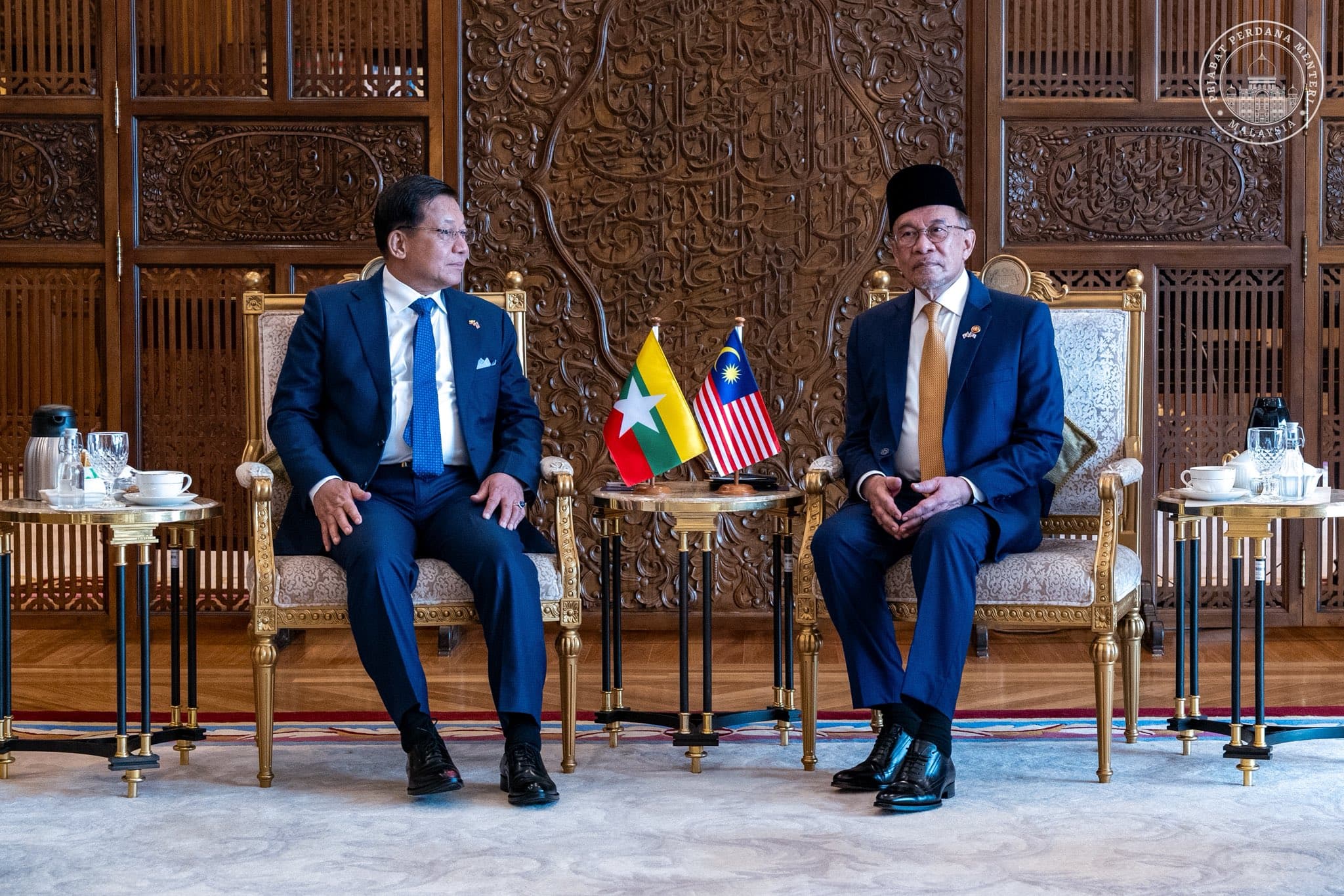
This poses a significant problem for Myanmar’s authoritarian government led by President Min Aung Hlaing, a retired general, as he seeks international legitimacy, starting with his country’s immediate neighbours.
The statement from Myanmar’s military regime, which came to power in a coup in 2021, follows an incident on 29 October in which a Thai civilian was wounded by a projectile during clashes between Myanmar troops and Karen forces near the Thai town of Mae Sot.
Myanmar claims that its troops do not use the weapons used in the incident, adding that it has already provided explanations to Thai military authorities, though it has offered no evidence to back its version of events. Meanwhile, the situation remains unstable further south, in Tak province.
Over the past week, fighting in Myanmar continued to have repercussions for the Thai civilians living along the border.
Also on 29 October, bullets and shrapnel landed in Thai territory; a 55-year-old woman was wounded, and a bullet pierced the roof of a house, landing on the chest of a 14-year-old boy, who, fortunately, did not sustain any injuries.
Last Saturday, two bombs dropped by a Myanmar airforce plane on a KNU position on the opposite bank of the Salween River damaged several buildings in Mae Sam Laep, in Thailand’s Mae Hong Son province.
According to local authorities, the shockwaves and debris from the blasts impacted 17 buildings, including a health centre, a childcare facility, an administrative building, as well as places of worship for Muslim, Buddhist, and Christian communities.
Several families, particularly those with children and seniors, have temporarily left their homes to relocate to areas further inland.
Tensions escalated further following a bombing on Tuesday that struck a girls' dormitory near De Pu No, a village in Myanmar’s Karen State. According to information gathered by Thai authorities, the attack resulted in two deaths and nine injuries.
Two young women in critical condition were taken by boat across the Salween River for medical treatment in Thailand, but one died while awaiting transfer to a hospital.
For its part, Thailand responded on Monday by summoning Myanmar’s military attaché, Win Thu Lin, to urge Myanmar to exercise greater caution during operations conducted near the border.
Thai Prime Minister Anutin Charnvirakul said that Thailand intends to safeguard its sovereignty. On the ground, Thai forces have stepped up patrols along the Salween, while residents have been advised to remain under cover in the event of further attacks.
Additionally, from 30 October to 5 November, the military suspended authorisations for the transport of goods through several informal crossings in the Mae Sot and Phop Phra districts, slowing down trade, an activity often vital to the communities living along the border.
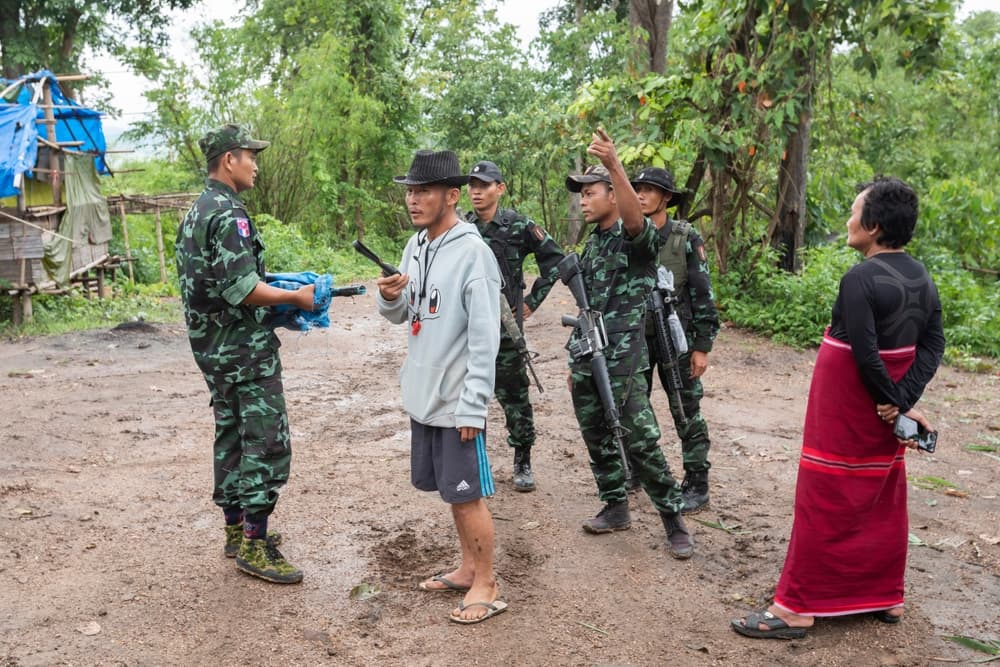
In recent months, the Myanmar military has intensified its attacks on areas controlled by the KNU and the KNLA, two of the main Karen resistance groups, particularly in the Hpapun district. The goal is to reclaim territory, and bolster its legitimacy in the eyes of the international community,
The region is also strategically important due to supply routes linked to Thai markets.
According to the KNU, attacks by government troops in the area since May have resulted in at least seven civilian deaths and 47 wounded, not to mention the displacement of more than 54,000 people from 67 villages.
The group further claimed that the bombing on 31 October of one of its bases on the Salween was intended to disrupt the trade and supply routes used by one of its brigades.
Founded in 1947, the KNU is one of Myanmar’s longest-standing ethnic armed organisations.
Following the 2021 coup, the group intensified its cooperation with other forces opposed to the military regime, providing training to young people who joined the resistance in the ranks of the PDFs, armed groups aligned with the NUG, the civilian government-in-exile.
The KNLA, in particular, controls several rural areas along the border; it is precisely here that Myanmar’s military is conducting ground operations and aerial bombardments.
According to United Nations, the civil war has resulted in about 100,000 deaths and more than 3.5 million people displaced in less than six years.
The crisis along 2,400 kilometres of border also highlights the limitations of Thailand’s strategy of re-engagement with Myanmar’s military regime, which the Thai government has pursued in recent months.
On 6–7 August, Prime Minister Anutin Charnvirakul hosted President Min Aung Hlaing in Bangkok for his first official visit to Thailand since he formally assumed the presidency in April, following fraudulent elections.
The visit, which included a ceremony with full military honours and a bilateral economic forum, marked a significant step in Thailand’s efforts to normalise relations with Myanmar’s military regime.
In a joint statement, Thailand pledged to support Myanmar’s full reintegration into ASEAN mechanisms, and both countries agreed to boost cooperation in security, trade, and energy, with the stated goal of increasing bilateral trade to US$ 12 billion.
Thailand’s approach, described as a “calibrated re-engagement”, is driven by concrete interests: the management of migration flows, the fight against drug trafficking and transnational criminal networks, border security, and energy dependency.
Myanmar supplies Thailand with approximately 15–20 per cent of its natural gas, sourced from the Yadana and Zawtika fields.
Furthermore, according to the International Organisation for Migration, more than 4.1 million Myanmar nationals live in Thailand, roughly 2.3 million as registered workers.
For Thailand, maintaining a direct channel to Myanmar is therefore an economic and security necessity, as well as a diplomatic choice.
However, the political concessions gained thus far appear limited. Min Aung Hlaing’s visit did not lead to any shift in the junta’s stance towards ASEAN.
On the contrary, the regime has continued to offer only marginal concessions to the regional organisation, refusing to release pro-democracy leader Aung San Suu Kyi and obstructing the role of the special envoy tasked with facilitating talks between the two warring sides.
For analyst Thitinan Pongsudhirak, Thailand could have maintained cooperation with Myanmar on trade, energy, and border control without granting Min Aung Hlaing such a clear political rehabilitation.
The risk is that the regime may see these overtures from neighbouring countries as an acknowledgment of its own legitimacy, without feeling any obligation to reduce violence or seek an agreement with the forces that currently control large swaths of the territory.