Yangon (AsiaNews) – Myanmar says no to the special envoy of the Association of Southeast Asian Nations (ASEAN).
A few days before General Min Aung Hlaing's official visit to Thailand, Myanmar announced that the diplomatic mission of the ASEAN envoy, Philippine Foreign Minister Maria Theresa Lazaro, is no longer necessary, since elections (despite being dismissed as undemocratic by much of the international community) have already taken place and brought Min Aung Hlaing to the presidency.
Specifically, the junta has made it clear that it sees no need to maintain diplomatic channels when the ASEAN rotating presidency (a position to which the special envoy is traditionally linked) passes to Singapore next year.
The decision, however, comes just as ASEAN is trying to decide whether and how to reopen dialogue with Myanmar.
On 12 July, ASEAN foreign ministers met informally in Bangkok for the first time since the beginning of the crisis.
Thailand, in particular, has long sought to recalibrate the bilateral relationship with a gradual resumption of formal relations contingent on progress towards peace, a strategy ASEAN is now also seeking to embrace. But Myanmar’s refusal highlights the limits of this approach.
The regional bloc is trying to bring Myanmar back into its diplomatic fold via a peace plan that has never been implemented, while the government led by Min Aung Hlaing appears to seek normalisation of relations without accepting the conditions set by the bloc.
The five-point consensus stalled
After the February 2021 coup and the outbreak of civil war, which has so far resulted in an estimated 100,000 deaths and nearly four million displaced people, ASEAN responded in April of that year by proposing a so-called five-point consensus, which still constitutes the main diplomatic framework to solve Myanmar’s crisis.
The plan calls for an immediate end to the fighting, talks between all parties, the appointment of a special envoy, the opportunity for the envoy to meet with those involved in the war, and access for humanitarian aid.
But these objectives are just wishful thinking more than five years later. In fact, Myanmar’s parliament, passed a motion just last month rejecting the five-point consensus, calling it interference in the country's internal affairs.
Between December and January of last year, the regime held sham elections in the territories under its control, and in April, General Min Aung Hlaing took over as president.
Thailand is now trying to bridge this gap.
Thailand's role
Bangkok has long been the ASEAN member with a more open and direct channel to Myanmar’s military. The reason is primarily geographic.
The two countries share more than 2,000 kilometres of border, and Thailand has to deal daily with the influx of refugees, drug trafficking, and online scam centres that popped up in border areas, plus environmental problems related to the rivers that cross the two countries.
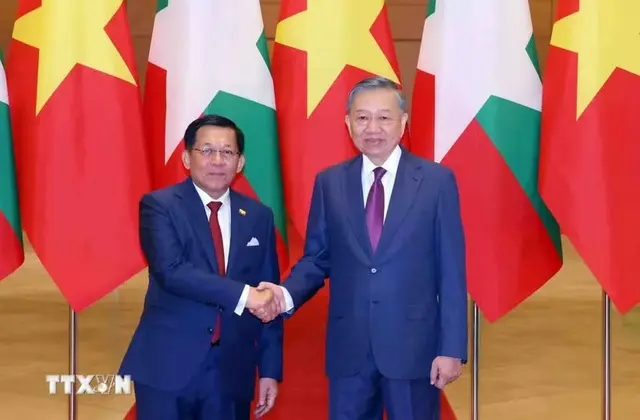
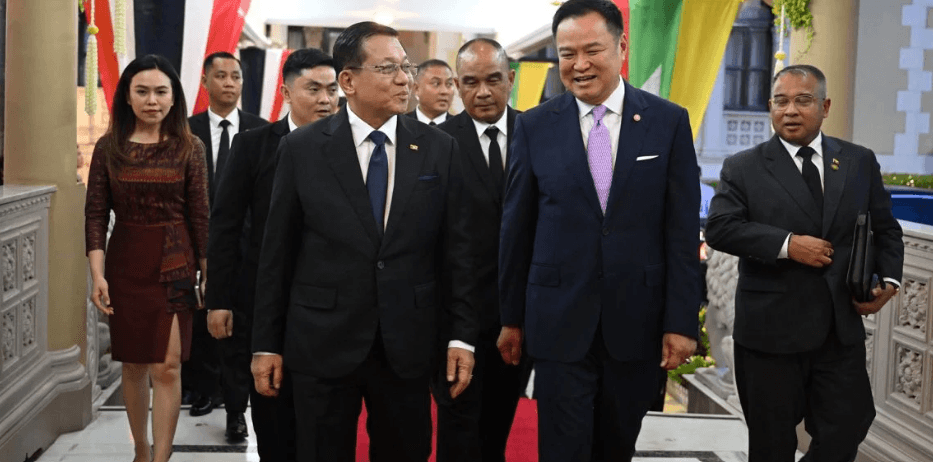
On Thursday, Thai Prime Minister Anutin Charnvirakul welcomed Min Aung Hlaing in Bangkok for his first official visit to Thailand as president.
Human rights groups have emphasised that Thailand’s approach risks legitimising Myanmar’s regime without achieving any concrete results for its people.
Thailand claims instead that it will promote Myanmar's progressive involvement only if a series of peace-building demands are met. Yet, during the meeting, the two sides reached agreements on migrant labour and the management of shared rivers, as well as discussed energy projects.
Gas supplies at the heart of the relationship
Myanmar has been supplying Thailand with natural gas for nearly 40 years, a Thai spokesperson noted.
The Yadana and Zawtika fields, off the southern coast of Myanmar, are operated, in partnership with the Myanmar’s state-owned company, by Thailand's national energy company, PTT Exploration and Production, which acquired Total and Chevron's stakes after the latter’s withdrawal from Myanmar between 2022 and 2024.
These fields are an integral part of Thailand's energy security with about 70 per cent of Yadana's gas production, for example, destined for the Thai market.
Thailand is currently evaluating contract renewals and new exploration activities, such as the development of offshore Block A6, a field in the Andaman Sea, about 80 kilometres off the coast of Pathein, in the Irrawaddy region.
This would be the first ultra-deepwater gas project ever launched in the country, but it is currently suspended following the withdrawal of international partners after the outbreak of the civil war.
With reserves estimated at 2 to 3 trillion cubic feet of gas, the project was originally designed to produce approximately 400 million cubic feet per day, equivalent to over a fifth of Myanmar's current national production.
Then there is Dawei, in southeastern Myanmar, an infrastructure project centred around a deepwater port that is already receiving Russian support.
Min Aung Hlaing tried to revive it during his visit to Bangkok, despite ongoing fighting in the Dawei area where local armed groups have reported that the Myanmar army has set fires, looted, and used civilians as human shields.
ASEAN's difficulties and the Aung San Suu Kyi issue
On 3 August, on the eve of Min Aung Hlaing's visit to Bangkok, Myanmar authorities released pictures of Aung San Suu Kyi meeting with a representative of the International Committee of the Red Cross.
This was the first time that a foreign representative met with the pro-democracy leader since she was detained in 2021.
The images provided Suu Kyi's family and supporters with confirmation that she was alive, as they had long demanded, but not of her release.
The Nobel Peace Prize laureate, now 81, continues to serve a reduced 18-year sentence on a series of trumped-up charges made by the military junta. For ASEAN, however, the issue of Suu Kyi remains central.
Last week, the bloc called for her unconditional release along with that of other political prisoners and reiterated that its special envoy should be able to meet with her.
Myanmar responded that her release can only occur “according to the law”. And now it maintains that the special envoy's presence is no longer necessary.
Even though Thailand maintains that dialogue is the only way to influence Myammar, one wonders how a diplomatic re-engagement (even a "calibrated" one) is possible if the government with which it is resuming dialogue does not accept the peace plan drafted by the organisation that is trying to welcome it back.
With his visit to Thailand, Min Aung Hlaing takes home the image of a head of state receiving the red-carpet treatment, offered the opportunity to speak directly to investors, and given a platform to promote this regime’s economic plans.
Thailand, however, has yet to demonstrate that the general's return to the diplomatic scene will translate into something concrete that might lead to the end of fighting and, above all, help Myanmar’s people.