Yangon (AsiaNews) – The Ta'ang National Liberation Army (TNLA) has become the first ethnic rebel group to join peace talks promoted by Myanmar’s military regime.
After years of fighting, this marks a significant turning point in the civil war in the northern areas of Shan State bordering China, which has been exerting considerable pressure from behind the scenes.
The TNLA delegation, led by Vice President Tar Jote Jar, met with the regime's National Solidarity and Peace Negotiating Committee (NSPNC), chaired by Lieutenant General Yar Pyae, on 19 July at the Shwe San Eain Hotel in Naypyidaw.
According to Myanmar sources, this is the first official meeting between the TNLA and the junta since the 2021 coup.
At the end of the talks, pro-junta media report that the two sides signed an agreement reiterating their commitment to a ceasefire agreed upon in the latest China-brokered talks and to cooperation under a peace plan proposed by Myanmar President General Min Aung Hlaing to end the fighting.
An autonomous Ta'ang state
According to the Democratic Voice of Burma (DVB), an independent Myanmar media organisation, the TNLA has called for recognition of the territories under its control as an autonomous state, while assuring that the entity would remain an integral part of the Union of Myanmar, without secessionist aims.
The group did not disclose the precise geographical boundaries of the proposal, but the regime responded that a Palaung Self-Administered Zone already exists and that only parliament has the power to grant full statehood.
In Myanmar, states represent the largest and most important administrative units, created for large ethnic minorities, while regions correspond to territories with a majority Bamar population, Myanmar’s majority ethnic group.
The 2008 constitution also provides for some self-administered zones, with limited forms of self-government to certain ethnic minorities; however, the latter have been fighting for greater autonomy since Myanmar's independence in 1948.
The Ta'ang (or Palaung) currently have a self-administered zone consisting of two townships in northern Shan State, but they are now demanding the creation of a full-fledged state.
The TNLA's goals
The TNLA was part of the Three Brotherhood Alliance, a group of three armed ethnic groups that launched Operation 1027 in October 2023, conquering scores of towns in northern Shan State and the Mandalay region.
Under pressure from Beijing, the group was subsequently forced to return the cities of Nawnghkio, Kyaukme, Hsipaw, Mogoke, and Mongmit to the military, while a sixth city captured in 2023, Kutkai, returned to the control of the Myanmar National Democratic Alliance Army (MNDAA), a militia composed of mostly Kokang ethnic groups, once an ally but now at loggerheads with the TNLA.
In April, the TNLA was the first member of the Alliance to publicly congratulate Min Aung Hlaing on his appointment as president (which took place after elections deemed largely illegitimate by the international community), a move that sparked criticism even within the Ta'ang community.
According to a political analyst interviewed by BBC Burmese, the TNLA is trying to consolidate its hold on the territories under its control due to the setbacks of the last year. The economic stakes associated with mineral resources may also have contributed to its openness to talks with the central government.
According to an analysis by the Stimson Center, after the loss of Mogoke, a ruby mining hub that the group was forced to hand back to the military in October last year, the TNLA found itself weakened militarily, financially, and politically.
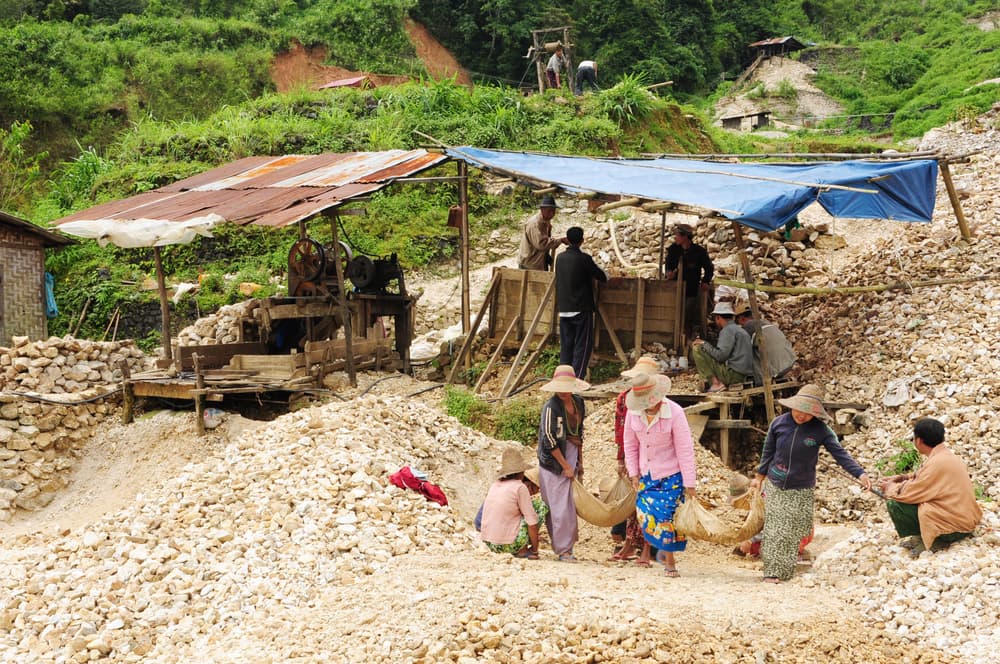
It should therefore not come as a surprise that around the same time, the first infrastructure for the extraction of heavy rare earths appeared in the township of Mantong. Analysts have identified at least 12 new mines, connected to the Chinese border by a series of roads clearly visible in satellite imagery.
The first sites were documented as early as December 2025, although the group has never officially confirmed the presence of mining activity.
In addition to Chinese companies, the MNDAA and the United Wa State Army also appear to be involved in these areas.
The new mines are located within the Palaung Self-Administered Zone, which the military already de facto recognises as TNLA territory. However, the regime – again under pressure from China, according to various reports – has reportedly asked the group to cede all the territories it conquered in and after 2023, with the exception of the two townships that comprise the aforementioned zone.
Thus, the TNLA may have chosen to sit down with the central government to try to negotiate ways to retain the conquered territories (and the resulting economic benefits) in light of the risk ceding them to the military under Beijing's diktat.
Beijing's long arm
The TNLA's move has sparked criticism among allied forces, which, in addition to other ethnic armed groups (such as the MNDAA), also include the People's Defence Forces (PDF), armed groups that emerged after the 2021 coup and (at least initially) loyal to the National Unity Government-in-exile.
A source familiar with the peace process told BBC Burmese that TNLA leader Tar Jote Jar usually resides in Panghsang, which is located in United Wa State Army (UWSA)-held territory bordering China, and that the delegation may have arrived in Naypyidaw directly from there.
This reinforces speculation of a direct Chinese role behind the talks. The UWSA is, in fact, used as Beijing's conduit for armed groups in the border areas.
China has not only pushed both the TNLA and the MNDAA into ceasefire agreements with the military junta, to which it supplies military equipment, but has also forced the UWSA to limit arms sales to resistance groups, resulting in higher prices on the black market.
According to The Irrawaddy, Beijing has also pressured other ethnic armed groups in Shan and Kachin States to participate in the peace initiative proposed by Min Aung Hlaing, which has a deadline of 31 July.
During a meeting in Kunming last month, Chinese officials reportedly urged the Kachin Independence Army (KIA) to engage in direct talks with the military. Similar pressure has reportedly been exerted on the Arakan Army and Shan State Army.
An increasingly fragmented resistance
The meeting between the TNLA and the NSPNC is part of a broader trend, towards surrender based on separate agreements tailored to each armed group, rather than a national political process.
The junta has always used ceasefires as a tool to manage clashes, limiting the number of open fronts, rather than resolve the conflict.
But while in the past, in the 1980s and 1990s, these deals guaranteed autonomy and economic concessions to armed groups while maintaining firm military control over the central areas of the country, today the scenario is reversed: the army is weaker, reducing the scope for mutually beneficial agreements.
Each agreement reflects the specific context in which it is signed, and so remains unstable, tactical in nature, and does not represent the basis for a lasting political solution.
The junta has thus far adopted different approaches depending on its interlocutor: informal contacts with the Arakan Army (the third group that was part of the Three Brotherhood Alliance) regarding a possible ceasefire in Rakhine State; a more cautious stance towards Kachin organisations, who control areas rich in rare earths, also important for Chinese industry; attempts at informal agreements with individual brigades of the Karen National Union, but not with the organisation as a whole; and a growing military crackdown on ethnic Karenni forces.
Overall, Myanmar appears increasingly fragmented into de facto enclaves administered by different actors (the military regime, ethnic armed groups, and the PDF who continue to fight) rather than moving towards a shared political solution.
Few major armed groups, like the TNLA, and perhaps soon the MNDAA, are part of a formal peace process.
The political concessions that once underpinned conflict resolution initiatives, greater autonomy and rights for ethnic minorities, are no longer part of the negotiations. In their place, the focus is on control of mineral resources, primarily destined for the Chinese market.