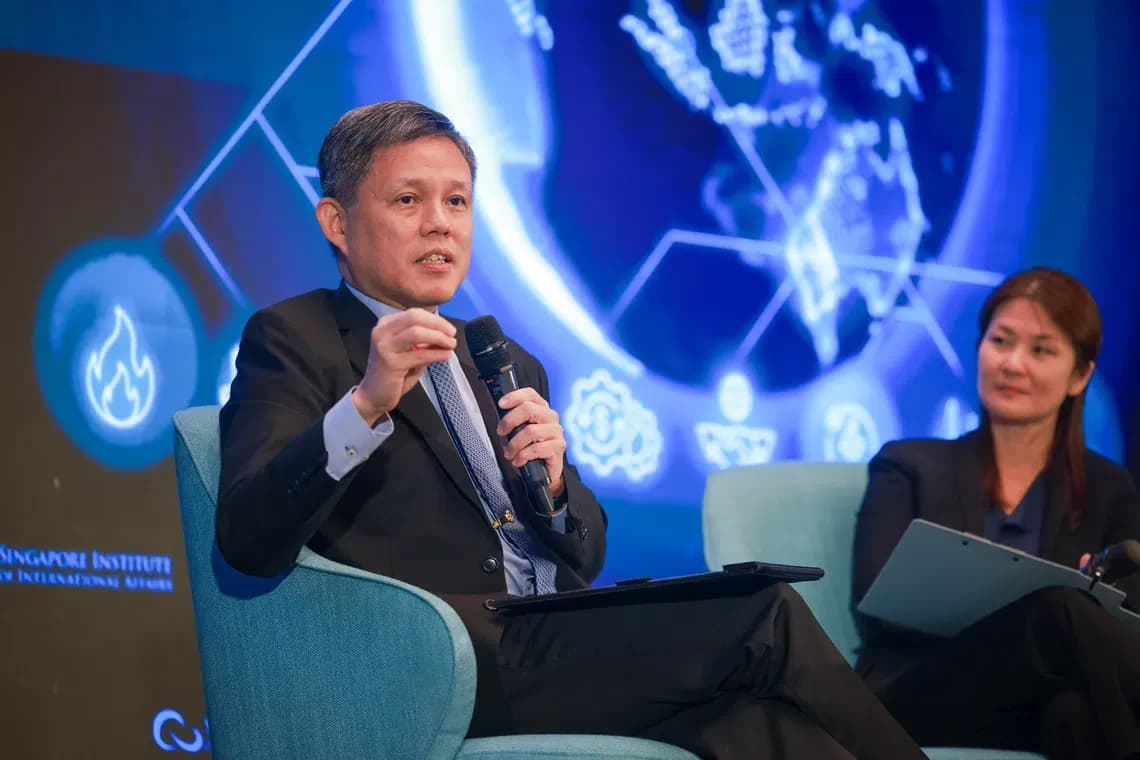
Singapore (AsiaNews) — ASEAN must overcome national barriers to data sharing and deepen cooperation in energy and finance if the 10-member bloc is to unlock its full economic potential, Singapore Defence Minister Chan Chun Sing said.
Speaking at the Singapore Institute of International Affairs’ 18th ASEAN and Asia Forum on Monday, Chan described data as “the new lubricant for the future economy”, arguing that its value increases when it can move seamlessly across borders.
“Every sector that we are interested in, that has tremendous potential for growth, will rely on the seamless flow of data,” he said during a dialogue titled, “Power and Agency Amidst Turmoil”.
Chan said data differed fundamentally from finite commodities such as oil because it could be shared without diminishing the resource available to others.
“The increase in the sharing of data between countries can result in more insights, products and services being generated,” he said.
ASEAN, he added, possesses an especially rich pool of data because of the diversity of its populations and economies. The challenge is whether member states can resist the temptation to protect data within national borders.
The bloc must “overcome the tendency or the temptation [for] data protectionism” if it wants to generate new insights and business opportunities, Chan said.
The remarks come as ASEAN seeks to deepen economic integration while its member states retain significant differences in political systems, economic development and regulatory frameworks.
Chan said regional coherence could not be achieved without first establishing stability and continuity within individual member states.
“Each of them has to work on it themselves, before trying to support each other by having a bigger goal,” he said.
He pointed to the frequently cited projection that ASEAN could become the world's fourth-largest economic entity by 2030, saying the bloc had an opportunity to achieve something “more than the sum of our individual parts”.
Energy as regional infrastructure
Energy cooperation, Chan said, was another area where deeper integration could deliver benefits across ASEAN.
Several member states have significant renewable energy potential, including solar, wind and geothermal resources. Yet national energy systems remain largely separate.
ASEAN is targeting a fully integrated regional electricity grid by 2045. Chan said greater interconnection could put “money on the table” while potentially reducing energy costs for consumers and businesses.
The challenge, however, was not primarily technical.
“Then the question is – will we be able to overcome some of the domestic political challenges for this vision of the more integrated ASEAN grid to come about?” he asked.
Some elements of regional integration are already operating, he noted, citing the Lao PDR-Thailand-Malaysia-Singapore Power Integration Project as an example.
Greater interconnection could allow electricity generated from renewable resources in one part of the region to reach areas with greater demand, potentially improving the efficiency and resilience of ASEAN's energy system.
Moving capital with fewer barriers
Chan also called for deeper financial integration, arguing that businesses should be able to move capital across ASEAN with fewer technical barriers and lower transaction costs.
A common currency was not necessary, he said. Instead, ASEAN could work towards more compatible financial systems that allow capital to move more efficiently between economies.
Singapore already has arrangements with Australia and New Zealand that demonstrate what greater financial integration could look like, he said.
“There’s very little technical reason why we cannot achieve this within ASEAN, where we can help businesses to mobilise capital, grow capital [in] a more integrated financial system.”
The broader objective, Chan said, was to make ASEAN's combined market sufficiently large and connected to compete with other major regions of the world.
Building a connected ASEAN
Transport cooperation is expected to be another priority when Singapore assumes the ASEAN chairmanship in 2027.
At an earlier session of the forum, Singapore Transport Minister Jeffrey Siow said Singapore hoped to advance initiatives to liberalise air services across the region and strengthen cooperation between ports.
“The objective is always to drive more integration, emphasise the size of the market, build connections, so that we can then put ourselves out in the world and provide a value proposition that is competitive with other regions in the world,” Siow said.
Taken together, the proposals point towards an ASEAN that is increasingly integrated not only through trade agreements but through the infrastructure that underpins modern economies — data networks, electricity grids, financial systems, ports and air links.
For Chan, the question is whether member states can look beyond national boundaries without sacrificing legitimate national interests.
The answer, he suggested, lies not in erasing national differences but in building systems that allow the countries of Southeast Asia to benefit from one another's strengths.
For a region whose economic future is increasingly shaped by digitalisation, renewable energy and cross-border investment, the ability to share rather than protect resources may determine whether ASEAN becomes merely a collection of growing economies or a genuinely integrated economic community.