Baku (AsiaNews) – In Azerbaijan, the Middle Corridor is regarded as more than just a transport route between Asia and Europe; Baku hopes that a broader economic system will gradually develop around it, integrating transport, energy, digital infrastructure, investment and human capital. This model was outlined by Azerbaijan’s Minister for the Economy, Mikhail Džabbarov, at the 2nd Azerbaijan International Investment Forum, where he stated that modern economic corridors should integrate five flows: goods and services, energy, data, capital and people.
Azerbaijan intends to develop the domestic processing of raw materials, including by harnessing the potential of the Alat Special Economic Zone and industrial parks, before supplying the markets of Turkey and Europe.
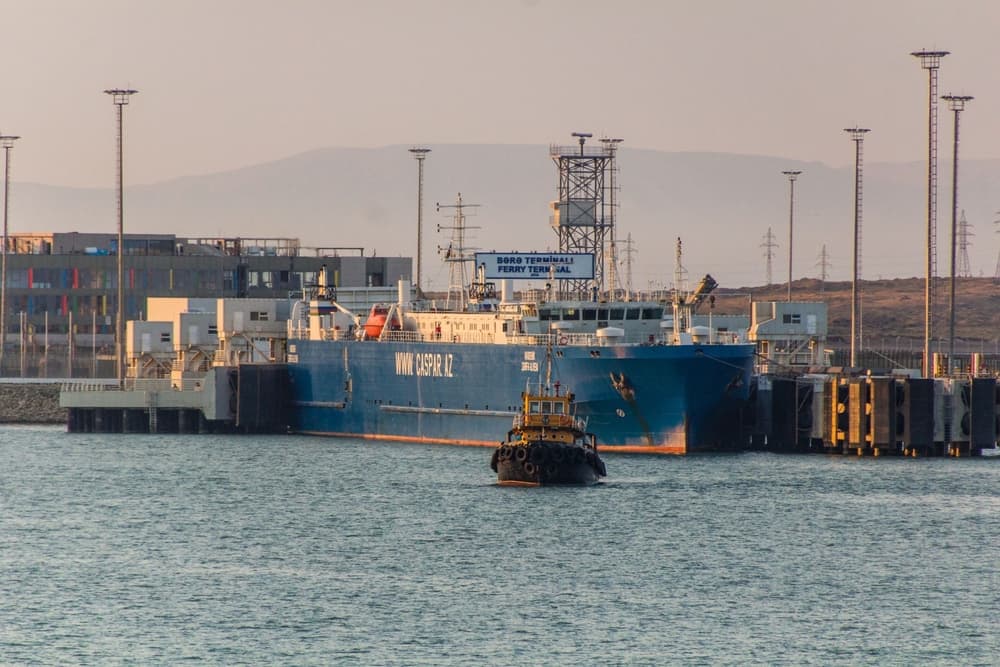
The Middle Corridor, which links China and Europe via Central Asia and the South Caucasus, remains the cornerstone of this model. Freight traffic on the Azerbaijani section continues to grow: according to Azcon, in the first half of 2026 the volume of transit freight carried by Azerbaijan’s railways along the East–West route – which the company classifies as the Central Corridor – reached 1.958 million tonnes, a 12 per cent increase compared with the same period the previous year.
The capacity of key transport infrastructure is also expanding: following the completion of the modernisation of the Georgian section of the Baku–Tbilisi–Kars railway, its annual handling capacity will increase from 1 million to 5 million tonnes.
Further growth is no longer linked exclusively to the expansion of physical infrastructure. The digitalisation of transport management and customs procedures – which is expected to reduce journey times and enhance competitiveness – is taking on particular importance, and the focus is gradually shifting from the creation of transport infrastructure itself to the efficiency of its use, and to the additional economic processes that may develop around it.
Another area of development for the economic corridor is the energy sector: Azerbaijan, Kazakhstan and Uzbekistan are working on the creation of a green energy corridor across the Caspian Sea.
The project is seen as an opportunity to link the energy systems of Central Asia with Azerbaijan and, potentially, to transport renewable energy to European markets. Currently, the Central Asian part of this system is undergoing a feasibility study. The first phase of the study began in the spring of 2026, and the feasibility study is due to be completed in May 2027.
Another sector in which significant progress has been made is data transmission: on 6 August, the installation of a submarine fibre-optic cable between Sumgait and Aktau, on the seabed of the Caspian Sea, was completed.
The cable is 380 km long and has a stated transmission capacity exceeding 400 Tbit/s; this project was carried out by AzerTelekom and Kazakhtelekom as part of the Digital Silk Road. Work is currently underway to integrate the cable with the coastal infrastructure and to construct the necessary onshore infrastructure.
The fifth element of the model concerns human capital: one of the tools available is the state programme for study abroad. In the 2026/2027 academic year, 500 people were selected under this programme: 125 undergraduates, 353 master’s students and 22 PhD students. Of these, 155 will study at universities ranked amongst the top ten in the world.
The various elements are, however, at different stages of implementation: the transport component is already operational and expanding, the digital component is nearing launch, whilst the most significant energy projects will require several phases of preparation and investment.
The transformation of the Middle Corridor into a broader economic system remains a long-term process, but the direction has already been set: Azerbaijan hopes to capitalise on its position between Central Asia and Europe not only for freight transport, but also for the development of energy, digital infrastructure, investment, manufacturing and human capital linked to the corridor.