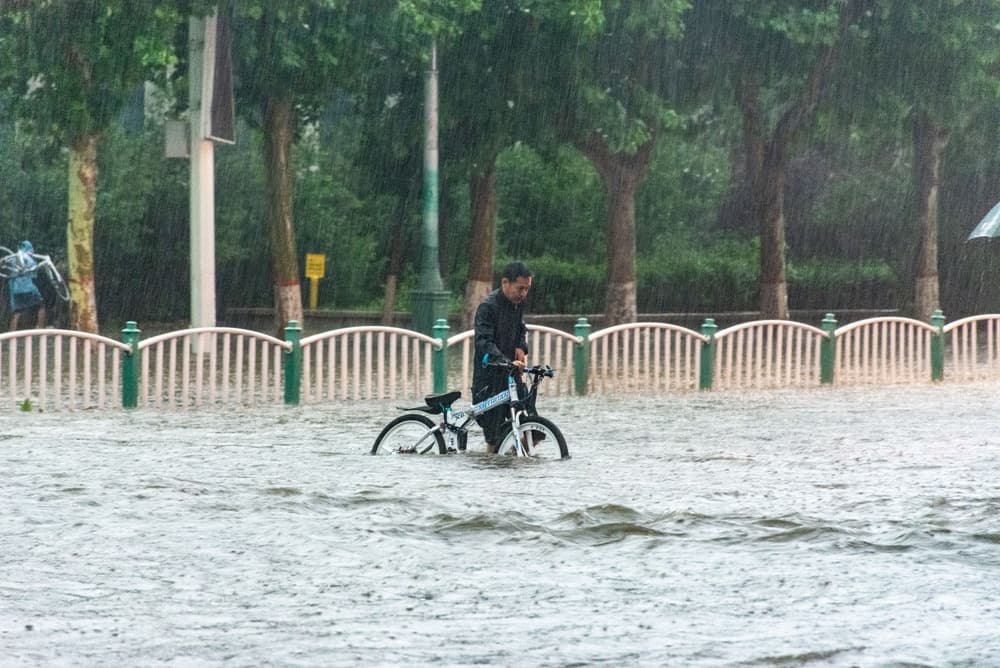
Beijing (AsiaNews) – The 2026 summer flood season is only halfway through, yet the Asian continent has already been hit several times by torrential rains, floods, debris flows, and mountain flooding in many places.
In China, the Liulan Reservoir in Guangxi and numerous small and medium-sized reservoirs collapsed on 6 July; three weeks later, on 28 July, the town of Chunyang and surrounding areas in Jilin Province saw local rivers and reservoirs overflow with unknown casualties.
In June, flooding was reported in the Taklamakan Desert; in July, more than 10 people died in a mountain flood in Shuangshimengou, Gansu; in May, nearly 20 people died in Yongchuan, Chongqing, due to exceptionally heavy downpours; in July, more than 60 people died in Pengshui, Chongqing, due to a landslide; on 14 July, Shenyang suffered flooding that beat historical records, subsiding only after 48 hours, with serious damage to villages and farmland in Liaoning and Jilin; on 19 July, flooding did not spare many areas of Yangpu, central Shanghai.
Looking back over the past few years, other equally shocking extreme floods come to mind: on 20 July 2021, heavy rainfall created a dangerous situation in the reservoir in Zhengzhou, Henan, with the discharge triggering severe flooding in Zhengzhou (which styles itself as a sponge city), killing 380 people.
In late July 2023, extreme rainfall from Typhoon Doksuri turned the Jing-Jin-Ji area in Zhuozhou into an ocean. On 1 August 2024, Typhoon Gaemi hit Zixing, Hunan, with record rainfall, causing small mountain reservoirs to overflow and the collapse of small mountain lakes.
For Chinese authorities, these disasters are simply “once-in-a-hundred-year” extreme weather phenomena; yet, they have become routine, recurring year after year, going beyond simple. Despite being extensive and systemic, the crisis is far from being taken seriously.
On the one hand, humans have altered some natural floodplains and ecosystems over the years; for example, around Baiyangdian, which historically served as an important flood discharge and storage area for rivers like the Yongding, the Xiong'an New Area has now emerged from nowhere, directly changing the local hydrological storage and discharge system, leading the Jing-Jin-Ji area to experience almost annual floods.
On the other hand, rapid urbanisation has resulted in large-scale surface construction, lagging behind, however, in sewer system and water main network, with cities' flood prevention and drainage capacity repeatedly failing when hit by torrential rains.
What is even more worrisome is that, in the name of the "great infrastructure country”, some regions are still driving GDP growth with the construction of similar projects.
Even more fatal and threatening is the blockage of active water discharge caused by humans and the collapse of flood prevention systems.
According to data from the Chinese water census and related disaster statistics, of the approximately 98,000 existing reservoirs and dams in China, 91.8 per cent are made of earth and rock, with 3,558 reservoir and dam failures occurring in recent history.
Overall, 42,000 reservoirs nationwide have been in operation for over 50 years, 21,000 for over 60 years, and more than 80 per cent were built during the so-called Great Leap Forward in the 1950s and 1960s, and afterwards.
These old, damaged and dangerous structures have been intensively overused for decades. Their sheer number and the hidden danger hanging over the heads of hundreds of millions of people have already reached a frightening level.
What is especially painful is that, at a time when natural and man-made disasters are converging, public opinion and official bureaucratic propaganda are silently undergoing a cold transformation.
In the past, whenever a major disaster struck, be it floods, heavy rain, snow, or the like, it often became an official platform for showing off the officials' ability to mobilise and their love for the people, with the military and the people cast as one.
All this is a thing of the past. Whether it was Jiang Zemin personally going to the Jiujiang embankment to give orders during the great flood in 1998, or Wen Jiabao repeatedly rushing to the front lines, or Li Keqiang inspecting muddy villages in disaster zones, today it is all a faded memory in people's minds.
The scenes of high-ranking officials rushing to the scene immediately after the outbreak of a serious crisis like a flood or epidemic are no longer for public consumption; the symbolic deed and the charade have gradually disappeared from public view.
What is more, the initial truth about a disaster can only be gleaned via short self-produced media recordings and videos shared on social media.
The civil defence agency is not allowed to enter a disaster zone without official permission; the original intent was to coordinate resources and prevent individual actions, but this indirectly also affects the enthusiasm of the forces on duty.
All this is happening while most people remain blinded by the enthusiastic narrative of "believing in the country, believing in the Party" and "turning a funeral into a joyous event."
For many Chinese, the truth about the tragic deaths of 240,000 people in the collapse of the Banqiao Reservoir Dam in Henan 50 years ago, a tragedy once listed as the top ten man-made disasters in the modern world, became public gradually only this century with the rise of the Internet. Few expected that, in just ten years, things in some respects would revert to 50 years ago.
Torrential rains and the discharge of water from reservoirs and dams often become a choice to "protect big cities at the expense of small and medium-sized towns"; behind rapid urbanisation, there is rarely a careful design for urban flood prevention and drainage system that can stand the test of time.
Water and fire are merciless, and the lives of the people are fraught with hardships, while government indifference and hidden dangers, left to decay for years, mean that the suffering endured by the population is inwardly profound.