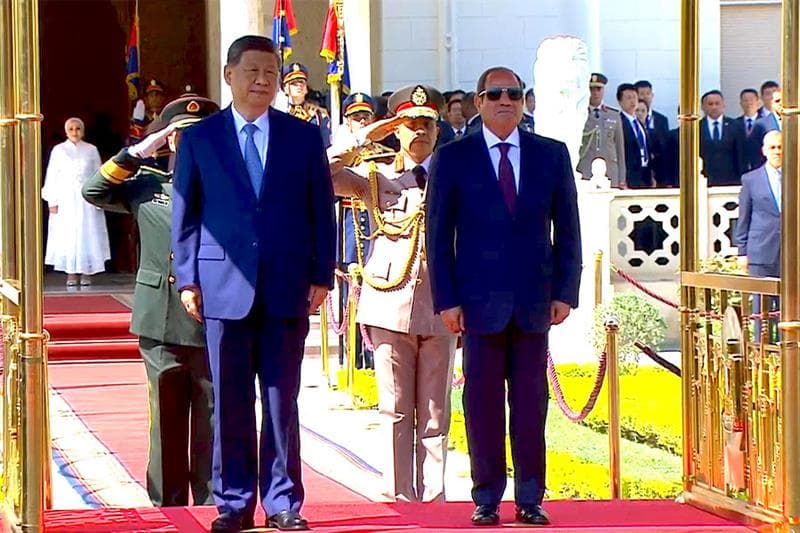
Cairo (AsiaNews) – Chinese President Xi Jinping arrived in Egypt yesterday on a three-day visit. Today, he held a bilateral meeting with his counterpart and host Abdel Fatah al-Sisi.
The visit’s undeclared goals are boosting the partnership between Beijing and Cairo, revitalise China's presence in the Middle East by building bridges with the region's countries, at a time of the progressive US disengagement, and above all, strengthening the Suez Canal as a "vital alternative" to the Strait of Hormuz.
Analysts note the two-pronged nature of the visit. Officially, it represents an opportunity to strengthen economic and diplomatic ties, but the deeper purpose is to undermine US leadership, and expand China’s influence in a rapidly evolving region.
Xi wants to present China as a factor of regional stability, unlike the United States, which has been militarily involved in the area for decades, with the ongoing war against Iran only the latest in a long series of conflicts.
After a meeting between the two presidents today, the Chinese leader was scheduled to visit the Grand Egyptian Museum, near the pyramids of Giza.
Xi’s visit – the first in Egypt in a decade and the first to the region since 2022 in Saudi Arabia – is centred on a number of issues, including developing closer ties with al-Sisi, who has visited China several times in recent years.
Yesterday, the two leaders celebrated 70 years of diplomatic relations between the two countries by publishing articles in Egypt's main state-run newspapers.
This was an opportunity to relaunch and "expand the scope of pragmatic cooperation" and highlight Chinese investments in Egypt, as well as reaffirm Egypt’s support for China’s claim that the “rebel” island of Taiwan was an integral part of China.
In 2023, China invited Egypt to join BRICS, a grouping of major emerging economies that includes Brazil, Russia, India, China, and South Africa, viewed as a counterweight to Western-led institutions, like the G7.
A year later, Cairo signed agreements with Beijing to work on its Belt and Road Initiative, Xi's flagship policy aimed at building energy and transportation infrastructure worldwide.
In Egypt China has invested more than US$ 10 billion, building a business hub east of the capital and an electric railway for industry in the Nile Delta.
According to government data, annual trade between the two countries is estimated at US$ 20 billion, a huge level considering that US-Egypt trade stood at “only” US$ 15.7 billion in 2025.
Finally, with the transit of oil and goods through the Strait of Hormuz in the Persian Gulf severely compromised by the war launched by the United States and Israel against Iran, the Egyptian-controlled Suez Canal is increasingly seen as a vital alternative.
“China has good reason to strengthen ties with the country that controls the route still open,” said Muhammad Zulfikar Rakhmat, a Middle East expert with Jakarta’s Center of Economic and Law Studies. Xi views Egypt “as a base to reach the wider Arab and African world, at a time when the U.S. has less attention to spare there,” said Rakhmat.
With this in mind, in August, China and Egypt conducted a multiday air exercise at various bases across the country, the first of which included combat assets such as Chinese J-16 fighter jets and Egypt’s French-built Rafale fighter jets.
In his address, which was reported by Egyptian media, Xi Jinping said that Beijing is ready to deepen its comprehensive strategic partnership with Egypt.
“The two sides,” the president emphasised, “should forge greater synergy in development strategies, engage in high-quality Belt and Road cooperation, proactively tap the potential and expand the scope of pragmatic collaboration in a bid to provide sustained impetus to the mutually beneficial cooperation.”
“China and Egypt,” Xi added, “should vigorously uphold world peace and stability, and international fairness and justice by practicing true multilateralism, enhancing multilateral coordination, and working together to deliver on the four global initiatives on development, security, civilization and governance.”
The two countries should “join hands to lead the way in China-Arab and China-Africa cooperation,” Xi noted, expressing his government’s readiness “to work with the Egyptian side to enhance the demonstration effect of our well-established cooperation”.
“As a major country in both the Arab world and Africa, Egypt plays an important role in promoting the collective cooperation between China and Arab states, and between China and African countries.”
In addition, China wants “to leverage Egypt's unique location in linking the Arab world and reaching across the African continent,” and “further implement the proposal on building ‘five cooperation frameworks’ between China and Arab states”, as well as Africa. “This will ensure that China-Arab and China-Africa cooperation keeps pace with the times, makes steady progress and goes a long way.”